
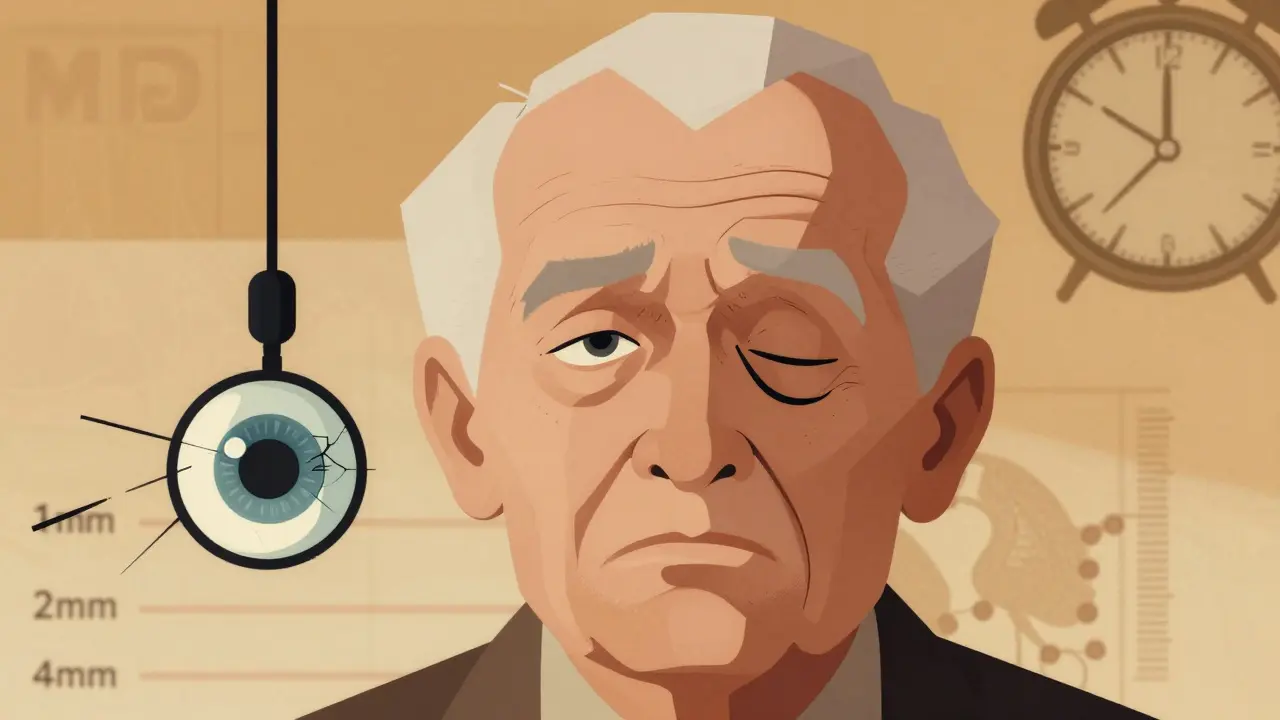
Think about the last time you blinked. Did your eyelid close smoothly? Or did it feel heavy, like someone was tugging it down? Or maybe you kept feeling like something was scratching your eye - even when there was nothing there? These aren’t just minor annoyances. They could be signs of real eye problems: ptosis or entropion. Both are common, especially as we age, and both can mess with your vision - and even threaten your sight if left untreated.
What Is Ptosis? When Your Eyelid Just Won’t Stay Up
The most common cause? Aging. Over time, the muscle that lifts your eyelid - the levator - stretches and weakens. It’s like a rubber band that’s been pulled too many times. About 5% of adults over 70 deal with this. But it’s not just age. Some people are born with it. Others develop it after eye surgery, trauma, or nerve damage. Even long-term contact lens wear can contribute - studies show it increases risk by around 30%.
Doctors measure ptosis using something called the margin reflex distance (MRD). Normal is 4 to 5 millimeters. If it drops below 2 mm, it’s considered moderate. Below 1 mm? That’s severe. You might not notice it at first, but you’ll start feeling it: eye strain, headaches from constantly lifting your brows, or even neck pain from tilting your head back to see better.
What Is Entropion? When Your Eyelid Turns Inward
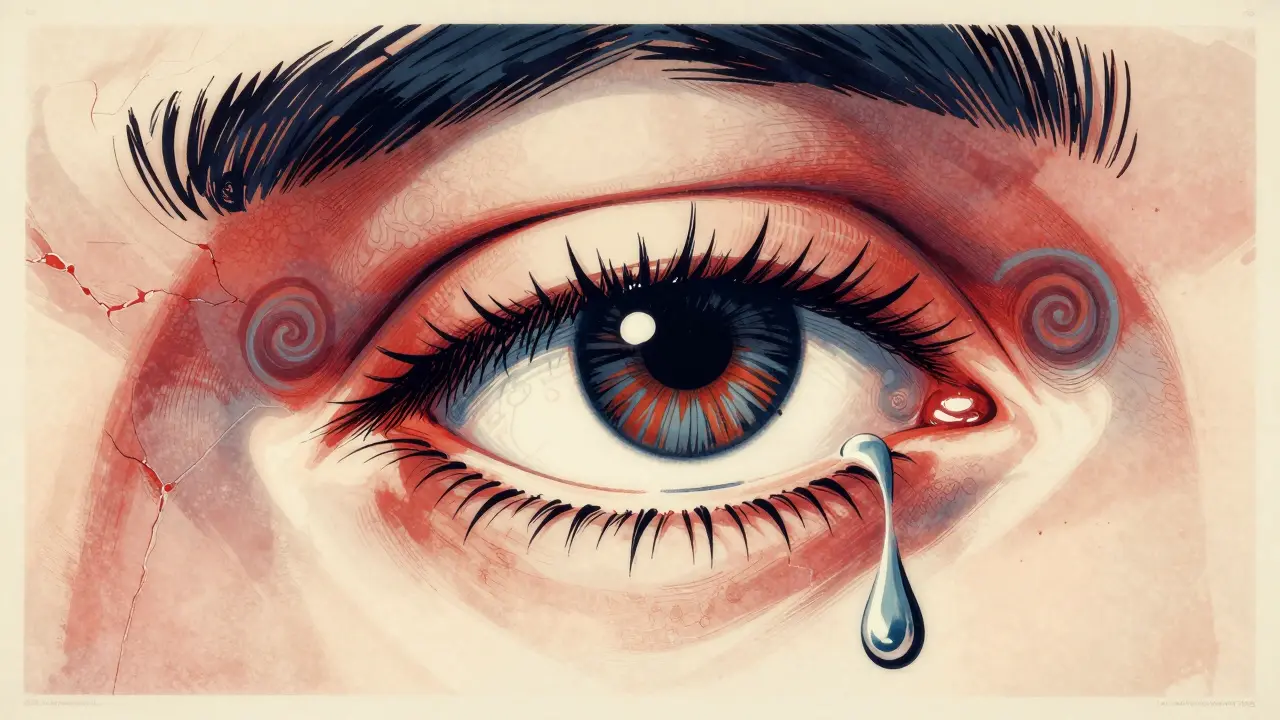
Entropion is the opposite problem - the eyelid rolls inward. It mostly happens in the lower lid, and in about 97% of cases, that’s where you’ll find it. When this happens, your eyelashes start rubbing against your eyeball. Imagine sandpaper gently scraping your cornea every time you blink. That’s what it feels like.
The result? Constant irritation, redness, watery eyes, mucus buildup, and a gritty feeling like you’ve got dirt in your eye. Left unchecked, this can lead to corneal scratches, ulcers, and even permanent vision loss. It’s not just uncomfortable - it’s dangerous.
The biggest cause? Aging. Around 80% of entropion cases in Western countries are involutional - meaning they come from the natural loosening of eyelid tissues over time. Other types include cicatricial (caused by scarring from burns, surgery, or infections like trachoma), spastic (temporary, from eye inflammation), and congenital (rare, present at birth).
Trichiasis is a related issue. It’s when eyelashes grow inward because the follicles are damaged - often from long-term blepharitis. It’s not full entropion, but it causes the same problem: lashes scratching your eye. Treatment? Epilation, electrolysis, or laser removal.
What’s the Connection to Blepharitis?
You can’t talk about eyelid disorders without mentioning blepharitis. It’s one of the most common eyelid problems out there - and it often shows up alongside ptosis and entropion. Blepharitis is inflammation of the eyelid margins. There are two types: anterior (crusty buildup at the base of lashes) and posterior (clogged oil glands - called meibomianitis).
When those glands get blocked, they don’t release the oily layer your tears need to stay stable. That leads to dry eyes, which makes irritation worse. And if you’re rubbing your eyes to feel better? That can actually make entropion or ptosis worse over time.
It’s chronic. That means no quick fix. You need daily hygiene: warm compresses, gentle lid scrubs with baby shampoo, and sometimes antibiotic ointments. Skip this, and you’re just feeding the cycle.
Surgical Repair: How Doctors Fix These Problems
Eye drops and ointments can help with symptoms, but they don’t fix the underlying problem. If your eyelid is drooping or rolling inward, surgery is usually the only real solution.
For ptosis, the approach depends on how strong your eyelid muscle still is:
- Levator resection: Used when the muscle still has decent strength (more than 4mm of movement). The surgeon shortens the muscle to lift the lid. Success rate? 85-95%.
- Frontalis sling: For severe cases where the muscle is too weak. The eyelid is connected to the forehead muscle (frontalis) using a synthetic or harvested tissue sling. It’s effective but can look a little unnatural.
- Müller’s muscle-conjunctival resection: Best for mild ptosis, especially if your eyelid lifts well after a phenylephrine eye drop test. Less invasive, faster recovery.
Since 2018, many surgeons have started using adjustable sutures. After surgery, you’re awake for a few minutes while the doctor fine-tunes the lid height. This cuts down on the need for revision surgery by about 25%.
For entropion, the surgery depends on the type:
- Tarsal fracture procedure: The gold standard for involutional entropion. The surgeon tightens the eyelid by repositioning the tarsal plate. Success rate? 90-95%.
- Tarsal wedge resection: Used for cicatricial entropion caused by scarring. A small wedge of tissue is removed to pull the lid back into place.
- Quickert sutures: A temporary fix. Thin sutures are placed to flip the lid outward. Works for 60-70% of cases - but often doesn’t last.
Newer techniques use absorbable sutures and minimally invasive tools. Recovery used to take 4-6 weeks. Now, many people are back to normal in just 1-2 weeks.
What About Ectropion? The Other Side of the Coin
While not the focus here, ectropion - when the eyelid turns outward - often shows up in the same patients. It’s the opposite of entropion. The lid pulls away from the eye, leaving it dry and exposed. It can be caused by aging, facial paralysis, or scarring from skin cancer or lymphoma.
Doctors sometimes treat it first with lubricating drops and steroid ointments. But if it’s severe - especially if it’s cicatricial - surgery is almost always needed. The same techniques used for entropion can be adapted, but the approach is reversed.
When to See a Doctor
Not every droopy eyelid needs surgery. But some signs mean you shouldn’t wait:
- Your eyelid suddenly droops - especially if it happened fast
- You can’t see clearly without lifting your brow
- Your eye feels scratched, painful, or unusually red
- You have constant tearing or thick mucus
- Your vision is blocked by skin or lashes
If you’re over 60 and notice changes - don’t brush it off as just aging. Early intervention stops complications. A simple eye exam can confirm whether it’s ptosis, entropion, or something else.
Who’s at Risk?
Age is the biggest factor. But other things raise your chances:
- History of eyelid surgery (increases risk by 40-60%)
- Chronic dry eye or blepharitis
- Previous eye trauma or burns
- Long-term contact lens wear
- Family history of eyelid problems
And yes - trachoma, a bacterial infection from poor sanitation, is still a leading cause of entropion in parts of Africa, Asia, and the Middle East. It’s rare in Australia, but global travel means it’s something doctors keep on their radar.
What to Expect After Surgery
Surgery is usually done as a day procedure under local anesthesia. You’ll go home the same day. Swelling and bruising are normal - they peak around day 2 and fade in 1-2 weeks. You’ll need to avoid heavy lifting, bending, and rubbing your eyes for at least a week.
Complications aren’t common, but they happen:
- Overcorrection (lid too high) - 5-10% of ptosis cases
- Undercorrection (lid still drooping) - 3-8%
- Lid asymmetry - 5-15%
- Dry eye - 10-20%
- Recurrence of entropion - 5-15%
- Infection or scarring - 1-5%
Most people report major improvements in vision and comfort. Many say they feel less tired, sleep better, and even look more alert.
The Bigger Picture
The global market for eyelid surgery is growing fast - up from $1.8 billion in 2022 to an expected $2.7 billion by 2028. Why? Because people are living longer. More of us are reaching ages where eyelid tissues weaken. And we’re more aware now - thanks to better information and less stigma around cosmetic eye procedures.
What’s next? Researchers are looking into genetic markers that might predict who’s likely to develop these conditions. Imagine a simple test at age 50 that tells you your risk. That could lead to earlier, simpler interventions - maybe even non-surgical options down the line.
For now, though, the best advice is simple: pay attention to your eyelids. If something feels off - don’t ignore it. See an eye specialist. It’s not just about looking better. It’s about protecting your sight.
Can ptosis or entropion go away on their own?
No. These are structural problems caused by stretched, weakened, or scarred tissues. Eye drops or ointments can relieve symptoms like dryness or irritation, but they won’t fix the position of the eyelid. Without treatment, entropion can lead to corneal damage, and ptosis can cause vision loss or chronic strain. Surgery is the only reliable fix.
Is eyelid surgery risky?
Eyelid surgery is one of the safest procedures in ophthalmology, especially when done by an experienced oculoplastic surgeon. The main risks are minor: temporary swelling, bruising, dry eyes, or slight asymmetry. Serious complications like vision loss are extremely rare. Most patients have excellent outcomes, with success rates above 90% for standard procedures like tarsal fracture or levator resection.
Does insurance cover eyelid surgery?
Yes - if it’s medically necessary. If your drooping eyelid blocks your vision or your inward-turning lashes are damaging your cornea, insurance will usually cover the cost. You’ll need a visual field test or photos to prove the problem. Cosmetic procedures - like lifting eyelids just to look younger - are typically not covered.
Can blepharitis cause ptosis or entropion?
Blepharitis doesn’t directly cause ptosis or entropion, but it can make them worse. Chronic inflammation leads to scarring, thickening of the eyelid, and misdirected eyelashes (trichiasis). Over time, this can contribute to the structural changes that lead to malpositions. Managing blepharitis daily with warm compresses and lid hygiene is key to preventing progression.
How long does recovery take after eyelid surgery?
Most people return to normal activities within 1-2 weeks. Swelling and bruising fade in that time. Full healing takes 4-6 weeks. Newer techniques with absorbable sutures have cut recovery time by half compared to older methods. Avoid heavy lifting, swimming, and rubbing your eyes for at least 10 days. Follow-up visits are usually scheduled at 1 week and 6 weeks post-op.
Sharon Lammas
March 1, 2026 AT 06:13It’s funny how we ignore our eyelids until they stop working right. We blink without thinking, like it’s just background noise in the life of our senses. But when that mechanism fails, it’s not just vision that’s affected-it’s dignity, comfort, even the quiet way we interact with the world. I’ve seen older relatives lift their brows like they’re trying to catch a falling curtain. No one talks about how exhausting that is. It’s not vanity. It’s survival.
And yet, we treat it like a cosmetic issue. Insurance won’t cover it unless you’re practically blind. Meanwhile, people are rubbing their eyes raw, afraid to see a doctor because they think it’s just ‘getting old.’ But aging isn’t an excuse-it’s a signal.
I wish more people knew how simple the fix can be. Not always surgery, but sometimes just a structured routine: warm compresses, clean lids, avoiding rubbing. Small things. Quiet things. Things we could teach in high school health class.
It’s not just about seeing clearly. It’s about not having to fight your own body to do it.
marjorie arsenault
March 1, 2026 AT 22:35My mom had ptosis after cataract surgery. She didn’t say anything for months. Just kept tilting her head back, saying she was ‘just tired.’ When I finally pushed her to see a specialist, they found her MRD was at 0.8 mm. She cried when she realized she hadn’t seen the top of her own kitchen cabinets in over a year.
They did a Müller’s resection. Two weeks later, she was cooking again-no more squinting, no more headaches. She says it felt like someone turned the lights up in her world.
If you’re over 60 and your eyelids feel heavy-don’t wait. Talk to your eye doctor. It’s not ‘just aging.’ It’s treatable.
You deserve to see your grandkids’ faces clearly.
Deborah Dennis
March 3, 2026 AT 08:49Shivam Pawa
March 4, 2026 AT 11:41From India-where trachoma still causes entropion in rural areas-I’ve seen this firsthand. No access to surgeons. People use neem leaf compresses. Some heal. Others lose vision. The real tragedy isn’t the condition-it’s the gap between knowledge and care.
Surgeons in the West talk about adjustable sutures like it’s magic. But in my village, we don’t even have a single oculoplastic specialist. I’m glad this info exists. But let’s not pretend this is just a ‘lifestyle issue’ for aging Westerners.
Global health isn’t a footnote. It’s the whole picture.
Diane Croft
March 4, 2026 AT 17:43Donna Zurick
March 4, 2026 AT 23:18Mariah Carle
March 5, 2026 AT 01:25It’s interesting how the body becomes a silent landscape of neglect. We outsource our awareness-until the eyelid, that quiet guardian, rebels. Ptosis isn’t just a droop. It’s a metaphor. We let things fall. We stop lifting. We let the weight of time collapse our vision. And we call it aging. But maybe it’s not time that’s the enemy. Maybe it’s indifference.
What if your eyelid isn’t failing you… but you’ve been failing it?
Just a thought.
Siri Elena
March 5, 2026 AT 05:35Divya Mallick
March 5, 2026 AT 18:07Let’s be real-this is all because Westerners are too lazy to take care of their eyes. In India, we’ve been dealing with trachoma for centuries. We use turmeric, neem, and saltwater rinses. No surgery. No insurance claims. Just discipline.
And now you people are paying $10,000 for a ‘frontalis sling’? That’s not medicine-that’s capitalism. You’re paying for a procedure because you don’t want to wash your face properly.
Stop medicalizing laziness. This isn’t ‘aging.’ This is neglect dressed up as a ‘condition.’
And yes, I’ve seen patients from the US come here for ‘affordable surgery.’ You’re not sick. You’re spoiled.
Pankaj Gupta
March 7, 2026 AT 03:38There’s an important nuance missing here: the role of systemic inflammation in eyelid tissue degradation. Chronic blepharitis isn’t just a surface issue-it’s a biomarker for low-grade systemic inflammation, often linked to metabolic syndrome or autoimmune dysregulation. Studies from 2021-2023 show elevated CRP and IL-6 levels in patients with involutional entropion and ptosis, independent of age.
This suggests that eyelid malposition may be an early sentinel condition-not just a mechanical failure, but a physiological one. We need to treat the whole system, not just the lid.
For clinicians: consider ordering basic inflammatory markers in patients over 55 with recurrent eyelid issues. It might reveal something deeper.