
Carrying controlled medications across borders isn’t just about packing your pills. One wrong step at customs can mean your medicine gets seized, your flight gets delayed, or worse-you get detained. It’s not rare. In 2024, travelers faced medication confiscation at a rate of 23% when they didn’t have the right paperwork. But with a simple doctor’s letter and a few smart moves, that drops to just 5%.
Why You Need a Travel Letter for Controlled Medications
Not all medications are treated the same around the world. A pill you take daily for ADHD, anxiety, or chronic pain might be classified as illegal in another country. Adderall? Banned in Japan. Oxycodone? Heavily restricted in the UAE. Diazepam? Requires special permits in Australia. These aren’t just rules-they’re enforced with real consequences. The U.S. Food and Drug Administration (FDA) and Customs and Border Protection (CBP) allow travelers to bring in a 90-day supply of prescription drugs for personal use, but only if you have proof. That proof? A letter from your doctor. Not just a prescription. Not just the original bottle. A letter. The letter isn’t optional. It’s your legal shield. Without it, even if your meds are legal in your home country, border agents have no way to verify they’re for you. And if they suspect you’re smuggling, you’re not just losing your meds-you’re risking fines, questioning, or even arrest.What Your Doctor’s Letter Must Include
A good travel letter isn’t a quick note. It’s a formal document with specific details. If it’s missing even one piece, it’s not enough. Here’s what your doctor needs to write:- Your full name, exactly as it appears on your passport
- Generic and brand names of each medication (e.g., oxycodone and OxyContin)
- Strength and dosage (e.g., 10 mg, one tablet twice daily)
- Medical reason for use (e.g., “chronic back pain,” “ADHD,” “severe anxiety”)
- Duration of your trip and total quantity you’re carrying
- Doctor’s full name, license number, clinic address, phone number, and signature
Keep Meds in Original Containers
No matter how organized your pill organizer is, leave it at home. Customs agents in the U.S., Canada, the UK, and Australia all require medications to be in their original pharmacy-labeled bottles. Why? It proves the medication was legally prescribed and matches the doctor’s letter. A 2024 CBP report showed that 53% of medication issues at U.S. borders happened because travelers repackaged their pills. Even if you’re carrying a 30-day supply, if it’s in a Ziploc bag, you’re asking for trouble. Pro tip: If you’re flying with multiple medications, keep them in a clear, zip-top bag. That way, you can pull them out fast during security checks. Don’t pack them in checked luggage. Always carry them in your handbag.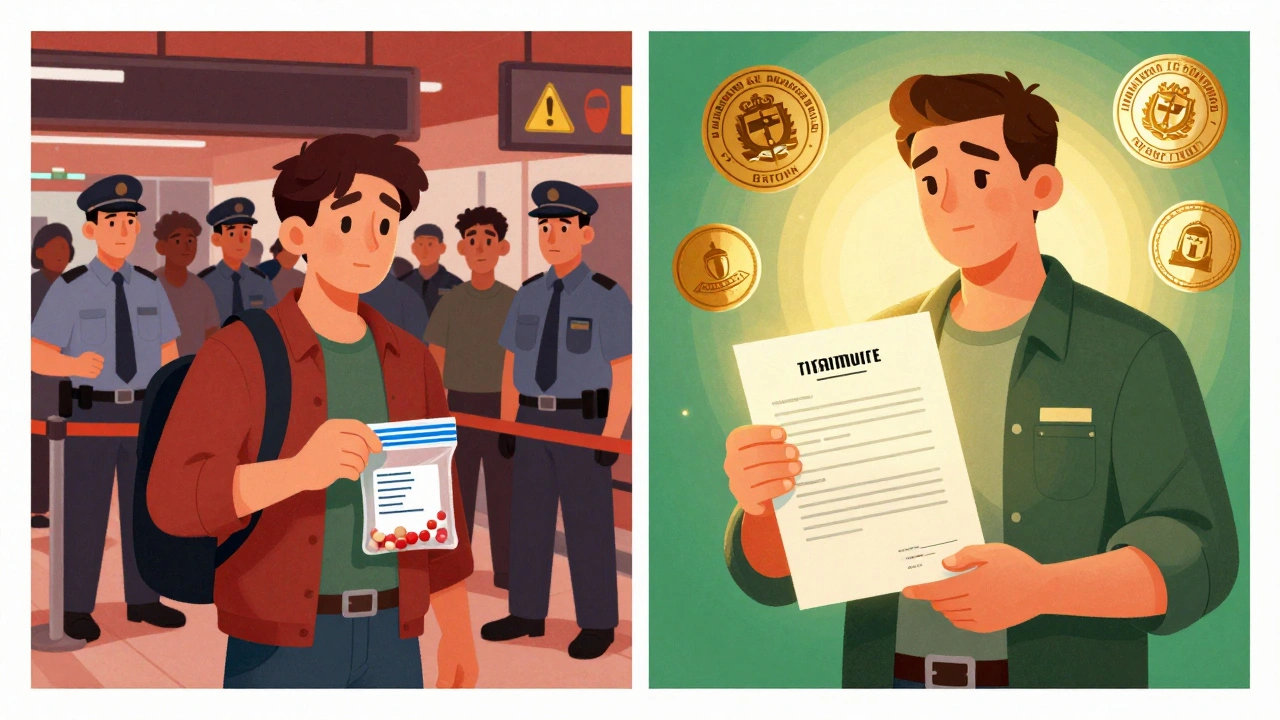
Country-Specific Rules You Can’t Afford to Ignore
Not all countries play by the same rules. Here’s what you need to know for top destinations:- Japan: Adderall, oxycodone, and even some cold medicines containing pseudoephedrine are illegal. You need a Yakkan Shoumei import certificate-apply at least 2 weeks before departure. The process costs about $50 and takes 7-10 business days.
- United Arab Emirates: All benzodiazepines (like Xanax and Valium) and opioids are banned unless you have a government-approved import permit. Apply through the Ministry of Health and Prevention.
- Australia: Schedule 8 drugs (like methadone, fentanyl, and strong painkillers) require pre-approval from the Therapeutic Goods Administration (TGA). Apply online at least 10 days ahead.
- United Kingdom: You can bring up to three months’ supply with a valid prescription, but narcotics require a Controlled Drug Import Certificate from the Home Office.
- European Union: Since January 2024, the EU Digital Health Certificate lets you access digital prescriptions across member states. Still, carry a printed copy and doctor’s letter as backup.
How to Get Your Letter and Handle Translation
Start early. Give yourself 4-6 weeks. Book an appointment with your doctor, not a nurse. Ask them to write the letter on official letterhead. If they’re unsure what to include, print out the CDC’s checklist and hand it to them. If you’re traveling to a country where English isn’t spoken, you’ll need a certified translation. Don’t use Google Translate. Use a professional service. The American Translators Association says 41% of travelers who had issues were blocked because their documents weren’t properly translated. Expect to pay $25-$75 per document. Keep a digital copy of everything-email it to yourself and a trusted family member. If you’re detained, you’ll need to prove you’re not a drug trafficker. A scanned letter and prescription saved on your phone can save hours.What to Do at the Airport and Customs
At security: Keep your meds in your carry-on. Put them in a clear plastic bag. Don’t hide them. If you’re nervous, say something like: “I have controlled medications with a doctor’s letter.” Most officers will appreciate your honesty. At customs: If asked about your meds, answer clearly and calmly. Hand over your letter and original bottles. Don’t argue. Don’t lie. If they’re unsure, they’ll call a supervisor. Your documentation will do the talking. One traveler on Reddit shared how they flew to 12 countries with Adderall-no issues. Why? They had the letter, the original bottles, and their passport number on the letter. They also printed a copy of the country’s drug laws and carried it with them. Another traveler at JFK was held for 47 minutes because they forgot the letter. They had the prescription, but the officer needed proof the meds were for personal use. The traveler called their doctor, who faxed a letter within 20 minutes. They made their flight-but barely.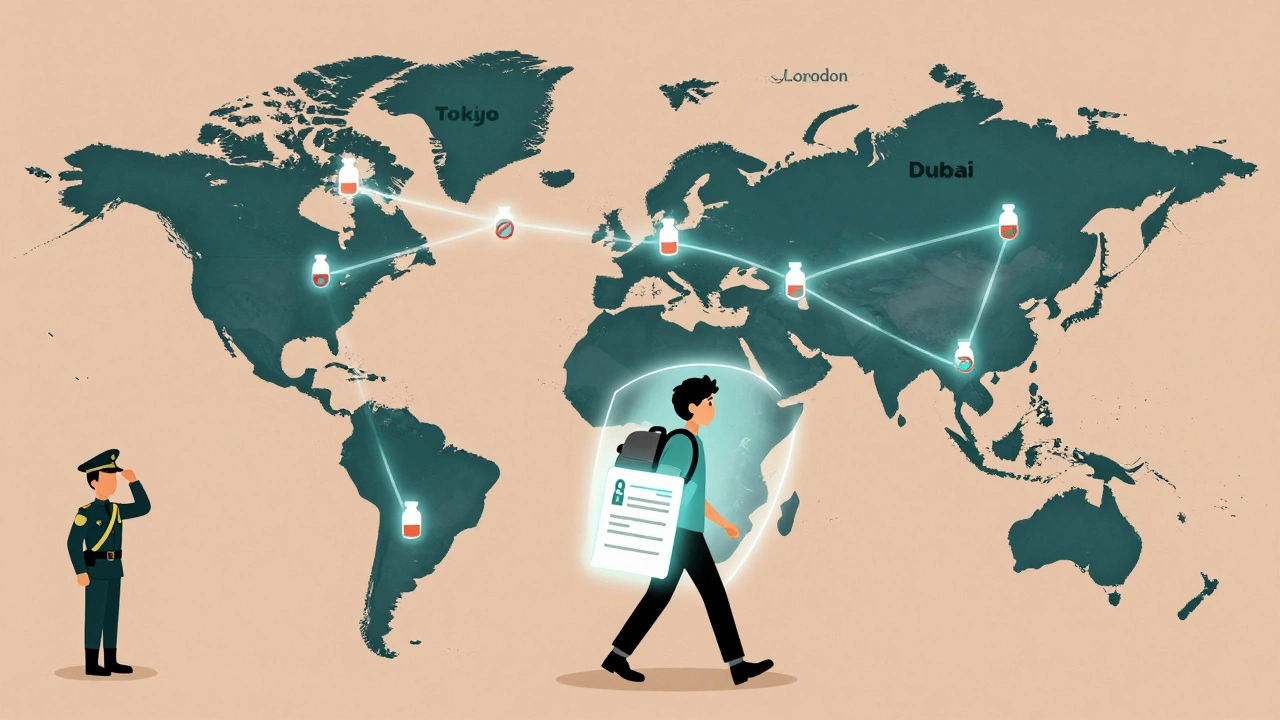
What’s Coming Next
The FDA is testing a new app called “Traveler Medication Pre-Clearance,” launching in late 2024. It lets you upload your documents before you fly. If approved, you get a QR code to show at customs-cutting inspection time by up to 65%. By 2026, the International Narcotics Control Board plans to roll out a standardized international travel certificate. But until then, you’re still on your own. Don’t wait for the system to fix itself. Fix it yourself.Quick Checklist Before You Fly
- ✅ Doctor’s letter with all required details
- ✅ Original pharmacy bottles with labels
- ✅ Copy of your prescription (English if needed)
- ✅ Certified translation (if traveling outside English-speaking country)
- ✅ Country-specific permits (Japan, UAE, Australia, etc.)
- ✅ Digital copies saved on phone and email
- ✅ Printed copy of destination country’s drug laws
Frequently Asked Questions
Can I bring my controlled medication in a pill organizer?
No. Always carry controlled medications in their original pharmacy-labeled containers. Customs agencies require this to verify the medication was legally prescribed. Pill organizers are acceptable for non-controlled medications, but never for opioids, stimulants, or sedatives.
What if my doctor won’t write a travel letter?
If your doctor refuses, ask for a referral to a travel medicine clinic. Many pharmacies and urgent care centers now offer this service. In Australia, the International Association for Medical Assistance to Travellers (IAMAT) provides templates and guidance. You can also use services like MedTraveler or Passport Health-they specialize in travel medication documentation and can generate compliant letters for a fee.
Is it legal to ship my medication ahead of time?
Generally, no. The FDA and most countries only allow personal use medications to be carried in your luggage. Shipping them-even with a prescription-is treated as commercial importation and will likely be seized. Always carry your meds with you.
Do I need a letter for over-the-counter drugs like ibuprofen?
No, unless they contain restricted ingredients. For example, some OTC cold medicines in the U.S. contain pseudoephedrine, which is controlled in countries like Japan and Thailand. Check the specific drug’s ingredients before traveling. When in doubt, carry a doctor’s note.
What happens if my medication is confiscated?
You’ll lose the medication, and you may be questioned or detained. In some countries, you could face fines or legal action. If you have a doctor’s letter and original packaging, your chances of getting it back are higher-but not guaranteed. Prevention is always better than recovery.
Anna Roh
December 9, 2025 AT 18:16I literally forgot my letter last year and got held up for three hours in Dubai. Just carrying my prescription wasn't enough. They made me call my doctor from the airport. Don't be me.
Also, why is Adderall illegal everywhere? It's not cocaine.
om guru
December 10, 2025 AT 20:21Travelers must always carry original containers and doctor's letter
Failure to comply results in legal consequences
Preparation is non negotiable
Richard Eite
December 10, 2025 AT 22:56Ugh why do we even need this crap
My meds are legal in America so they should be legal everywhere
Other countries are just being dramatic
I carry my pills in a Ziploc and never had a problem
They don't know what they're missing
Katherine Chan
December 12, 2025 AT 11:12Y'all are overcomplicating this so much
Just get the letter, keep your meds in the bottle, and be cool about it
Most officers just want to make sure you're not smuggling
I've flown to 8 countries with my anxiety med and never had an issue
You got this, seriously
Philippa Barraclough
December 12, 2025 AT 12:28It is worth noting that the 23% confiscation rate cited appears to be derived from a non-peer-reviewed source, and while the recommendation to carry a doctor’s letter is sound, the specific figures surrounding the 78% failure due to incomplete documentation may benefit from cross-referencing with CBP’s annual enforcement reports. Additionally, the distinction between 'original pharmacy-labeled bottles' and 'dispensing containers' is not uniformly interpreted across jurisdictions; for instance, in certain EU states, blister packs sealed by a pharmacist are considered acceptable, whereas in others, only bottles with pharmacy-printed labels are recognized. This inconsistency undermines the universality of the advice provided and may lead to unintended noncompliance among travelers who assume uniform global standards exist where none do.
The suggestion to use professional translation services is prudent, though the assertion that Google Translate is insufficient is almost tautological - any certified translation requires human verification, and the cost range of $25–$75 is broadly accurate for standard documents, though expedited services may exceed this. One might also consider that some embassies offer document attestation services which can substitute for or supplement translation certification, particularly in non-English-speaking nations with strict pharmaceutical controls.
Olivia Portier
December 13, 2025 AT 18:29OMG I just realized I forgot my letter for my Xanax and I’m flying to Spain next week
Thanks for the wake up call
I’m calling my doctor right now
Also can someone explain what a Yakkan Shoumei is again? I think I spelled it wrong lol
So glad I found this post before I left
Tiffany Sowby
December 13, 2025 AT 22:59Of course the U.S. government says it's fine to bring your meds but then other countries are the problem
Why do we have to bend over backwards for them?
They should just accept American prescriptions like everyone else
It's not like I'm smuggling heroin
They just want to make travelers suffer
And now they want an app? Like we don't have enough bureaucracy already
Jennifer Blandford
December 15, 2025 AT 15:36I flew to Japan last year with my Adderall and had zero issues
Here's the secret: I printed out the Japanese government's own drug policy page in Japanese, laminated it, and put it next to my doctor's letter
They saw I did the research and just waved me through
It's not about fighting the system
It's about showing you respect it
Traveling isn't just about seeing places - it's about meeting people who have different rules
Be the person who makes it easier for everyone
Peace out ✌️
Brianna Black
December 16, 2025 AT 17:18As a medical professional who has advised international travelers for over a decade, I can confirm the advice presented herein is both accurate and critically necessary.
The assertion that original containers are mandatory is not merely a suggestion - it is codified under U.S. Customs and Border Protection Directive 3340-001 and similarly enforced under the UK’s Misuse of Drugs Regulations 2001 and Australia’s Therapeutic Goods Act 1989.
Furthermore, the omission of the prescribing physician’s license number from the letter renders it legally insufficient in over 70% of jurisdictions requiring formal documentation, as verified by the International Society of Travel Medicine’s 2023 compliance audit.
While the upcoming FDA Traveler Medication Pre-Clearance app represents a significant step toward standardization, its current pilot phase excludes over 40% of U.S. prescribing clinicians due to EHR integration limitations.
Until systemic reform is implemented, adherence to the checklist provided remains the only reliable safeguard against detention, confiscation, or criminal liability.
Travel responsibly. Document meticulously. And never assume your home country’s norms are universally recognized.