
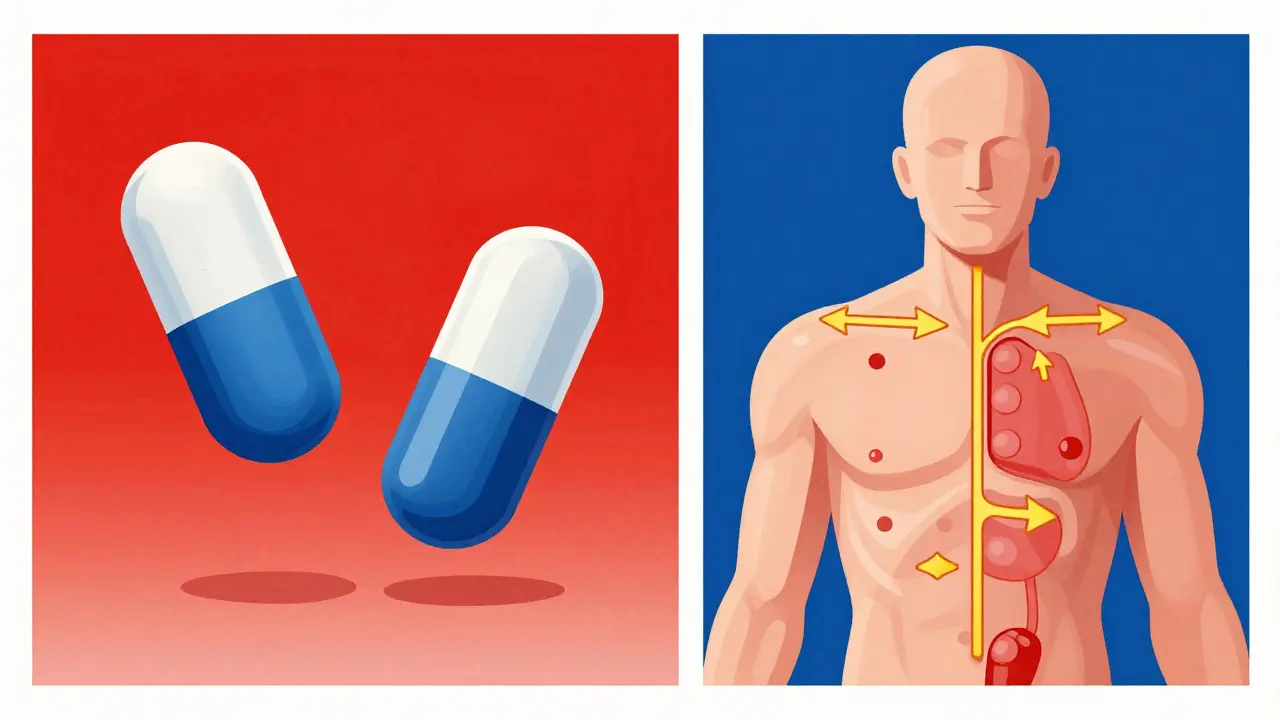
When you pick up a prescription at the pharmacy and see a different name on the bottle than what your doctor wrote, it’s natural to wonder: Is this the same thing? The answer lies in a term you’ve probably heard but might not fully understand: bioequivalent. It’s not about chemistry. It’s not about branding. It’s about what happens inside your body.
What bioequivalence actually means
Bioequivalence doesn’t mean two drugs are chemically identical. Two pills can look completely different-one white, one blue, one with a logo, one without-and still be bioequivalent. What matters is how your body absorbs and uses the active ingredient.
The U.S. Food and Drug Administration (FDA) defines bioequivalence as: the absence of a significant difference in the rate and extent to which the active ingredient becomes available at the site of drug action. In plain terms: if you take two bioequivalent versions of the same drug, your blood will carry roughly the same amount of the medicine at roughly the same time. That’s it.
This standard was created in 1984 under the Hatch-Waxman Act. Before that, generic drugs had to go through full clinical trials just like brand-name drugs. That made them expensive and slow to market. The breakthrough was realizing that if two pills deliver the same active ingredient the same way in the body, you don’t need to re-prove they work. You just need to prove they behave the same in the bloodstream.
How bioequivalence is tested
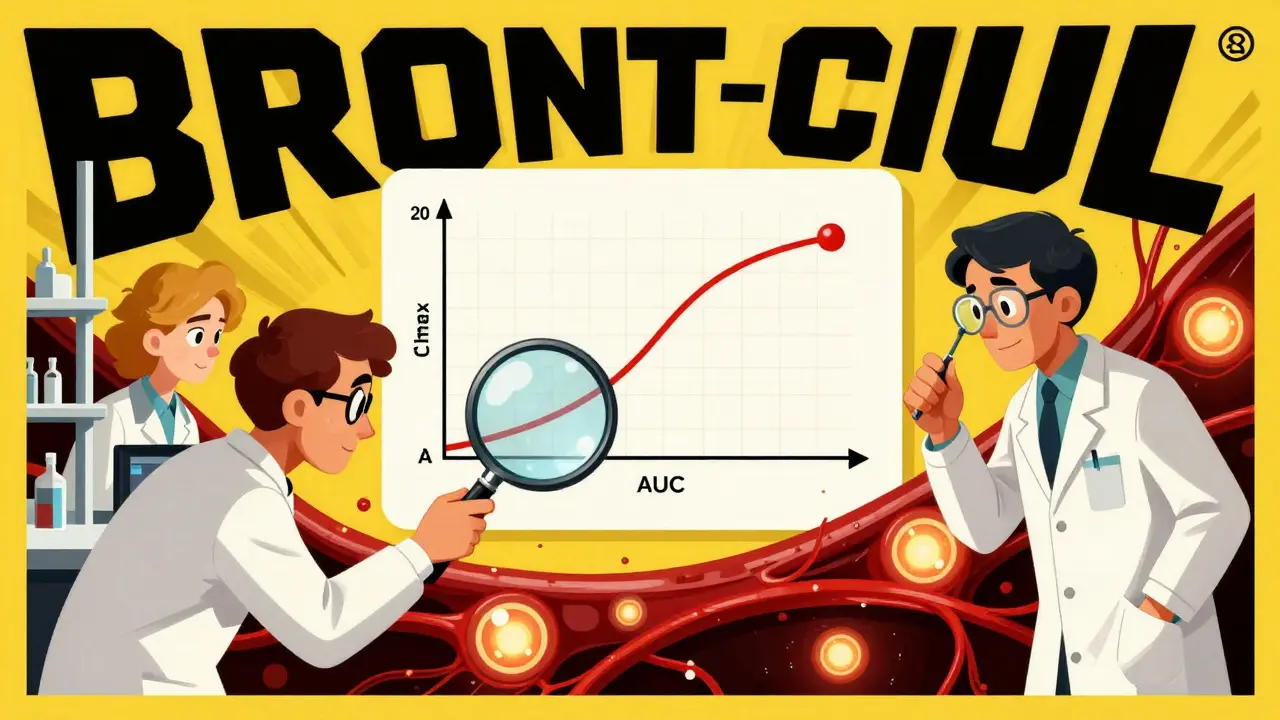
Manufacturers don’t guess. They test. In controlled studies with 24 to 36 healthy volunteers, researchers measure three key things:
- Cmax: The highest concentration of the drug in the blood.
- tmax: How long it takes to reach that peak.
- AUC: The total amount of drug absorbed over time (area under the curve).
For a generic drug to be approved, its values for Cmax and AUC must fall within 80% to 125% of the brand-name drug’s values. That’s not random. It’s based on decades of data showing that a 20% difference in absorption rarely changes how well a drug works or how safe it is.
For example, if the brand-name drug delivers an AUC of 100 units, the generic must deliver between 80 and 125 units. If it’s 79 or 126, it fails. Simple. Precise. Scientific.
These studies are done under fasting conditions, unless the drug is meant to be taken with food. In that case, they test it with a meal too. The goal? To mimic real-world use.
Not all drugs are created equal
Most medications? The 80-125% range works fine. But for some, even a small difference can matter.
Drugs with a narrow therapeutic index-like warfarin, levothyroxine, or certain anti-seizure medications-have a tiny gap between the dose that works and the dose that causes harm. For these, the FDA may require tighter limits: 90% to 111%. That’s a much smaller window.
That’s why pharmacists often stick with the same generic manufacturer once you’ve started a medication like levothyroxine. Even if two generics are technically bioequivalent, slight differences in inactive ingredients or manufacturing processes can affect absorption in sensitive individuals. It’s not a failure of the system-it’s a recognition that biology isn’t always predictable.
Bioequivalent vs. pharmaceutical equivalent vs. therapeutic equivalent
These terms get mixed up a lot. Here’s the difference:
- Pharmaceutical equivalent: Same active ingredient, same dose, same form (pill, liquid, patch), same strength, same route (oral, injection). But they can have different fillers, dyes, or coatings.
- Bioequivalent: Same as above, but also proven to behave the same way in your body.
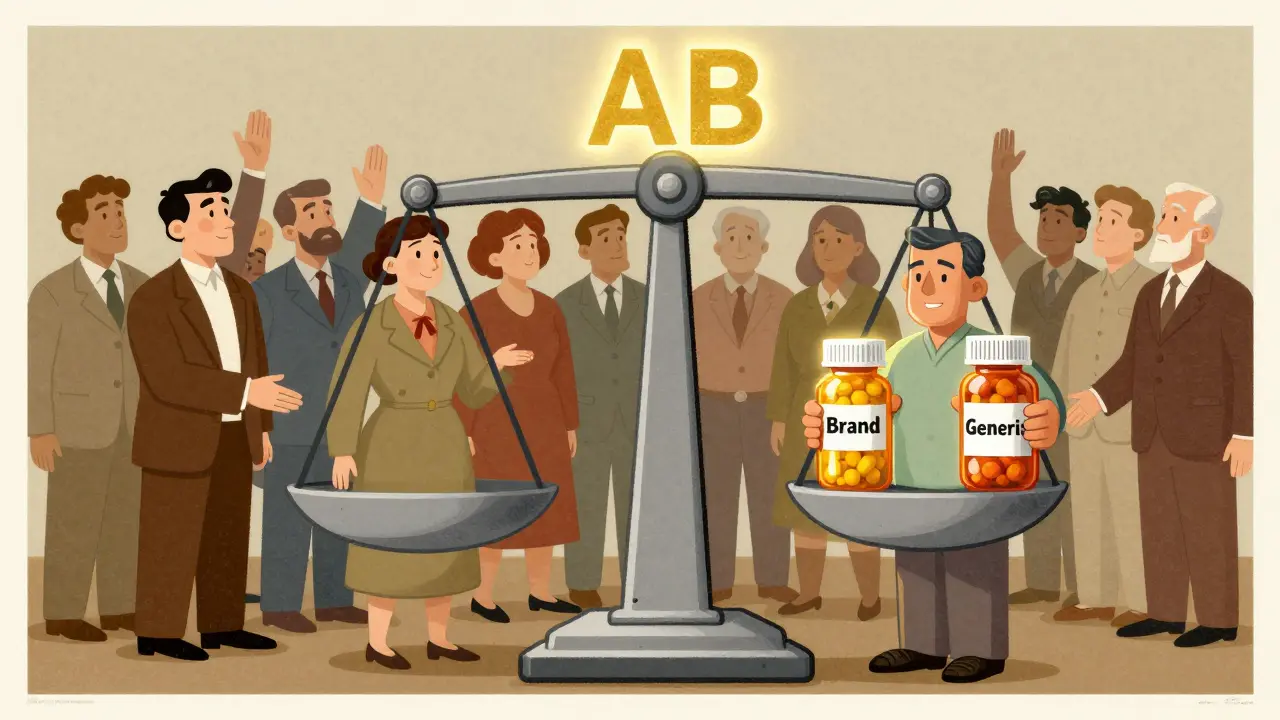
- Therapeutic equivalent: Both pharmaceutical and bioequivalent. This is what the FDA calls an “A-rated” drug. These are the ones you can swap with confidence.
The FDA publishes a list called the Orange Book that shows which generics are rated “AB”-meaning they’re approved as therapeutically equivalent. If a generic isn’t rated AB, it might not be interchangeable.
What the data says about real-world use
Some people swear they feel different on a generic. A 2022 survey of 1,245 independent pharmacists found 87% reported no noticeable differences between brand and generic drugs for most conditions. Consumer Reports’ 2023 survey of 3,421 patients showed 78% were satisfied with generics-compared to 82% for brand-name drugs.
The gap? It’s widest with anti-seizure medications. About 0.8% of patients switching to generics experienced breakthrough seizures, according to a 2021 study in JAMA Internal Medicine. But here’s the context: those same patients were on brand-name drugs for years before switching. The issue isn’t that generics are unsafe-it’s that for some, even a tiny change in blood levels can trigger a seizure.
The FDA analyzed over 2,000 generic approvals and found 98.7% of them had AUC values within 90-110% of the brand-far tighter than the 80-125% rule. That means most generics perform nearly identically.
And the numbers don’t lie: generics make up 90% of all prescriptions filled in the U.S. If they weren’t safe and effective, the system would collapse. But it hasn’t.
Why bioequivalence saves money
Developing a new brand-name drug can cost over $2 billion and take 10-15 years. Generic manufacturers don’t repeat that. They use the brand’s data. Their main cost? Bioequivalence studies-about $2.2 million on average. That’s why generics cost 80-85% less.
Over the last decade, generic drugs have saved the U.S. healthcare system an estimated $2.2 trillion. For the average patient? That’s about $313 saved per prescription.
It’s not just about cost. It’s about access. Without bioequivalence standards, millions couldn’t afford their medications. The system works because it’s built on science, not guesswork.
What’s changing now
Not all drugs are simple pills. What about inhalers, nasal sprays, or topical creams? For these, measuring blood levels doesn’t tell the whole story. The drug might act locally-like a steroid spray in the nose or a cream on the skin.
The FDA has issued new guidance for these products. Instead of blood tests, they might use in vitro testing (lab tests on the product itself) or clinical endpoint studies (measuring symptoms, not drug levels). In 2023 alone, the FDA released 27 new guidance documents for complex generics.
There’s also talk about moving from fixed ranges to personalized thresholds using pharmacometric modeling. But that’s still theoretical. For now, the 80-125% rule remains the gold standard.
What you should know
- If your doctor prescribes a brand-name drug, ask if there’s a generic. Most of the time, there is.
- If you switch to a generic and feel different, talk to your pharmacist. It might be a formulation change, not the drug itself.
- For drugs like levothyroxine, seizure meds, or blood thinners, consistency matters. Stick with the same manufacturer if possible.
- Bioequivalence doesn’t mean perfect. But it means reliable. And for 9 out of 10 prescriptions, that’s enough.
The bottom line? Bioequivalence isn’t a loophole. It’s a science-backed shortcut that lets you get the same medicine for a fraction of the price. The system isn’t perfect, but it’s working-for millions of people, every single day.
Andrew Mamone
March 17, 2026 AT 10:33MALYN RICABLANCA
March 19, 2026 AT 05:20gemeika hernandez
March 19, 2026 AT 07:52Linda Olsson
March 20, 2026 AT 13:38Ayan Khan
March 22, 2026 AT 09:44Emily Hager
March 23, 2026 AT 16:36Lauren Volpi
March 24, 2026 AT 08:08jared baker
March 25, 2026 AT 14:02Michelle Jackson
March 25, 2026 AT 20:19becca roberts
March 27, 2026 AT 02:44SNEHA GUPTA
March 28, 2026 AT 11:26