
Over half the world’s population carries H. pylori in their stomach-most never know it. This tiny, spiral-shaped bacterium doesn’t cause symptoms in many people. But for others, it’s the hidden cause of chronic stomach pain, ulcers, and even stomach cancer. The good news? It’s treatable. The bad news? The treatments we’ve relied on for decades are failing more often than ever because of rising antibiotic resistance. If you’ve been told you have H. pylori, or you’re wondering whether testing is worth it, here’s what actually works today-and what doesn’t.
How H. pylori Survives in Your Stomach
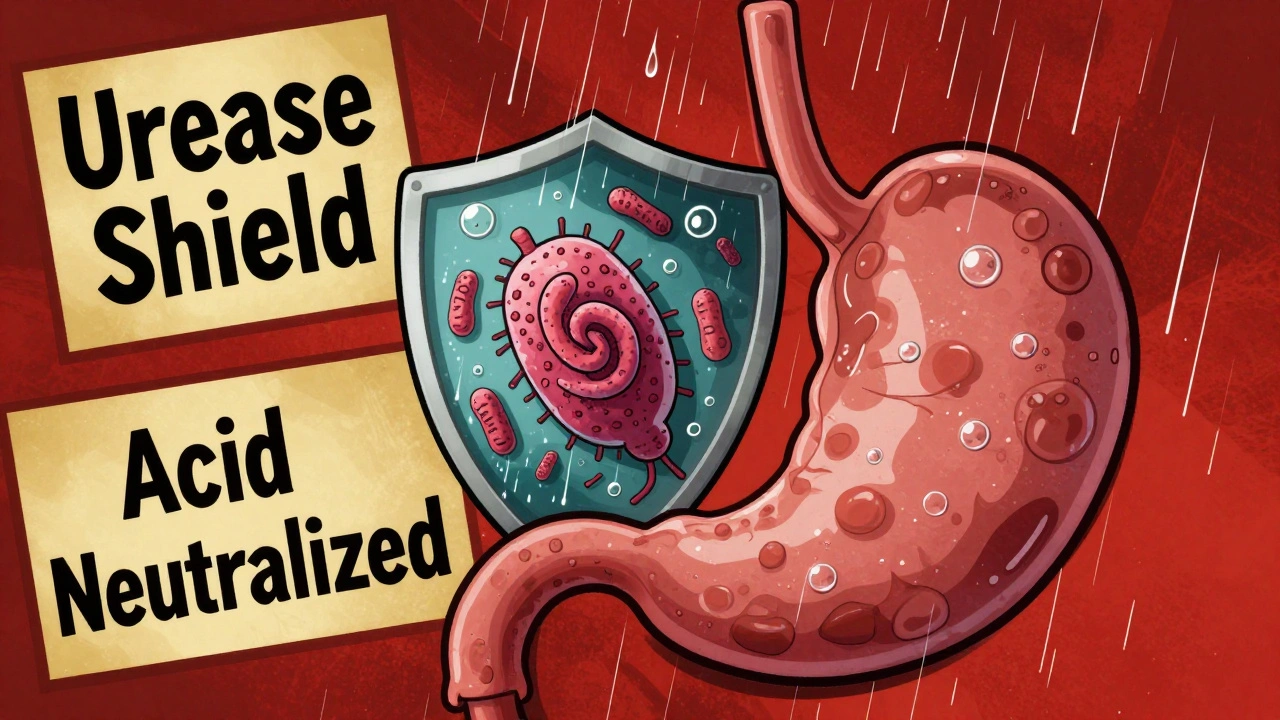
Stomach acid is strong enough to kill most bacteria. But H. pylori has a trick. It makes an enzyme called urease, which turns urea (a natural compound in your body) into ammonia. That ammonia acts like a shield, neutralizing the acid around it so the bacteria can cling to your stomach lining. This isn’t just a nuisance-it causes inflammation, damages the protective mucus layer, and can lead to ulcers or, over time, stomach cancer. It’s why the World Health Organization classifies H. pylori as a Group 1 carcinogen.
The infection usually starts in childhood and lasts for decades unless treated. It spreads through contaminated food, water, or close contact-think shared utensils or poor sanitation. In developing countries, up to 90% of adults carry it. In the U.S. and Western Europe, it’s lower-around 20-50%-but still common enough that doctors test for it regularly.
Testing for H. pylori: What Works and What Doesn’t
Not all tests are created equal. The right one depends on your situation: Are you being tested for the first time? Did you just finish treatment? Are you a child? Here’s what gastroenterologists actually use.
Non-Invasive Tests: The Go-To Options
Urea breath test (UBT) is the gold standard for detecting active infection. You drink a solution containing carbon-labeled urea. If H. pylori is present, it breaks down the urea into carbon dioxide, which you exhale. A machine detects the labeled carbon. Sensitivity and specificity? Both above 95%. That’s better than most blood tests. But here’s the catch: you have to stop proton pump inhibitors (PPIs) like omeprazole or esomeprazole for at least 14 days before the test. Many patients don’t realize this-and end up with a false negative. One study found nearly 30% of people skipped this step, leading to missed diagnoses.
Stool antigen test (SAT) looks for H. pylori proteins in your poop. It’s just as accurate as the breath test, doesn’t require stopping PPIs, and is FDA-approved for kids. That’s why pediatricians prefer it. No radiation, no drinking weird-tasting liquids. One parent on a support forum called it “the only reason my 8-year-old didn’t cry during testing.” Results come back in 1-2 days. Cost? Around $38 under Medicare. It’s cheaper, easier, and just as reliable.
Serology (blood test) checks for antibodies. Sounds simple, right? But here’s the problem: once you’ve had H. pylori, your body keeps making antibodies-even after it’s gone. So a positive blood test doesn’t mean you’re infected now. It just means you’ve been infected at some point. That’s why the American College of Gastroenterology says: don’t use it for diagnosis in low-prevalence areas like the U.S. It’s useful for screening in places like rural Asia, but not for deciding if you need treatment.
Invasive Tests: Done During Endoscopy
If you’re having an endoscopy anyway-say, because you’re bleeding or have weight loss-doctors can take tissue samples. The rapid urease test (like CLOtest) gives results in hours. It’s cheap, fast, and specific. But it can miss the infection if you’ve taken PPIs or antibiotics recently. That’s why experts recommend taking at least 2-3 biopsies from different parts of the stomach. One biopsy isn’t enough.
Biopsy culture is the only way to know which antibiotics the bacteria are resistant to. But it’s slow-takes 3-7 days-and needs special lab conditions. Most clinics don’t do it routinely. That’s changing. New tools like the GeneXpert H. pylori test can detect resistance mutations in under 90 minutes, but it’s only available in about 150 U.S. medical centers right now. Cost? Around $250.
Why Quadruple Therapy Is Now First-Line Treatment
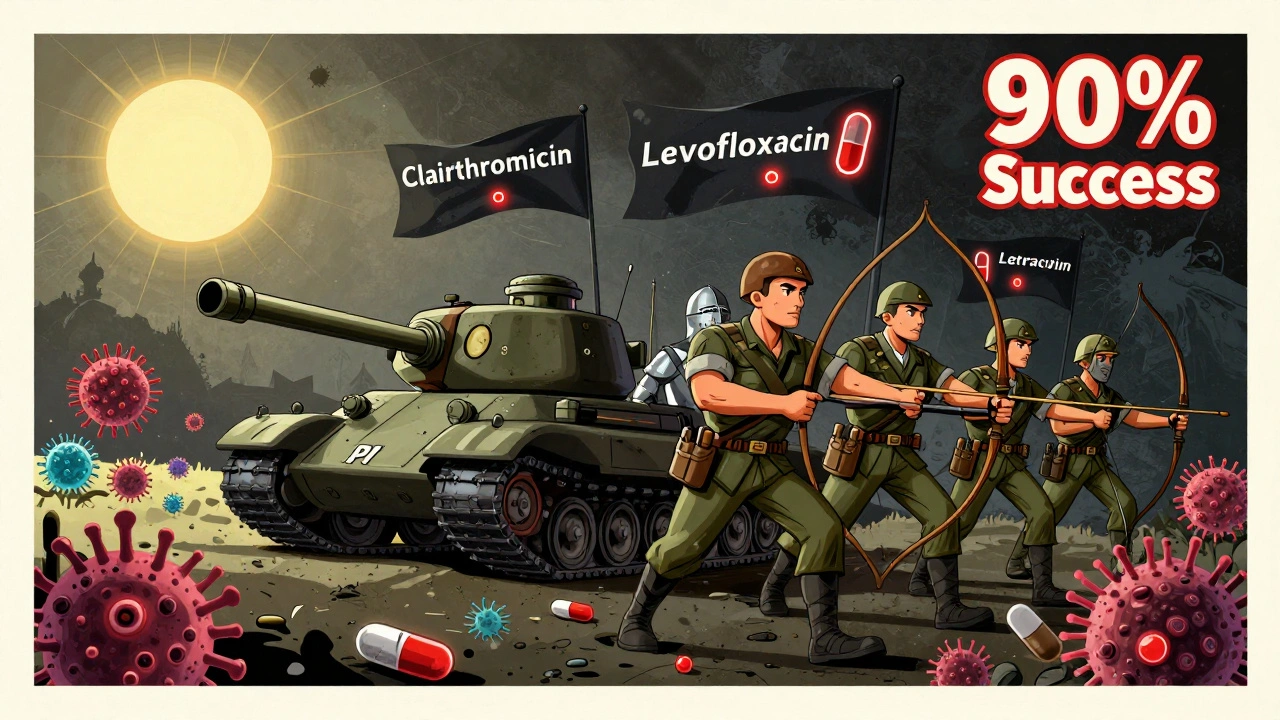
Twenty years ago, the standard treatment was triple therapy: a proton pump inhibitor (PPI) plus two antibiotics-usually clarithromycin and amoxicillin. Success rate? Around 90%. Today? In many places, it’s below 70%. Why? Clarithromycin resistance. In the U.S., Europe, and parts of Asia, more than 15% of H. pylori strains are resistant to clarithromycin. In some cities, it’s over 40%. That means nearly half the people getting triple therapy are being treated with an antibiotic that doesn’t work.
That’s why guidelines from the American College of Gastroenterology and the European Helicobacter Study Group now recommend bismuth quadruple therapy as first-line treatment in regions with high clarithromycin resistance. This regimen includes:
- A proton pump inhibitor (PPI)
- Bismuth subsalicylate (like Pepto-Bismol)
- Tetracycline
- Metronidazole
You take this for 10 to 14 days. It’s not glamorous. Tetracycline can make you sensitive to sunlight. Metronidazole can cause a metallic taste and nausea. Bismuth turns your stool black-scary if you don’t know it’s normal. But the success rate? Around 85-90%, even in areas with high resistance.
There’s also a non-bismuth quadruple therapy-concomitant therapy-that uses the PPI plus three antibiotics at once. It’s effective too, but not as widely used. The bismuth version is preferred because it’s cheaper, more reliable, and resistance to its components is still low.

Resistance Is the Real Enemy
Antibiotic resistance isn’t just a problem-it’s accelerating. Clarithromycin resistance is up. Levofloxacin resistance is rising too-now hitting 15-30% in Western countries. That means if first-line treatment fails, your second option might also fail.
That’s why experts are pushing for resistance-guided therapy. Instead of guessing which antibiotics to use, test for resistance first. Molecular tests can detect the exact mutations in H. pylori’s DNA that make it resistant to clarithromycin. A 2023 study in Gut showed that when treatment was tailored based on these tests, eradication jumped from 75% to 92%. That’s a huge difference.
Right now, getting resistance testing means an endoscopy. But new stool-based PCR tests are in clinical trials. If they work, you could get a simple stool test that tells you which antibiotics will work-no endoscopy needed. That could change everything.
What Happens After Treatment?
Just finishing the meds isn’t enough. You need to confirm the bacteria is gone. That’s called confirmation of eradication. You should get tested again-4 weeks after finishing treatment. Why wait 4 weeks? Because the bacteria can be temporarily suppressed, leading to false negatives if you test too soon.
Use the urea breath test or stool antigen test for follow-up. Not blood. Not a repeat endoscopy unless you have symptoms. If the test is still positive, you’ll need a second-line regimen-usually involving different antibiotics like rifabutin or furazolidone, sometimes with newer drugs like vonoprazan.
Vonoprazan, approved by the FDA in 2023, is a potassium-competitive acid blocker. It suppresses stomach acid better than PPIs, which helps antibiotics work more effectively. Early data shows it boosts eradication rates, especially in resistant cases. It’s not yet first-line everywhere, but it’s becoming a key tool.
What Patients Are Saying
Real people are struggling with the process. On health forums, common complaints include:
- Stopping PPIs for two weeks causes terrible heartburn
- The UBT drink tastes like sour candy mixed with chemicals
- Black stools from bismuth freak people out
- Side effects from antibiotics make them quit early
One patient wrote: “I took all the meds, but skipped the last two days because I felt awful. Then the test came back positive. I had to start over.” Compliance is a huge issue. Missing even a few doses can lead to treatment failure and further resistance.
Doctors are catching on. More clinics now offer detailed counseling before treatment. They explain the side effects upfront. They give you a calendar to track pills. They warn you about the black stools. It makes a difference.
What’s Next for H. pylori Treatment?
The future is personalized. Instead of giving everyone the same combo, we’ll test for resistance first. Stool-based molecular tests could replace endoscopy for screening and guiding therapy. New drugs like vonoprazan are expanding options. Vaccines are in early trials. And public health efforts are pushing for better sanitation to reduce transmission.
But right now, the most important thing is this: if you have symptoms like chronic bloating, nausea, or unexplained stomach pain, ask for testing. Don’t assume it’s just stress. And if you’re diagnosed, make sure you get the right treatment-not the old one, but the one that works today.
H. pylori isn’t going away. But with the right test and the right therapy, it can be beaten.
Can I test for H. pylori at home?
No reliable at-home test exists yet. Stool antigen tests require lab processing, and breath tests need specialized equipment. Some companies sell mail-in stool kits, but they’re not FDA-cleared for diagnosis and aren’t recommended by medical societies. Always get tested through a doctor’s office or clinic.
Do I need an endoscopy to diagnose H. pylori?
No. Most people don’t need one. Non-invasive tests like the urea breath test or stool antigen test are accurate enough for diagnosis. Endoscopy is only needed if you have warning signs like weight loss, bleeding, vomiting blood, or if you’re over 50 with new stomach symptoms. It’s also used if initial treatment fails.
Why can’t I take PPIs before a breath test?
PPIs reduce stomach acid, which makes H. pylori less active. If the bacteria aren’t producing much urease, the breath test won’t detect them-even if they’re still there. That’s why you must stop PPIs for 14 days. Antacids and H2 blockers like famotidine are okay, but don’t take them without checking with your doctor first.
Is bismuth safe for long-term use?
Bismuth subsalicylate is safe for the 10-14 days used in H. pylori treatment. It’s the same ingredient in Pepto-Bismol. Long-term daily use (months or years) can rarely cause neurological side effects, but that’s not a concern with short-term therapy. Black stools and a dark tongue are harmless side effects.
What if my treatment fails?
Don’t try the same regimen again. Failure means resistance. Your doctor will likely order a culture or molecular test to check for antibiotic resistance. Second-line treatments may include rifabutin, levofloxacin (if resistance is low), or vonoprazan-based regimens. Sometimes, a third round is needed. Persistence matters-most people are cured after two attempts.
If you’ve had H. pylori before and it came back, you’re not alone. Resistance is growing. But with updated guidelines, better tests, and smarter treatment, beating it is still very possible. The key is working with your doctor to choose the right test-and the right therapy-for your situation.
Christian Landry
December 8, 2025 AT 11:40Just finished my 14-day bismuth quad and my stool’s been black as tar lol 🤪 honestly thought I was dying. But hey, at least my breath test came back clean. PPI withdrawal was brutal though-felt like my esophagus was on fire for a week. Worth it?
Mona Schmidt
December 8, 2025 AT 23:27It’s critical to note that the urea breath test requires strict PPI cessation-not just ‘a few days.’ Many patients are misinformed by primary care providers who don’t specialize in GI. A 14-day window isn’t arbitrary; it’s based on pharmacokinetic clearance data from multiple RCTs. Skipping this step invalidates the test entirely. Always confirm with your gastroenterologist before testing.
Chris Marel
December 9, 2025 AT 20:43I grew up in a village where everyone had this bug. No one ever got tested. We just ate ginger tea and hoped for the best. It’s wild to think now that we can detect it with a breath test and cure it with pills. But I worry-what about people who can’t afford these tests? Or the ones who don’t even know they’re sick? Medicine is amazing, but access isn’t fair.
Nikhil Pattni
December 11, 2025 AT 15:45Okay, so let me get this straight-so we’re saying that triple therapy is obsolete because of clarithromycin resistance, but then we’re throwing four drugs at people? Isn’t that just antibiotic overkill? And don’t even get me started on metronidazole tasting like battery acid. I’ve seen patients quit mid-treatment because they thought they were being poisoned. And now we’re talking about molecular stool tests? Who’s gonna pay for that? The system is broken. We need vaccines, not more pills. And why isn’t anyone talking about probiotics? I read a meta-analysis last year that showed L. reuteri can reduce H. pylori load by 40% without antibiotics. But nope, we’re still stuck in the 1990s.
Arun Kumar Raut
December 13, 2025 AT 09:07My uncle had this for years. He didn’t know. Just had belly pain and blamed it on stress. Got tested after he lost weight. Did the stool test-no endoscopy. Took the bismuth stuff. Black poop? Yeah. Nausea? Yeah. But he’s fine now. No more pain. Just follow the doctor’s plan. Don’t skip pills. Even if you feel better. That’s the key.
Haley P Law
December 15, 2025 AT 07:38So let me get this straight… you’re telling me I have to stop my omeprazole for TWO WEEKS to test for this thing… and then take FOUR antibiotics that make me feel like a zombie… and then pay $250 for a follow-up test… and if I miss one pill I have to start OVER? And this is what modern medicine calls ‘treatment’? 😭 I’m just here for the black poop memes. I’ve already posted 3 on Instagram.
Katie Harrison
December 17, 2025 AT 00:08Thank you for the detailed breakdown. I appreciate the emphasis on confirmation of eradication-so many people assume treatment = cure. But I’ve seen too many cases where patients stop antibiotics early because they ‘feel fine,’ then come back with recurrent ulcers. The black stools? Totally normal. The metallic taste? Temporary. The discomfort? Real. But the risk of cancer? Realer. Please don’t skip the follow-up. It’s not optional.
precious amzy
December 17, 2025 AT 08:14One cannot help but observe the deeply technocratic, reductionist paradigm underpinning this entire therapeutic framework. H. pylori is not merely a pathogen-it is a symptom of a disordered microbiome, a consequence of industrialized food systems, and a reflection of our alienation from ancestral modes of digestion. To treat it with antibiotics is to engage in a metaphysical violence against the body’s innate wisdom. The real cure lies in ancestral diets, fermented foods, and the reclamation of gut sovereignty. Why do we persist in reducing life to biochemical warfare?
Carina M
December 18, 2025 AT 05:37While the article presents a clinically oriented perspective, it fails to address the ethical implications of population-wide antibiotic deployment in the absence of universal screening. The normalization of quadruple therapy as first-line treatment, particularly in low-resource settings, constitutes a form of medical colonialism-exporting high-cost, high-compliance regimens to populations with inadequate infrastructure to support adherence or follow-up. The article’s tone is alarmist yet devoid of structural critique. One must question whether eradication is a medical imperative or a pharmaceutical construct.
Guylaine Lapointe
December 18, 2025 AT 06:22Wow. So we’re just supposed to trust that this ‘quadruple therapy’ isn’t just creating superbugs? And why is vonoprazan being pushed like it’s magic? It’s not even approved everywhere. Meanwhile, people in developing countries are still drinking contaminated water and dying from ulcers because no one has the $250 test or the time to stop their PPIs for two weeks. This article reads like a pharmaceutical ad disguised as public health advice. Where’s the equity? Where’s the compassion? It’s not just about science-it’s about who gets to be healthy.