
Opioid Sleep Apnea Risk Calculator
Risk Assessment Tool
This tool estimates your risk of opioid-induced breathing problems during sleep. Based on factors like dose, sleep apnea status, and medication combinations. High risk requires immediate medical attention.
Risk Assessment Results
When you take an opioid for pain, you might not think about your breathing. But for many people, especially those with sleep apnea, opioids can quietly shut down their ability to breathe while they sleep. This isn’t a rare side effect-it’s a leading cause of death among people on long-term opioid therapy. And the worst part? Many patients and even some doctors don’t see it coming until it’s too late.
How Opioids Slow Your Breathing
Opioids like oxycodone, hydrocodone, fentanyl, and morphine don’t just block pain signals. They also target specific areas in your brainstem that control breathing. The two key regions involved are the pre-Bötzinger complex and the parabrachial complex. These are tiny clusters of nerve cells deep in your brain that act like the body’s breathing command center. When opioids bind to mu-opioid receptors (MORs) in these areas, they disrupt the rhythm of your breath.Here’s what happens: your exhale gets longer and deeper, while your inhale becomes shallow or even pauses completely. Studies show opioids can increase expiration time by up to 200%, which means your lungs hold air too long and don’t get enough fresh oxygen. In some cases, this leads to apnea-complete stops in breathing that last 10 seconds or more. During sleep, when your body is already relaxed, this effect becomes deadly.
Sleep Apnea and Opioids: A Deadly Mix
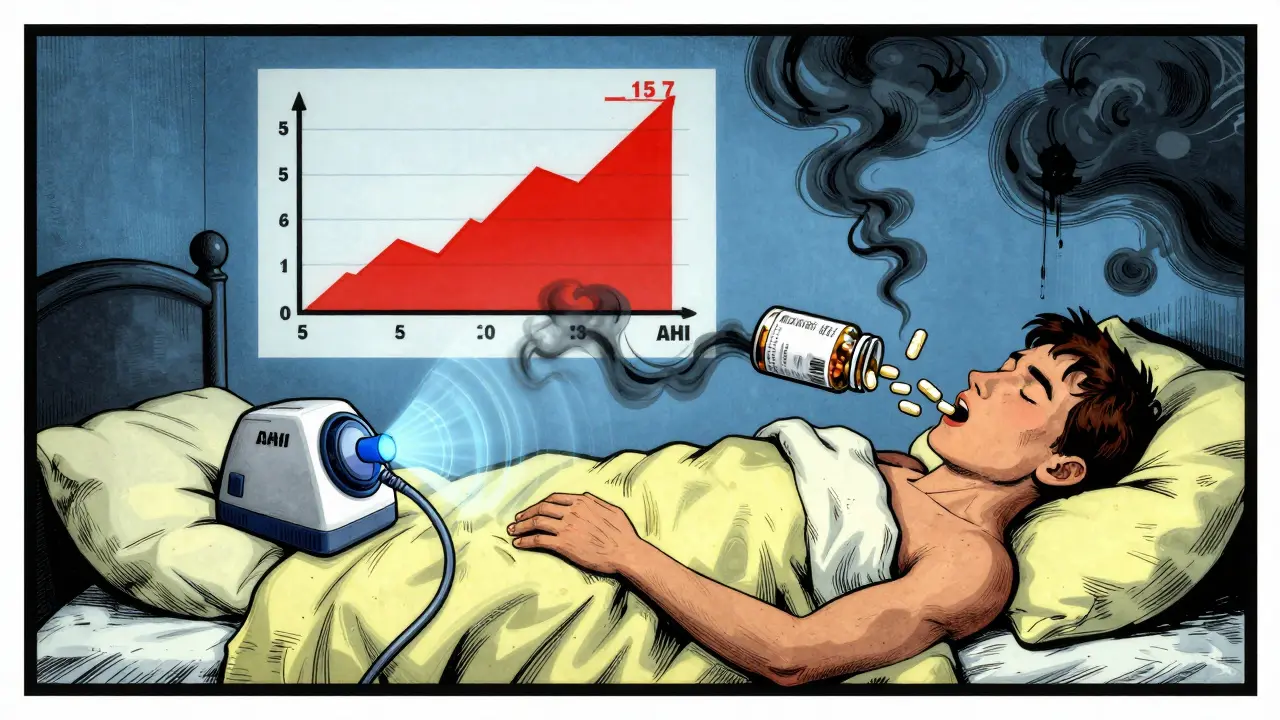
If you already have sleep apnea, adding opioids is like pouring gasoline on a fire. Sleep apnea means your airway collapses or your brain forgets to tell your lungs to breathe during sleep. Opioids make both problems worse. They suppress the brain’s ability to wake you up when oxygen drops, and they weaken the muscles that keep your airway open.Research from Harvard and Beth Israel Deaconess Medical Center found that chronic opioid users have a 30-40% higher chance of developing central sleep apnea. One study showed patients on high-dose opioids (100+ morphine milligram equivalents per day) had an average apnea-hypopnea index (AHI) of 15.7 events per hour. For comparison, someone without opioids typically has fewer than 5. An AHI above 15 is considered moderate to severe sleep apnea.
And it’s not just about the number of events. These pauses in breathing cause oxygen levels to crash. People report waking up gasping, with pounding headaches, or feeling exhausted even after 8 hours in bed. This isn’t just discomfort-it’s a sign your body is struggling to survive every night.
Why Some People Are at Higher Risk
Not everyone on opioids develops breathing problems. But certain factors make it much more likely:- High doses: Over 100 MME/day increases risk dramatically.
- Combining with other depressants: Mixing opioids with benzodiazepines (like Xanax or Valium), alcohol, or sleep meds raises overdose risk by 300-500%.
- Existing sleep apnea: If you’ve been diagnosed with OSA or have loud snoring, daytime fatigue, or witnessed apneas, you’re at high risk.
- Age: Older adults have slower metabolism and reduced lung function, making them more vulnerable.
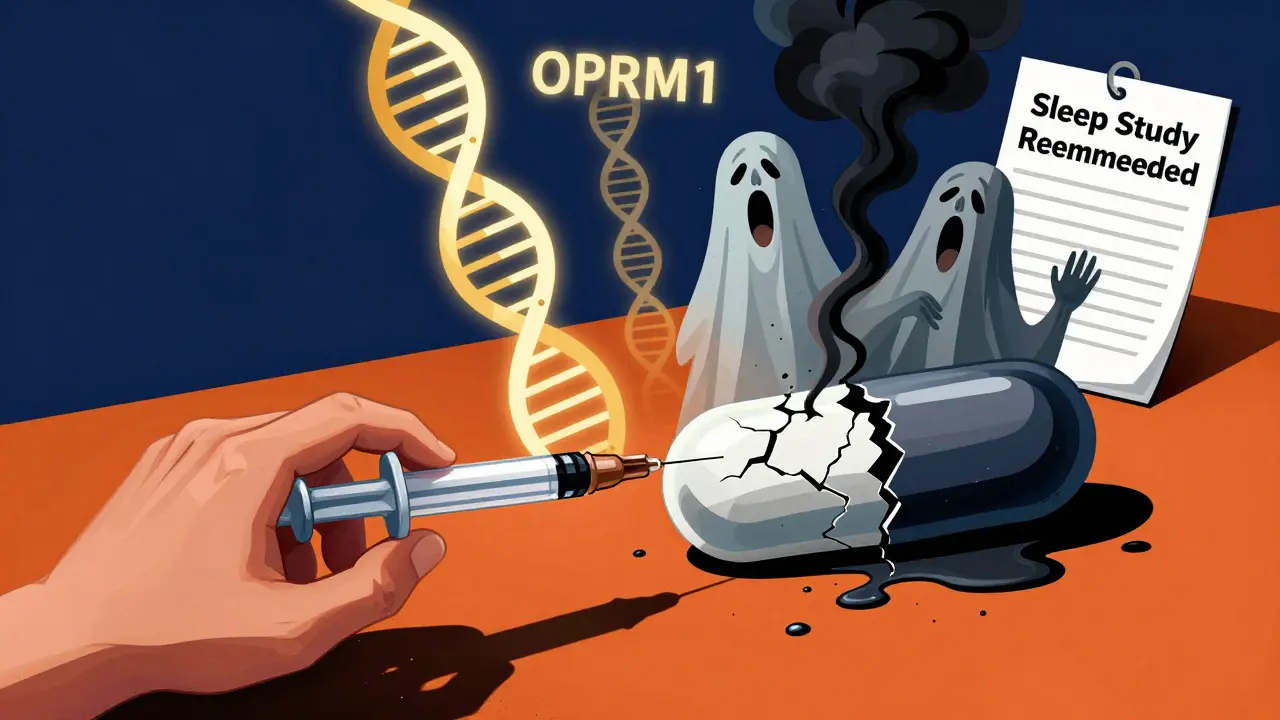
- Genetics: Some people carry variants in the OPRM1 gene that make their receptors more sensitive to opioids’ respiratory effects.
One alarming fact: about 10-15% of the population has naturally low ventilatory responses to rising carbon dioxide. For these people, even a small opioid dose can trigger fatal apnea because their body doesn’t have the backup system to compensate.
What Clinicians Miss
Most doctors focus on pain relief and addiction risk. Breathing problems? Often overlooked. Pulse oximeters, which measure blood oxygen, can give false reassurance. They don’t detect early-stage hypoventilation-the slow, shallow breathing that happens before oxygen drops. By the time SpO2 falls below 90%, the damage may already be done.Only 15-20% of primary care providers routinely screen for sleep apnea in patients on long-term opioids, according to a 2023 study in the Journal of Pain Research. Meanwhile, hospitals with high-risk patients use continuous capnography (measuring carbon dioxide in exhaled air) 85% of the time. The gap between inpatient and outpatient care is dangerous.
What You Can Do
If you’re on opioids, here’s what matters:- Get screened for sleep apnea. If you snore, feel tired during the day, or wake up gasping, ask for a sleep study. A home sleep test is quick and non-invasive.
- Never mix opioids with alcohol, benzodiazepines, or sleep aids. This combination is a leading cause of overdose deaths.
- Know the signs of respiratory depression: Slow, shallow breathing; confusion; blue lips or fingertips; unresponsiveness.
- Keep naloxone on hand. Naloxone (Narcan) reverses opioid overdose. Even if you’re not at risk, having it available could save a life. It’s available without a prescription in most states.
- Ask about alternatives. Are there non-opioid pain options? Physical therapy? Nerve blocks? Sometimes, reducing or eliminating opioids is the safest path.
What’s Being Done to Fix This
Researchers are working on smarter opioids. New drug candidates called MOR-biased agonists aim to activate pain pathways without touching the breathing centers. Early animal studies show these compounds can deliver 70-80% of the pain relief with only 20-30% of the respiratory depression.The NIH’s HEAL Initiative has poured $1.5 billion into this research since 2018. One promising direction is targeting the parabrachial complex specifically. Studies show deleting MORs from this area in mice reduced morphine-induced apnea by 75-80%. The challenge? This region also helps process pain. So any future drug must be precise-blocking breathing suppression without losing pain control.
By 2026, genetic testing for OPRM1 variants may become routine. If your genes show high sensitivity, doctors could adjust dosing or avoid opioids entirely. This isn’t science fiction-it’s already in clinical trials.
The Bottom Line
Opioids and sleep apnea don’t just coexist-they feed each other. The more opioids you take, the worse your breathing gets during sleep. The worse your sleep apnea, the more opioids you might need to manage pain from exhaustion and stress. It’s a cycle that can end in death.There’s no shame in asking for help. If you’re on opioids and you’re tired all the time, or your partner says you stop breathing at night, don’t ignore it. Talk to your doctor. Get tested. Carry naloxone. Your life depends on it.
Can opioids cause sleep apnea even if I didn’t have it before?
Yes. Opioids can trigger central sleep apnea in people who never had it before. They suppress the brain’s drive to breathe, especially during sleep. Studies show 30-40% of chronic opioid users develop clinically significant sleep-disordered breathing, even without prior diagnosis. Symptoms like morning headaches, fatigue, or waking up gasping are red flags.
Is it safe to take opioids if I have sleep apnea and use a CPAP machine?
It’s risky. While CPAP helps keep your airway open, opioids still suppress the brain’s breathing drive. This means you can still develop central apneas-pauses caused by your brain not signaling your lungs to breathe. Many patients on CPAP and opioids still experience dangerous drops in oxygen. Close monitoring, lower doses, and regular sleep studies are essential.
How do I know if I’m experiencing opioid-induced respiratory depression?
Watch for: breathing slower than 10 breaths per minute, shallow breaths, confusion, dizziness, blue lips or fingertips, difficulty waking up, or waking up gasping. These aren’t normal side effects-they’re warning signs. If you notice these, especially during sleep, seek help immediately. Naloxone can reverse it, but time matters.
Can naloxone prevent death from opioid-induced sleep apnea?
Yes, but only if given in time. Naloxone blocks opioid receptors and can restore breathing within minutes. It’s most effective when used early, before oxygen levels drop too low. Many overdose deaths happen because no one recognizes the signs until it’s too late. Keeping naloxone at home-even if you’re not at high risk-is a simple, life-saving step.
Are there alternatives to opioids for chronic pain that don’t affect breathing?
Yes. Non-opioid options include physical therapy, nerve blocks, cognitive behavioral therapy for pain, anti-inflammatory medications, gabapentinoids (like pregabalin), and certain antidepressants (like duloxetine). Newer treatments like spinal cord stimulation and radiofrequency ablation are also effective for some conditions. While opioids may be necessary for severe pain, they shouldn’t be the first or only option.
Why don’t doctors always screen for sleep apnea in opioid patients?
Many providers focus on addiction risk and pain control, not respiratory safety. Screening requires time, equipment, and awareness. Only 15-20% of primary care clinics routinely screen for sleep apnea in opioid users. But guidelines from the American Society of Anesthesiologists and the FDA’s REMS program recommend it. Patients should advocate for themselves-ask for a sleep study if you have risk factors.
Divya Mallick
March 3, 2026 AT 07:24Meanwhile, we're told to 'just take it easy' while our oxygen levels plummet. Naloxone? Sure, keep it handy. But why isn't it automatic? Why isn't every prescription paired with a sleep study? This is systemic murder, and nobody's holding anyone accountable.
Pankaj Gupta
March 3, 2026 AT 16:51Furthermore, the interaction between obstructive and central apneas under opioid influence is not merely additive; it is synergistic. The loss of upper airway muscle tone from opioids compounds the neural suppression of respiratory drive, creating a perfect storm. This is why CPAP alone is insufficient in opioid-treated patients with sleep apnea.
Alex Brad
March 4, 2026 AT 16:37Renee Jackson
March 5, 2026 AT 20:38RacRac Rachel
March 7, 2026 AT 14:09Also-Naloxone in the medicine cabinet now. No shame. Just safety. If you’re reading this and you’re on opioids? Please. Get checked. It’s not dramatic. It’s necessary.
Jane Ryan Ryder
March 7, 2026 AT 19:51Wow. Shocking. Never seen this coming. 🙃
Callum Duffy
March 9, 2026 AT 05:10It is not sufficient to rely on pulse oximetry or patient self-reporting. The physiological cascade leading to fatal apnea begins long before SpO2 declines.
Levi Viloria
March 10, 2026 AT 13:48Don’t wait for a near-death experience. Ask for the test. It’s 10 minutes in your bed. Could save your life.
Richard Elric5111
March 10, 2026 AT 17:09Thus, the moral imperative is not merely clinical-it is metaphysical: to alleviate suffering without extinguishing the very breath that sustains the sufferer. This is the unspoken burden of modern analgesia.