
Every year, tens of thousands of children end up in emergency rooms because of a simple mistake: the wrong dose of medicine. Not because parents are careless, but because the system is stacked against them. In pediatric emergencies, medication errors happen more than twice as often as in adults. One in three kids gets hit with a dosing mistake-sometimes deadly, often preventable.
Why Kids Are So Vulnerable
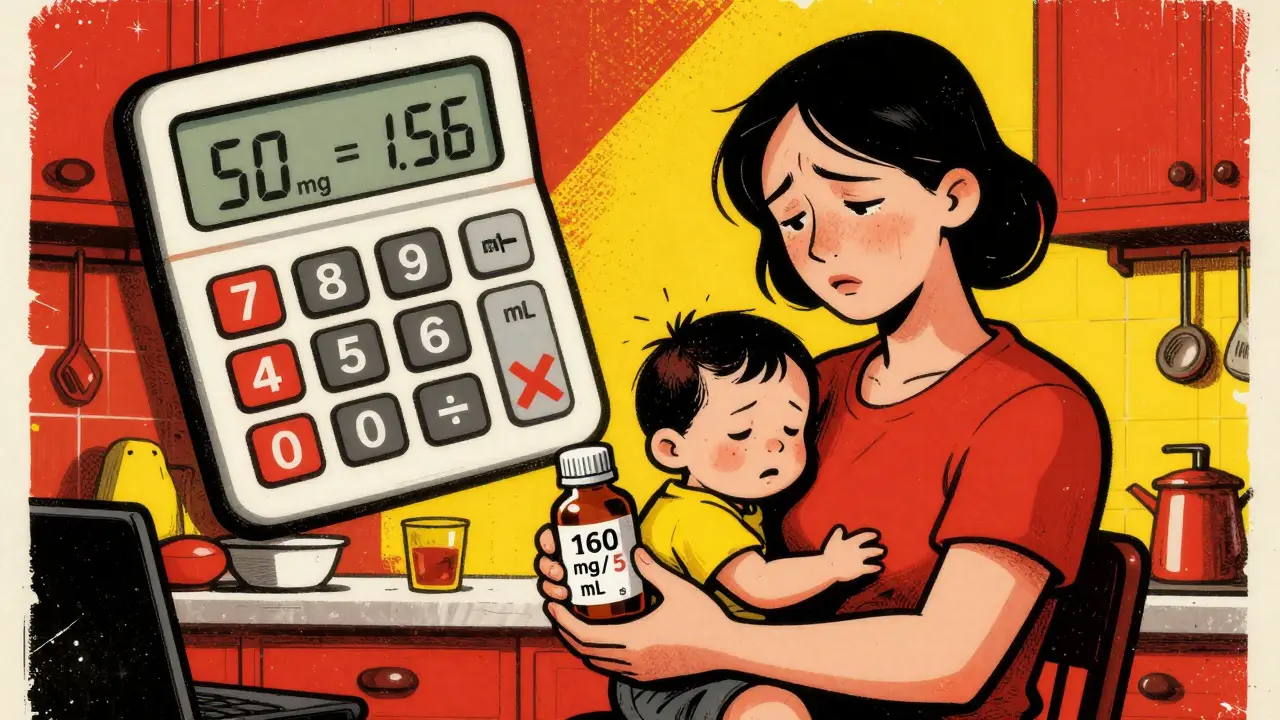
Adults take pills. Kids get liquids. And liquids are where things go wrong.Imagine this: Your 18-month-old has a fever. The doctor says, "Give 5 mg per kilogram of acetaminophen." You’re tired. The bottle says "160 mg per 5 mL." Your child weighs 10 kg. That’s 50 mg total. But how many milliliters is that? If you guess, you’re risking a 10-fold overdose. That’s not theory. That’s a real case from a 2019 emergency report-a mother gave 5 mL thinking it was the dose, not realizing she needed to calculate it based on weight. Her child ended up in the ICU.
Weight-based dosing is the norm for kids. But most parents don’t have a calculator handy. And even nurses, under pressure, can miscalculate. Studies show 20-35% of pediatric medication errors come from simple math mistakes. One wrong decimal point. One misread zero. One confused milligram with milliliter.
And it’s not just the hospital. At home, 60-80% of dosing errors happen with liquid medicines. Parents use kitchen spoons. They mix up infant and children’s concentrations. They don’t realize "children’s Tylenol" and "infant Tylenol" have different strengths. One Reddit parent wrote: "I gave my 2-year-old 5 mL of children’s Tylenol instead of infant concentrate. My pediatrician called me back two hours later. I had no idea they were different."
The Hidden Numbers
The official numbers don’t tell the whole story. Hospitals only report about 10-30% of actual errors. Most slip through because no one notices-or no one reports. A 2004 study found syringes with wrong concentrations hidden in drawers, unnoticed until someone analyzed them. That’s the tip of the iceberg.
Here’s what the data shows:
- 31% of pediatric patients experience a medication error in the ER-compared to 13% in adults.
- 13% of those errors cause actual harm. Another 47% reach the child but don’t hurt them. The rest are caught before they matter.
- Wrong dose is the #1 error-13% of all pediatric safety events.
- 1 in 10 parents of children with leukemia make dosing errors at home.
- Parents with low health literacy make errors 2.3 times more often.
- Non-English-speaking families have a 45% dosing error rate-nearly double that of English-speaking families.
And it’s not just about knowledge. It’s about access. Medicaid-enrolled kids have 27% higher error rates. Families without reliable transportation, stable housing, or consistent healthcare are at the greatest risk.
What Happens in the Emergency Room
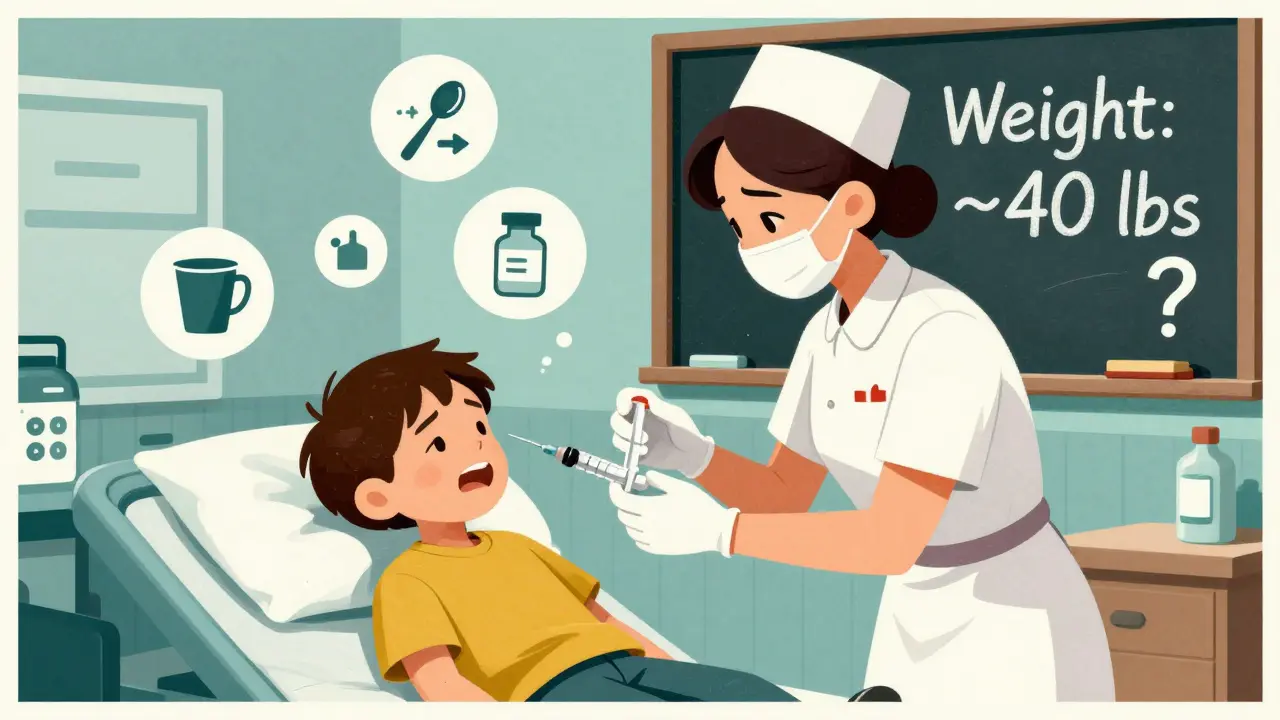
Picture this: A 4-year-old arrives with a seizure. The triage nurse doesn’t have the child’s weight. The parents say "about 40 pounds." The doctor gives a verbal order. The nurse grabs a vial of midazolam. No double-check. No pharmacy review. No electronic alert. Ten minutes later, the child is stable-but the system almost failed.
Emergency departments are chaotic. Time is short. Staff are stretched thin. Pediatric cases are often outnumbered by adults. Most general ERs aren’t built for kids. They don’t have pediatric-specific dosing calculators. They don’t have pharmacists on-site 24/7. They use adult-sized syringes and adult charts. That’s dangerous.
At dedicated children’s hospitals, things are different. Nationwide Children’s Hospital cut harmful medication events by 85% using three simple rules:
- Every child’s weight is measured and entered into the system before any med is ordered.
- High-risk meds like sedatives and opioids require two staff members to verify the dose.
- All pediatric orders are checked by a pharmacist before being given.
That’s not luxury. That’s basic safety. But only 68% of children’s hospitals have automated dosing tools. In community ERs? Less than 30%.
What Works: Real Solutions That Save Lives
There’s good news. We know what fixes this.
The MEDS intervention-a 90-second change in discharge instructions-reduced dosing errors from 64.7% to 49.2%. How? They gave parents:
- Clear pictograms showing how much to give
- One measuring device (a syringe, not a cup)
- A "teach-back" moment: "Can you show me how you’ll give this?"
It’s not expensive. It doesn’t need new tech. Just time. And attention.
Another win: Standardized measuring tools. Parents who used the syringe provided by the hospital had 35-45% fewer errors than those who used spoons or cups. That’s huge. And yet, many ERs still hand out cups because they’re cheaper.
Language matters too. Spanish-speaking families had 32% higher error rates-even when given translated instructions. Why? Because translation isn’t enough. You need cultural context. You need to explain why the dose is small. You need to show them how to hold the syringe. You need to ask, "Do you have a way to measure this at home?"
What Parents Can Do Right Now
You don’t need to be a doctor to keep your child safe. Here’s what works:
- Always ask for the dose in milligrams per kilogram. Write it down. Don’t trust memory.
- Use the syringe that comes with the medicine. Never use a teaspoon or tablespoon.
- Confirm the concentration. Is it 160 mg/5 mL? Or 80 mg/5 mL? They’re not the same.
- Ask the nurse or doctor: "Can you show me how to give this?" Then do it in front of them.
- Keep a list of all meds your child takes. Even over-the-counter ones. Bring it to every visit.
- If you’re unsure, call your pediatrician. Better safe than sorry.
One parent told me: "I used to think giving extra medicine would help my kid feel better faster. Now I know it can hurt them worse. I keep a note on my phone: ‘5 mg/kg. Not 5 mL.’"
The Bigger Picture
This isn’t just about individual mistakes. It’s about broken systems.
Medication errors cost the U.S. $28 million a year in pediatric ER visits alone. That’s 63,000 children-many of them from families who can’t afford to miss work, who don’t have a car, who don’t speak the language. We’re punishing the vulnerable for a system that wasn’t designed for them.
The American Academy of Pediatrics says medication safety is one of their top five priorities. But they also admit: we don’t have good ways to measure outpatient errors. We don’t track them like we track infections or falls. Until we do, we won’t fix them.
Changes are coming. By 2025, they plan to roll out standardized metrics for pediatric medication safety. That’s progress. But until then, every ER, every clinic, every pharmacy needs to treat pediatric dosing like it’s a bomb defusal-because for a child, it is.
What’s Next
Here’s the hard truth: We won’t eliminate all errors. But we can slash them. By 80%. By 90%. We’ve already proven it’s possible.
It starts with asking the right questions. With measuring weight every time. With giving parents the right tools. With listening when they say, "I don’t understand."
The next time your child needs medicine in an emergency, don’t assume someone else has it covered. Ask. Double-check. Speak up. Because in pediatric emergencies, the difference between safety and harm is often just one clear conversation.
Christine Joy Chicano
January 6, 2026 AT 12:43It’s wild how something so simple-like a syringe instead of a spoon-can save a kid’s life. I never realized how many parents are just guessing because the instructions are written like a legal contract. The pictograms and teach-back method? Genius. No tech, no cost, just humanity. Why isn’t this standard everywhere?
steve rumsford
January 7, 2026 AT 13:46my kid had a fever last winter and i just used a kitchen spoon. i thought it was fine. turns out i could’ve killed him. thanks for this. i’m throwing out all my measuring cups.
Mina Murray
January 8, 2026 AT 21:12Of course this is happening. The pharmaceutical industry doesn’t want parents to be too smart. They profit from confusion. Look at the difference between infant and children’s Tylenol-same company, different bottles, same active ingredient. It’s not an accident. It’s a business model. And don’t get me started on how hospitals use adult syringes for kids. This isn’t negligence. It’s exploitation.
Adam Gainski
January 10, 2026 AT 20:44I work in a community ER and we’re trying to implement the MEDS protocol. It’s slow going-staffing, budget, training-but the change is real. We started handing out syringes with every prescription and asking parents to demonstrate dosing. Error rates dropped 40% in six months. It’s not magic. It’s just doing the basics right. We need more funding, not more regulations.
Elen Pihlap
January 12, 2026 AT 04:19my baby almost died because of a typo on the bottle. they wrote 160mg/5ml but it was actually 80mg/5ml and no one caught it. now i don’t trust any label. not even the ones with big fonts. i take pictures of every bottle and send them to my sister who’s a nurse. she says i’m paranoid. i say i’m alive.
Sai Ganesh
January 12, 2026 AT 11:41In India, we don’t have the same access to pediatric specialists, but we’ve learned to adapt. Many families use a traditional measuring spoon called a "chammach"-but we’ve started teaching them to use insulin syringes, which are cheap and accurate. Cultural context matters. A doctor in Delhi showed me a video of a mother using a syringe with her toddler. She smiled. That’s progress.
Katrina Morris
January 12, 2026 AT 14:46i had no idea 1 in 10 parents of kids with leukemia mess up dosing at home… i’m crying. my cousin’s daughter had cancer and we were all so scared to give the meds right. nobody told us how to check the concentration. i wish someone had just sat us down and said "here, this is how you do it"
Andrew N
January 13, 2026 AT 06:45the data is skewed. most errors happen because parents are lazy. they don’t read labels. they use spoons. they don’t weigh their kids. stop blaming the system. fix the parents.
Christine Joy Chicano
January 14, 2026 AT 10:50So you think the solution is to shame parents who are exhausted, under-resourced, and told by their doctor to "give 5 mg per kg" without a calculator? That’s not fixing the system. That’s blaming the victim. The system gave them the tools of a third-grader and expected a PhD.
LALITA KUDIYA
January 15, 2026 AT 05:53in india we use a lot of herbal remedies but when we do use medicine we always ask the pharmacist to show us how to measure. i think this is why our error rate is lower than you think. it’s not about money. it’s about asking. 🙏
Poppy Newman
January 16, 2026 AT 16:16just read this while holding my 18-month-old who’s on antibiotics… and i’m sweating. i used a spoon last time. 😳 i’m buying a syringe right now. thank you for this. i didn’t know i was playing russian roulette.
Aparna karwande
January 18, 2026 AT 02:23This is why America is failing. We don’t teach basic math in schools anymore. We let corporations design medicine labels to confuse people. We don’t train nurses properly. And now we’re surprised when kids get hurt? This is the inevitable result of a society that values profit over life. Shame on every hospital that still uses adult syringes. Shame on every pharmacy that doesn’t hand out measuring tools. This is not an accident. This is negligence dressed as policy.