
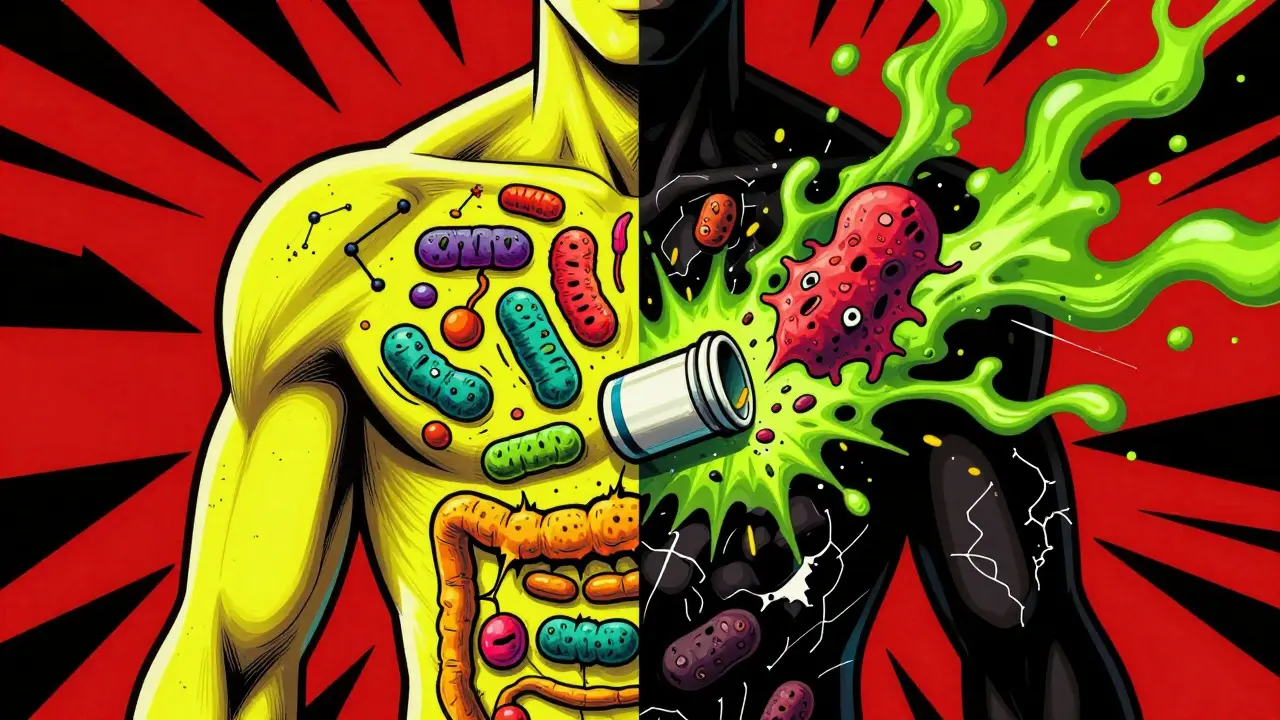
When antibiotics go wrong, they don’t just kill bad bacteria-they wreck your gut. For thousands of people every year, a simple course of antibiotics leads to something far worse than an upset stomach: C. difficile colitis. It starts with diarrhea, but it can spiral into hospitalization, repeated infections, and even death. And here’s the twist: the very drugs meant to help you are often the ones making it worse.
What Exactly Is C. difficile Colitis?
Clostridioides difficile, or C. diff, is a bacterium that lives quietly in some people’s guts without causing trouble. But when antibiotics wipe out the good bacteria that keep it in check, C. diff takes over. It releases toxins that attack the colon lining, causing severe diarrhea, cramping, fever, and in worst cases, colon rupture or sepsis.
This isn’t rare. In the U.S. alone, about 500,000 people get C. diff infections each year, and nearly 30,000 die from complications. The CDC calls it an “urgent threat.” It’s not just a hospital problem anymore-nearly half of new cases happen in people who haven’t been hospitalized. You can get it after taking antibiotics at your doctor’s office, pharmacy, or even just from being around someone who’s infected.
Which Antibiotics Are Most Likely to Trigger C. diff?
Not all antibiotics carry the same risk. Some are like sledgehammers to your gut flora; others are more like scalpels.
Research from JAMA Network Open analyzed over 33,000 hospital stays and found that certain antibiotics dramatically increase your chances of getting C. diff:
- Piperacillin-tazobactam (a type of BLBLI) - highest risk, nearly 2.2 times more likely to cause C. diff than other antibiotics.
- Carbapenems and third- and fourth-generation cephalosporins - also top offenders.
- Clindamycin - one of the worst offenders, even outside hospitals. It’s still prescribed for acne and dental infections, despite decades of evidence showing its danger.
On the other end of the spectrum, tetracyclines like doxycycline carry the lowest risk. That doesn’t mean they’re harmless-but if you need an antibiotic and have a history of C. diff, your doctor might consider one of these instead.
Here’s the scary part: every extra day you’re on antibiotics increases your risk by 8%. The risk doesn’t rise steadily-it spikes after about 14 days. That’s why guidelines now say: review your antibiotics within 48 to 72 hours. If you don’t need them anymore, stop.
Why Stopping Antibiotics Can Be the Best Treatment
If you’re diagnosed with C. diff and you’re still taking the antibiotic that caused it, you’re making things worse. Continuing the drug keeps your gut environment hostile to good bacteria, letting C. diff thrive.
The Infectious Diseases Society of America says clearly: stop the offending antibiotic if you can. For many people, just stopping it is enough. Their gut recovers naturally, and the infection clears up on its own.
But not everyone gets that lucky. Some people need more help.
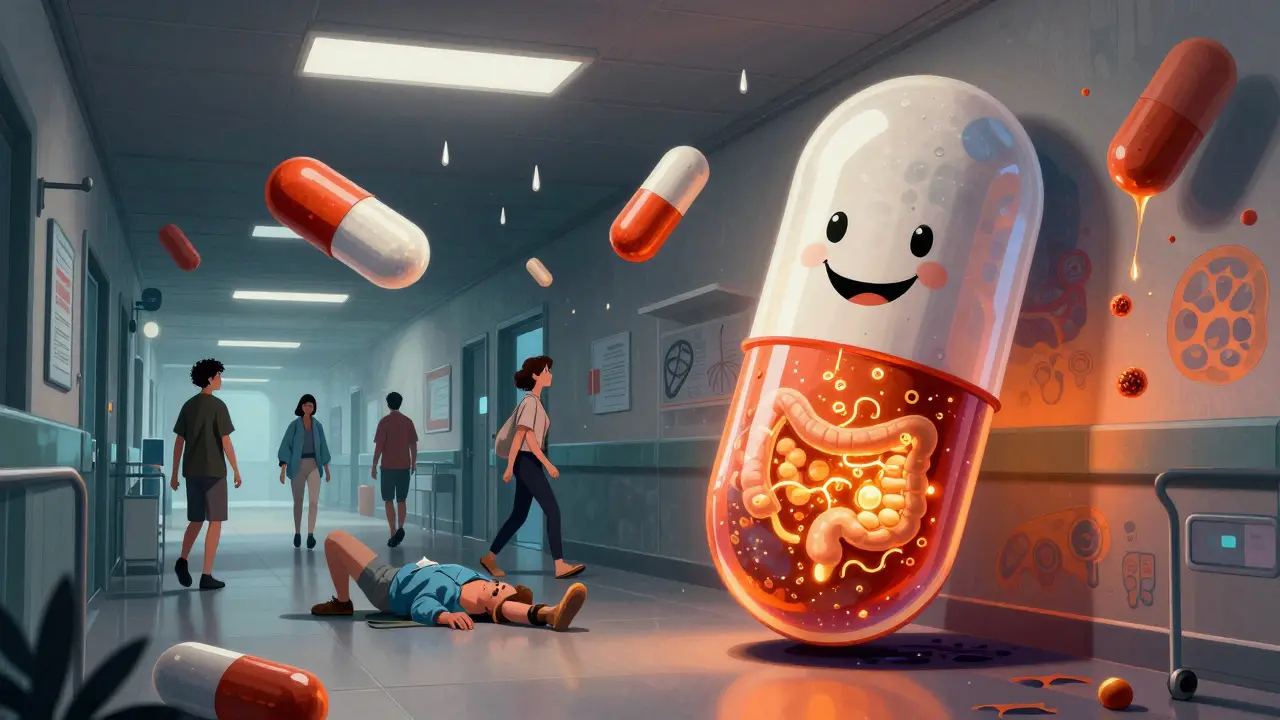
Fecal Transplant: A Radical Cure for Recurrent Infections
If you’ve had C. diff two or three times, standard antibiotics like vancomycin or fidaxomicin often fail. That’s where fecal microbiota transplantation (FMT)-commonly called a fecal transplant-comes in.
It sounds gross, but it’s science. The idea is simple: take healthy stool from a screened donor, process it, and put it into your colon. The good bacteria from the donor crowd out the C. diff and restore balance.
A landmark 2013 study in the New England Journal of Medicine showed FMT cured 94% of patients with recurrent C. diff after just one or two treatments. Compare that to vancomycin, which worked in only 31% of cases. That’s not a small improvement-it’s a revolution.
Today, the American Gastroenterological Association recommends FMT for anyone with three or more recurrences. Success rates? 85% to 90%.
There are different ways to deliver it:
- Colonoscopy - most common (about 65% of cases). Gives direct access to the colon.
- Enema - less invasive, used in outpatient settings (20%).
- Oral capsules - frozen, pill-form stool. Increasingly popular because it’s easy and private (15%).
And it’s no longer just a lab experiment. The FDA approved two standardized FMT products in 2022 and 2023: Rebyota and Vowst. These are manufactured, tested, and shipped like regular medicines. No more hunting for donors. No more “yuck factor.” Just science, packaged.
What About Probiotics?
You’ve probably heard that probiotics can help. Yogurt, kefir, supplements-they’re everywhere. But here’s the truth: the evidence doesn’t support them for preventing or treating C. diff.
The IDSA says there’s not enough proof to recommend probiotics. Worse, in people with weakened immune systems, probiotics have been linked to dangerous bloodstream infections. One small study suggested kefir might help, but it was tiny and not replicated. Don’t rely on it.
There’s one exception: bezlotoxumab. It’s not a probiotic-it’s a monoclonal antibody that neutralizes one of C. diff’s main toxins. When given alongside antibiotics, it cuts recurrence risk by 10%. It’s expensive ($3,700 per dose), but for high-risk patients, it’s worth it.
Costs, Access, and the Bigger Picture
FMT isn’t cheap. In the U.S., a single procedure can cost $1,500 to $3,000. But compare that to the cost of a single hospital stay for recurrent C. diff: around $11,000. And if you have three recurrences? You’re looking at $33,000 in hospital bills alone.
That’s why hospitals are investing in FMT programs. In 2015, only 5% of U.S. hospitals offered it. Now, 35% do. Insurance usually covers it for recurrent cases.
And the market is growing fast. The global market for C. diff treatments hit $1.2 billion in 2023. New oral therapies like SER-109 (a purified microbiome pill) are in late-stage trials, with 88% success rates. They’re designed to replace traditional FMT entirely-no stool, no colonoscopy, just a pill.
What You Can Do Right Now
If you’re on antibiotics:
- Ask your doctor: “Is this really necessary?”
- Ask: “Can we use a narrower-spectrum antibiotic?”
- Ask: “Can we stop it in 5-7 days instead of 10?”
If you’ve had C. diff before:
- Keep a record. Tell every doctor you’ve had it.
- Avoid clindamycin, fluoroquinolones, and broad-spectrum cephalosporins if possible.
- Know your options. If it comes back, FMT isn’t a last resort-it’s the best chance for long-term recovery.
And if you’re caring for someone with C. diff: wash your hands with soap and water. Alcohol-based sanitizers don’t kill C. diff spores. Only soap and water will.
Why This Matters Beyond the Hospital
C. diff isn’t just a medical problem-it’s a system problem. We overprescribe antibiotics. We don’t monitor them. We treat symptoms instead of the root cause: a broken gut microbiome.
But the tide is turning. Antibiotic stewardship programs are now required in U.S. hospitals. FMT is becoming mainstream. New microbiome therapies are coming fast.
The goal isn’t just to treat C. diff-it’s to prevent it. And that means rethinking how we use antibiotics altogether.
Can C. diff go away on its own without treatment?
Yes, in some cases. If the infection is mild and you stop the antibiotic that triggered it, your body can often clear C. diff naturally. The gut microbiome can recover on its own, especially in younger, healthier people. But if symptoms are severe-high fever, bloody stool, severe pain-you need medical treatment. Waiting too long can lead to life-threatening complications.
Is fecal transplant safe?
When done through approved programs, yes. Donors are rigorously screened for infections like HIV, hepatitis, and other gut pathogens. The FDA requires this for both donor stool and commercial products like Rebyota. The biggest risk is temporary bloating or diarrhea after the procedure. Long-term risks, like changes in weight or mood, are still being studied, but no major safety issues have been confirmed in large trials. The benefits far outweigh the risks for recurrent C. diff.
Can you get C. diff from food or water?
Not directly. C. diff spores aren’t typically spread through food or water. The main route is person-to-person contact-especially in healthcare settings. Spores can live on surfaces like doorknobs, bed rails, or toilets for months. If you touch a contaminated surface and then touch your mouth, you can get infected. That’s why handwashing with soap is critical. It’s not about what you eat-it’s about what you touch.
Are there alternatives to fecal transplant for recurrent C. diff?
Yes, but they’re less effective. Fidaxomicin is better than vancomycin for first-time recurrence, with a higher cure rate. Bezlotoxumab, an antibody injection, reduces recurrence by 10% when used with antibiotics. But neither matches FMT’s 85-90% success rate. New oral microbiome pills like SER-109 are showing promise in trials, with results close to FMT. These may replace traditional FMT in the next few years.
How long does it take to recover after a fecal transplant?
Most people see improvement within 24 to 48 hours. Diarrhea stops, energy returns, and cramping fades. Full recovery of the gut microbiome can take weeks to months, but you’re usually symptom-free within days. You can typically resume normal activities the same day if you had capsules or an enema. Colonoscopy delivery might require a day of rest. Follow-up is usually minimal unless symptoms return.
Kayleigh Campbell
December 15, 2025 AT 07:02And FMT? Sounds like something out of a sci-fi horror movie, but hey, if it works, I’m not judging. Science is weird sometimes.
Randolph Rickman
December 15, 2025 AT 13:44Also, Rebyota and Vowst? That’s the future. No more ‘gross stool’ stigma. Just medicine. Finally.
SHAMSHEER SHAIKH
December 16, 2025 AT 04:25James Rayner
December 17, 2025 AT 22:21It wasn’t magic. It was science. And it worked. I’m not even embarrassed to say it anymore. I tell people now. It’s not gross. It’s healing.
And yeah, I cry every time I think about how close I came to not being here.
sue spark
December 18, 2025 AT 06:26anthony epps
December 19, 2025 AT 12:57Dan Padgett
December 19, 2025 AT 19:48Andrew Sychev
December 21, 2025 AT 17:46Colleen Bigelow
December 22, 2025 AT 18:33Billy Poling
December 24, 2025 AT 11:39Aditya Kumar
December 24, 2025 AT 14:04Tiffany Machelski
December 25, 2025 AT 11:09Josias Ariel Mahlangu
December 26, 2025 AT 23:42