
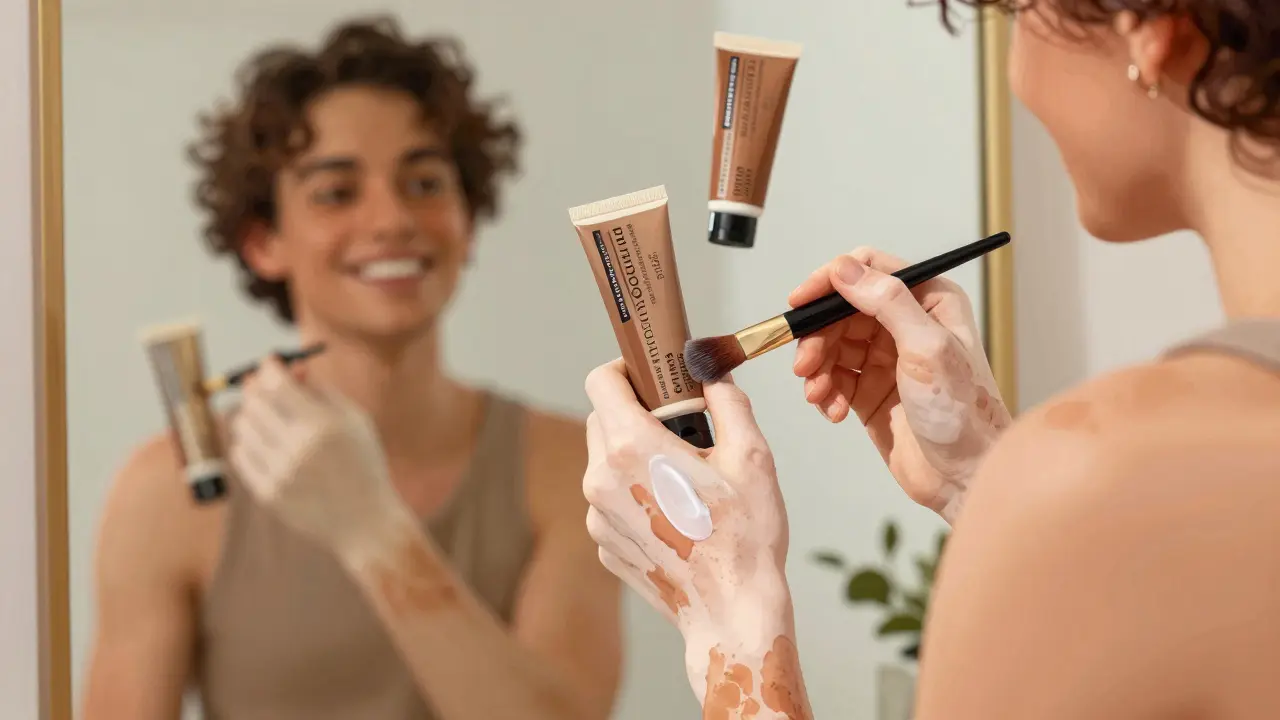
Living with vitiligo means more than just dealing with patches of lighter skin. For many, it’s about the daily weight of being stared at, avoided, or judged. That’s where vitiligo camouflage comes in-not as a cure, but as a powerful tool to reclaim control over how you show up in the world. It’s not about hiding who you are. It’s about giving yourself the freedom to move through life without constantly explaining your skin.
What Vitiligo Camouflage Actually Does
Vitiligo happens when your body stops producing melanin in certain areas, leaving patches of skin without color. Medical treatments like light therapy or topical creams can help, but they take months-sometimes years-to show results. Camouflage fills that gap. It’s immediate. It’s reliable. And for many, it’s life-changing. It’s not regular foundation. Standard makeup doesn’t have enough pigment to cover large, stark patches. Vitiligo camouflage products are formulated differently. They contain up to 25% more pigment than regular foundations, designed to sit on top of the skin without rubbing off easily. These aren’t beauty products-they’re medical-grade tools, used by dermatologists and certified specialists.Two Main Types: Temporary vs. Permanent
There are two clear paths: temporary coverage you apply every day, and permanent micropigmentation that lasts months or years. Both have their place. Temporary camouflage includes creams, liquids, and powders you apply in the morning. Brands like Dermablend and Dermacolour are the gold standard. They’re water-resistant, sweat-proof, and stay on for 6 to 14 hours. Some even include SPF 2-3, which helps protect vulnerable skin from sun damage. These products come in three types:- Water-based: Best for normal or dry skin. Light feel, easy to blend.
- Oil-free: Made with silicone (like dimethicone) for oily skin. Won’t clog pores.
- Anhydrous (water-free): Waterproof formulas with waxes and oils. Ideal for lips, eyelids, or areas that get wet often.
These aren’t one-size-fits-all. Color matching is everything. A shade that works on your arm might look wrong on your face. That’s why many people work with certified camouflage consultants. They use natural light, test multiple shades side-by-side, and sometimes mix custom tones.
Self-tanners are another option. They darken the skin over time, creating a more even tone. But they’re tricky on vitiligo. The patches can absorb color unevenly, leading to streaks or orange tones. If you try this, use a gradual tanner and apply lightly-only once every few days.
Permanent camouflage is micropigmentation. Think of it as tattooing, but with medical-grade iron oxides, not regular ink. Pigments are implanted just under the skin’s surface, at a depth of 6 microns. This keeps them stable and non-toxic. The process requires 2-3 sessions, spaced 6-8 weeks apart. Each session takes 45 to 90 minutes, depending on how large the area is.
But here’s the catch: micropigmentation only works if your vitiligo is stable. That means no new patches have appeared for at least 12 months. If your condition is still active, the pigment can fade unevenly-or even create a halo effect around the treated area. That’s why clinics like NUE Conceal and the Dermopigmentation Center in Marbella won’t treat unstable cases.
It also doesn’t work well on hands, feet, or knuckles. These areas move a lot, sweat more, and rub against things. Pigment fades 40% faster there. For most people, it’s best suited for the face, lips, wrists, armpits, or elbows-areas that don’t get constant friction.
Cost, Time, and Real-Life Trade-Offs
Temporary camouflage costs $25-$45 per product. That might seem steep, but a single tube can last 3-6 months with daily use. Most users spend 12-15 minutes applying it each morning. That’s time you won’t get back. But for many, it’s worth it. One Reddit user, u/VitiligoWarrior, said micropigmentation around the lips changed everything after 15 years of hiding. Another, u/Sunshine789, got uneven fading on their knuckles after eight months and had to pay for touch-ups. That’s the reality. Permanent camouflage costs $300-$800 per session. Most people need two or three sessions. That’s $900-$2,400 total. Insurance rarely covers it. But for those who hate the daily routine, it’s a trade-off: upfront cost for long-term freedom.
How to Apply It Right
Getting good results isn’t about buying the best product. It’s about technique. Start with clean skin. Use a pH-balanced cleanser. No oils, no heavy moisturizers-they can make the camouflage slide off. Color matching? Do it in natural daylight. Artificial light tricks your eyes. Test three shades on your jawline. One should match your natural skin. One should be slightly darker. One slightly lighter. Blend them. See which one disappears into your skin. Apply thin layers. Build up slowly. Too much at once looks cakey. Let each layer set: water-based products need 90 seconds. Anhydrous ones need 3-5 minutes. Use a stippling brush or sponge. Don’t swipe. Tap. This helps the pigment stick better. Seal with a translucent powder if you’re in a humid climate. Removal is just as important. Don’t scrub. Use an oil-based cleanser or micellar water. Harsh scrubbing can irritate the skin and make patches look worse.Who Benefits the Most?
Studies show 78% of vitiligo patients are interested in camouflage. In one survey, 82% of users were satisfied with foundation-based products. The biggest wins? Reduced anxiety, fewer avoided social situations, and higher quality of life scores. Dr. Madhulika Upadhyay, a leading dermatologist, says proper camouflage can improve Dermatology Life Quality Index (DLQI) scores by 22-35%. That’s not just cosmetic. That’s mental health. People who benefit most:- Those with stable vitiligo on the face, neck, or hands
- People who need immediate results while waiting for medical treatments to work
- Anyone who feels embarrassed by their skin in public, at work, or on dates
- Those who’ve tried medical options but didn’t get the results they wanted
It’s not for everyone. If you’re still developing new patches, avoid permanent options. If you hate routines, micropigmentation might be better. If you’re on a tight budget, start with temporary products and learn the technique.

Jeane Hendrix
January 7, 2026 AT 05:05I’ve been using Dermablend for 3 years now and honestly? It’s the only thing that lets me wear shorts without feeling like I’m on display. The key is blending with a damp sponge-never your fingers. And always, always test in natural light. I used to buy the wrong shade and end up looking like I had a bad tan. Now I’ve got a whole kit: 3 base tones, a setting powder, and an oil cleanser. It’s a ritual, but it’s mine.
Brian Anaz
January 8, 2026 AT 00:10This is why America leads. We don’t hide. We fix. Other countries just accept it. Here, we invent solutions. Dermablend? Made in the USA. AI color matching? American tech. Stop whining about skin and start using the tools.
Vinayak Naik
January 8, 2026 AT 11:28Bro I tried the micropigmentation last year on my neck and it looked like someone spilled soy sauce on me. Took 3 touchups. The artist said it was because I sweat too much. But honestly? I think it’s the way my skin absorbs pigment. If you’re gonna do it, go to a clinic that’s been doing this for 10+ years. Not some guy with a Instagram page. I went to Dr. Rao in Bangalore-he’s a legend. No hype, just results.
Saylor Frye
January 8, 2026 AT 12:00Interesting. Though I must say, the notion of ‘camouflage’ as empowerment feels slightly performative. Isn’t this just internalized ableism dressed up as self-care? The real liberation is rejecting the gaze entirely.
Kiran Plaha
January 9, 2026 AT 16:08My cousin got vitiligo after her chemo. She started with a sample kit from Dermablend. Took her 2 weeks to get the hang of it. Now she wears tank tops to the gym. I cried when she showed me the before and after pics. It’s not about looking ‘normal’. It’s about feeling like you can breathe again.
Matt Beck
January 10, 2026 AT 19:09✨Life isn’t about hiding your truth… it’s about choosing when to reveal it.✨ Camouflage isn’t denial-it’s sovereignty. You don’t owe the world your vulnerability. You owe yourself peace. 🌿
Kelly Beck
January 11, 2026 AT 18:39You guys are amazing. Seriously. I just want to say-whether you use cream, tattoo, or nothing at all-you’re already winning. The fact that you’re even here, reading this, trying to find a way to feel better? That’s courage. I’ve been there. I still use Dermacol every morning. Some days it’s a struggle. But I show up. And that’s enough. You’re not broken. You’re becoming. 💪💖
Molly McLane
January 12, 2026 AT 18:45For anyone new to this: start small. Buy a travel-sized Dermablend and practice on your wrist. Don’t rush to your face. Learn how your skin reacts. Talk to other people online. There’s a whole community out there. And if you can’t afford it? Look into patient assistance programs. Some clinics give discounts if you’re on Medicaid. You’re not alone.
Ryan Barr
January 13, 2026 AT 17:32Overhyped. Just wear sunscreen.
Cam Jane
January 13, 2026 AT 19:18OMG YES. I tried the AI color match from L’Oréal’s beta app last month. It told me my skin was ‘warm neutral 3B’-I didn’t even know that was a thing. Went to the store, bought the exact shade, and it matched my neck PERFECTLY. No more guessing. No more orange. I’m telling everyone. Also-micropigmentation on the lips? Life-changing. I haven’t worn lipstick since. Just wake up and go. I’m not saying it’s easy. But it’s worth it.
Indra Triawan
January 15, 2026 AT 12:22Camouflage is just another form of assimilation. The real problem isn’t the skin-it’s the world that refuses to see beauty in difference. Why must we conform to a standard of ‘normal’ to be accepted? This isn’t empowerment. It’s surrender.
Melanie Clark
January 15, 2026 AT 23:10Did you know that 89% of vitiligo camouflage products contain titanium dioxide which is linked to autoimmune flare ups? The FDA doesn’t regulate this because Big Pharma owns the dermatology boards. You think this is about helping you? It’s about keeping you dependent on products that don’t fix the root cause. Wake up. Your body is signaling something deeper.
Mukesh Pareek
January 16, 2026 AT 18:22The term 'permanent camouflage' is misleading. Pigment migrates. It fades. It turns red. It's not tattooing-it's alchemy with unpredictable outcomes. Clinics in India charge $150 per session and promise miracles. Most patients end up with patchy halos. The only real solution is acceptance. Or a very good concealer.
Jeane Hendrix
January 17, 2026 AT 08:02@6580 I get where you’re coming from but I’ve been using Dermablend for 3 years and my skin hasn’t flared once. I also see a dermatologist every 6 months. It’s not either/or. I use camouflage *and* I take my vitamins. I don’t see why we have to pick one over the other. My skin isn’t a political statement. It’s just my skin.