
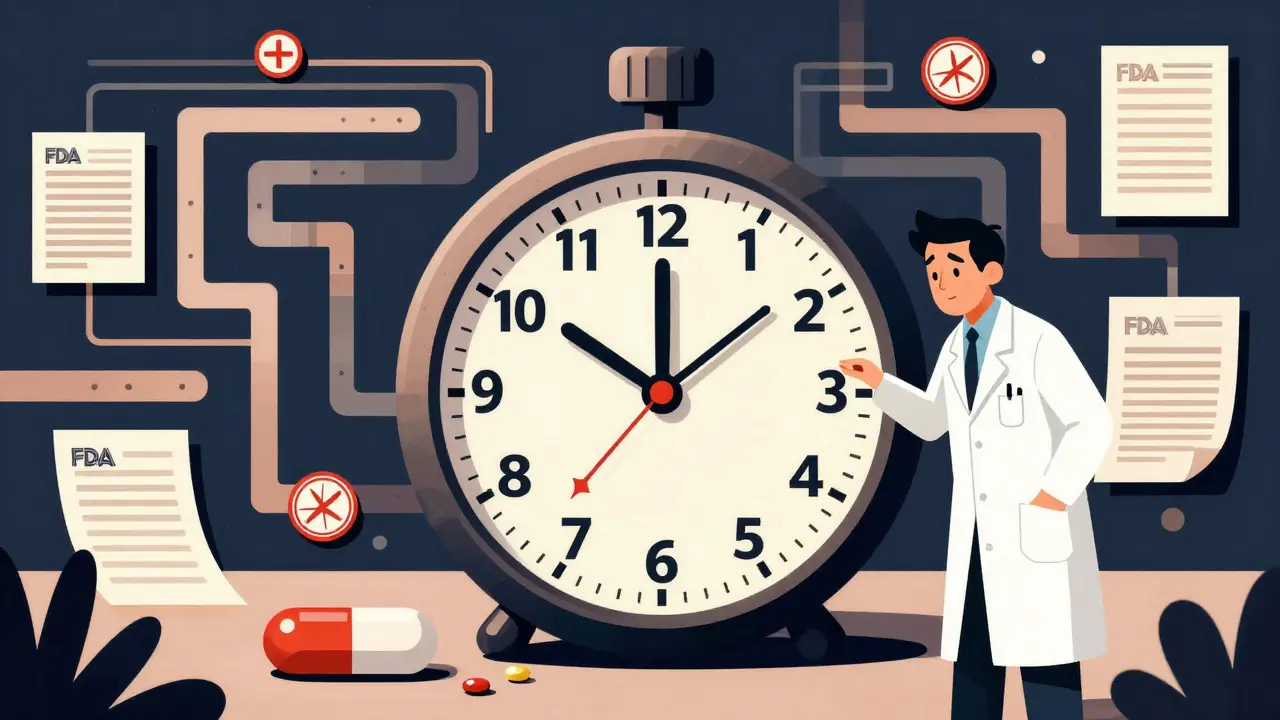
When you hear that a drug has a 20-year patent, it’s easy to assume that means 20 years of exclusive sales. But in reality, most brand-name drugs have effective patent life of just 10 to 13 years-sometimes less. That’s because the clock starts ticking long before the drug even hits the pharmacy shelf.
Here’s the catch: patent protection begins on the day the application is filed, not when the drug is approved. For pharmaceutical companies, that means years of research, pre-clinical testing, and multi-phase clinical trials happen while the patent timer is running. By the time the FDA gives final approval, half the patent term is already gone.
How the 20-Year Patent Becomes a 10-Year Monopoly
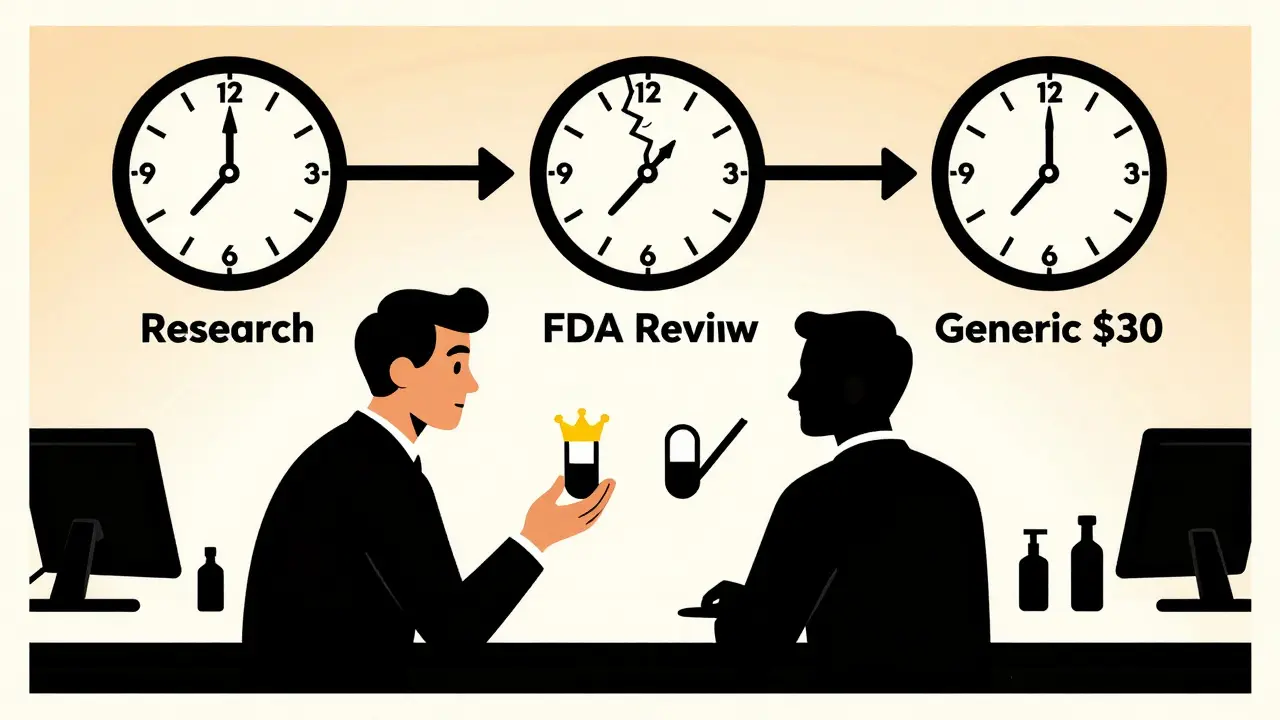
The U.S. patent system grants 20 years of protection from the earliest filing date. That sounds solid-until you look at how long drug development takes. On average, it takes 8 to 12 years to get a new drug from lab to market. Clinical trials alone can last 6 to 7 years. Add in the FDA review period, which often takes 1 to 2 years, and you’ve used up nearly half your patent before a single pill is sold.
For example, imagine a company files a patent for a new cholesterol drug in 2010. By 2018, it’s completed Phase III trials. The FDA approves it in 2020. That means by the time the drug goes on sale, only 12 years of patent life remain. If the drug launches in late 2020, the patent expires in 2030. But if the company had waited to file the patent until after approval, they’d have had the full 20 years. They can’t do that-patents must be filed early to protect intellectual property.
The Hatch-Waxman Act: A Compromise That Changed Everything
In 1984, Congress passed the Drug Price Competition and Patent Term Restoration Act-better known as the Hatch-Waxman Act. It was meant to strike a balance: reward innovation while letting generics enter the market faster. The law created two key tools:
- Patent Term Extension (PTE): Allows drugmakers to extend their patent by up to five years to make up for time lost during FDA review.
- Regulatory exclusivities: Separate protections that don’t rely on patents, like 5 years for a new chemical entity or 7 years for orphan drugs.
But here’s the limit: even with the extension, the total market exclusivity can’t go beyond 14 years after FDA approval. So if a drug gets approved in 2020, the latest it can stay exclusive is 2034-no matter how long the original patent was.
This rule was designed because lawmakers assumed most drugs would only get 14 years of exclusivity after approval. But in practice, companies have found ways around it.
Secondary Patents and the ‘Evergreening’ Game
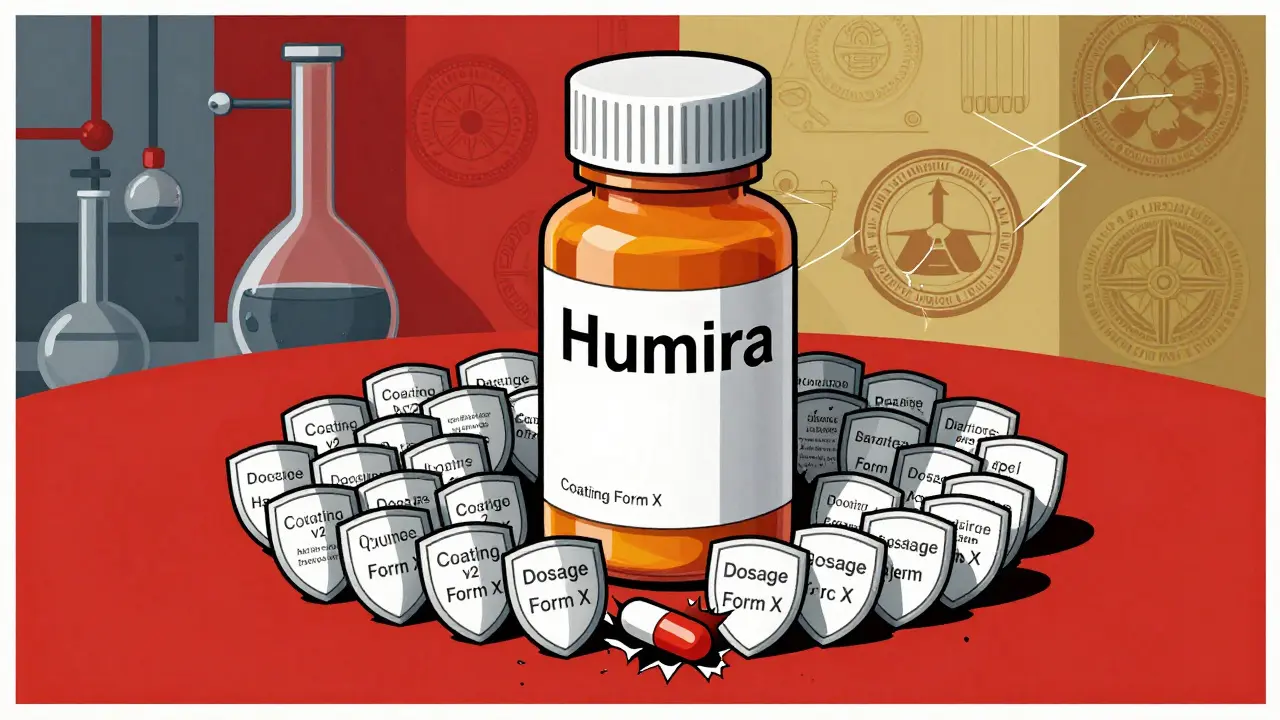
Most drugs don’t rely on just one patent. A single drug can have 20, 30, even 50 patents covering different aspects: a new tablet coating, a different dosage form, a method of use, or even a metabolite. These are called secondary patents.
Take a blockbuster drug like Humira. By the time its original patent expired, the manufacturer had filed over 100 patents covering variations of the drug. Many were granted years after approval. This practice-called ‘evergreening’-keeps generics out longer by creating a legal maze.
A 2023 study from the R Street Institute found that high-revenue drugs are 37% more likely to get these post-approval patents. The average blockbuster drug accumulates 20-30 patents. Together, they add 6 to 7 extra years of exclusivity. That’s why some drugs stay protected for 15-17 years, even though the original patent clock ran out years earlier.
What About Other Countries?
The U.S. isn’t alone in this. Canada offers a Certificate of Supplementary Protection (CSP), which gives up to 24 months of extra protection after patent expiry. Japan allows up to 5 years of patent term extension, similar to the U.S. But the rules vary. In the EU, the Supplementary Protection Certificate (SPC) can add up to 5 years, but only if the drug was first approved in the EU.
One big difference: in the U.S., regulatory exclusivities and patents run in parallel. In Europe, SPCs are tied directly to the original patent. That means the timing and strategy are different-and sometimes more predictable.
The Real Cost of Lost Exclusivity
When a drug’s exclusivity ends, prices drop fast. Generic versions typically cut the brand-name price by 80-90% within the first year. For companies, that’s a massive revenue cliff. EY estimates that by 2025, over $250 billion in global drug sales will be at risk due to patent expirations.
That’s why companies spend millions on lifecycle management: reformulating drugs into extended-release versions, adding new indications, or combining them with other drugs. These aren’t always major medical advances-they’re legal strategies to delay competition.
Managed care organizations and insurers know this. They’ve learned to anticipate patent expirations, but the complexity makes planning hard. A drug might lose its patent in 2027, but a secondary patent on a new formulation could block generics until 2029. That’s why some drugs stay expensive long after their core patent expires.
Why This Matters to Patients and Prescribers
It’s not just about corporate profits. When exclusivity ends, patients get access to cheaper generics. But when companies use patent thickets to delay competition, patients pay more for longer. In some cases, patients are stuck with brand-name drugs for years after they should have had generic options.
And it’s not just cost. The delay in generics can also slow innovation. If a drug stays protected too long, other companies can’t build on its science to create better alternatives.
Some legal challenges are already underway. Courts are starting to question whether certain secondary patents-like those covering trivial changes-are valid. The FDA is also reviewing how it lists patents in the Orange Book, which is the official directory of protected drugs. Changes here could make it harder to hide behind weak patents.
What’s Next?
The system was built for a different time. When the Hatch-Waxman Act passed, drugs took less time to develop. Today, with complex biologics and personalized therapies, development can take over 15 years. The 20-year patent term doesn’t fit.
Some experts argue for reform: extend patent terms based on actual development time, or tie exclusivity to approval date instead of filing date. Others say the real problem isn’t the patent length-it’s the abuse of secondary patents. Clearer rules on what counts as a legitimate innovation could help.
For now, the game continues. Companies are getting smarter. Regulators are catching up. And patients are waiting for the day when the system works the way it was meant to: protecting innovation without blocking access.
Brandon Vasquez
February 26, 2026 AT 12:36Full Scale Webmaster
February 28, 2026 AT 00:22Brandie Bradshaw
February 28, 2026 AT 23:54Angel Wolfe
March 2, 2026 AT 07:01Ajay Krishna
March 3, 2026 AT 00:20Charity Hanson
March 4, 2026 AT 08:45Ben Estella
March 5, 2026 AT 23:34Jimmy Quilty
March 6, 2026 AT 18:29Miranda Anderson
March 8, 2026 AT 05:44Gigi Valdez
March 8, 2026 AT 17:28