
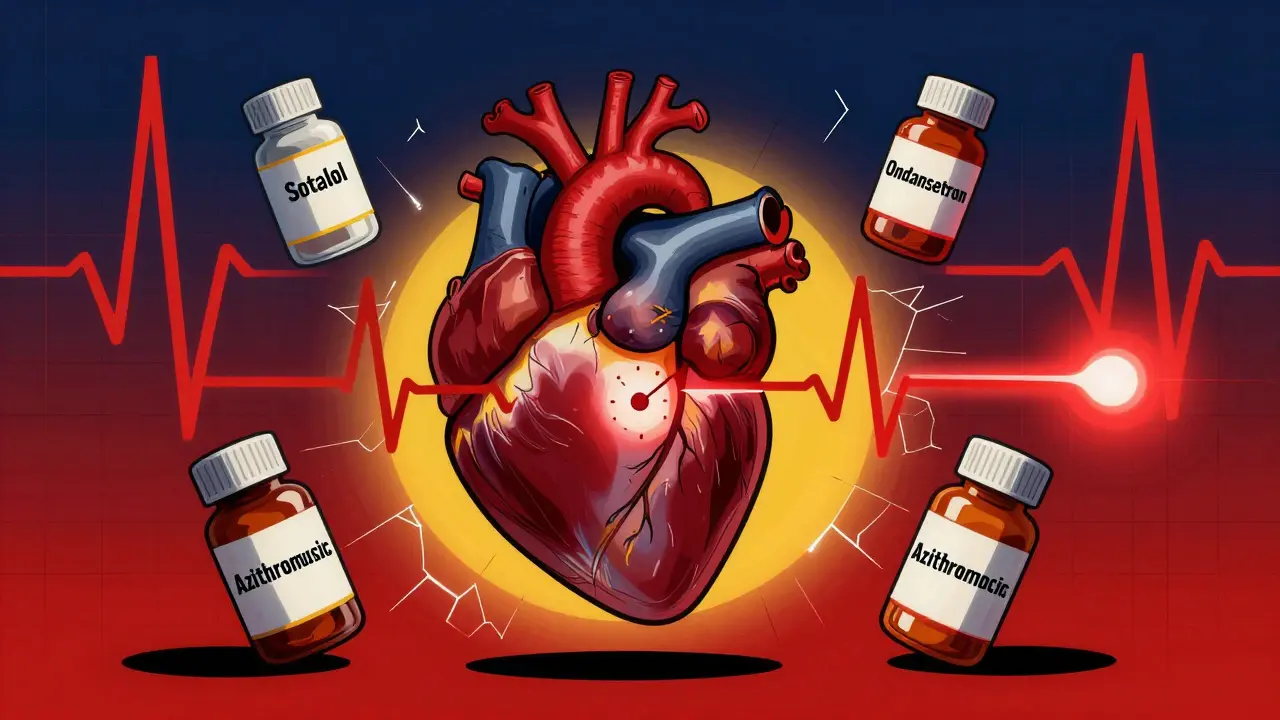
When you take a medication, you expect it to help - not to put your heart at risk. But some common drugs, even ones prescribed for everyday conditions, can quietly stretch out your heart’s electrical cycle. This is called QT prolongation. It doesn’t cause symptoms on its own. But left unchecked, it can trigger a dangerous heart rhythm called torsades de pointes - a type of ventricular tachycardia that can spiral into sudden cardiac arrest. The good news? Most cases are preventable if you know which drugs to watch for and how your body responds.
What QT Prolongation Really Means
The QT interval on an ECG measures how long it takes your heart’s lower chambers (ventricles) to recharge between beats. When this interval gets too long - usually defined as a corrected QT (QTc) over 500 milliseconds - your heart becomes electrically unstable. It’s not just about the number. A jump of more than 60 milliseconds from your baseline ECG is just as concerning. This isn’t theoretical. Studies show the risk of torsades de pointes triples when QTc exceeds 500 ms.
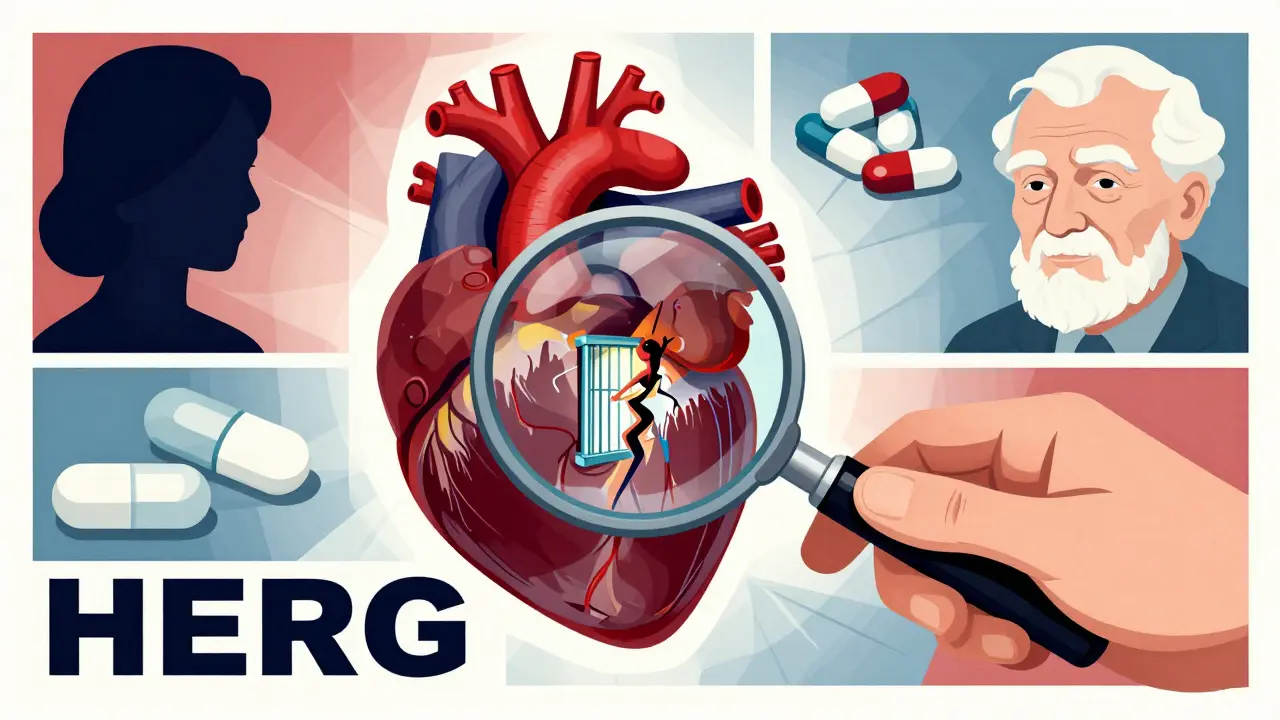
The main culprit? Drugs that block the hERG potassium channel. This channel, found in heart muscle cells, helps reset the heart’s electrical charge after each beat. When it’s blocked, the heart takes longer to recover. That delay creates a window where abnormal rhythms can start. It’s why drugs like sotalol - meant to treat arrhythmias - can ironically cause them. The same mechanism affects antibiotics, antidepressants, and even anti-nausea meds.
High-Risk Medications You Might Be Taking
Not all QT-prolonging drugs are created equal. Some are unavoidable in certain conditions, but many are prescribed without considering the bigger picture. Here’s what’s on the list:
- Class III antiarrhythmics: Sotalol, dofetilide, ibutilide. These are designed to prolong repolarization - but sotalol carries a 2-5% risk of torsades in clinical trials.
- Antibiotics: Clarithromycin and erythromycin (macrolides) can prolong QT by 15-25 ms. Even azithromycin, often thought to be safer, has been linked to cases - especially when combined with other risk factors.
- Antipsychotics: Haloperidol, ziprasidone, quetiapine. Ziprasidone has a black box warning for ventricular arrhythmias. Haloperidol is still widely used in ERs for agitation, but it’s one of the top drugs involved in documented torsades cases.
- Antiemetics: Ondansetron (Zofran). A 2020 FDA review found it implicated in 42% of reported torsades cases. It’s often given for nausea, especially after chemo or surgery - but not always with an ECG check.
- Antidepressants: Citalopram and escitalopram. The FDA capped citalopram at 40 mg/day (20 mg if over 60) because of clear dose-dependent QT prolongation.
- Opioid replacement: Methadone. Doses over 100 mg daily significantly raise risk. But many patients on maintenance therapy have no ECG monitoring at all.
- Oncology drugs: Vandetanib, nilotinib, and others. Over 40% of newer cancer drugs carry QT warnings. These are often prescribed in outpatient settings with minimal cardiac follow-up.
And it’s not just one drug. The real danger comes from stacking them. A 2017 study found that patients taking two or more QT-prolonging drugs had a 3.5 times higher risk of torsades than those on just one. A common combo? Ondansetron + azithromycin for stomach flu. That’s a recipe for a QTc spike from 440 ms to 530 ms in under 24 hours.
Who’s Most at Risk?
It’s not just about the drug. Your body matters too. Women make up about 70% of torsades cases. Why? Estrogen slows heart repolarization. That’s why postpartum women are especially vulnerable. Age matters - people over 65 have slower drug clearance. Low potassium or magnesium? That’s a red flag. Heart disease? That’s another layer. Even genetics play a role. Around 30% of drug-induced torsades cases involve inherited variants in the hERG gene. You might not know you carry them until something triggers a reaction.
And here’s the quiet truth: many people don’t even realize they’re at risk. A 2022 survey of hospital pharmacists showed that 63% struggled to predict safe drug combinations. It’s not that doctors are careless. It’s that the information is scattered, outdated, or buried in electronic health records.
How to Stay Safe
Prevention is simple - if you know what to look for.
- Know your baseline. If you’re starting a high-risk drug - like methadone, sotalol, or ondansetron - get an ECG before you begin. This gives you a reference point. If your QTc is already over 450 ms, you’re already in a higher-risk zone.
- Check for interactions. Never combine two QT-prolonging drugs unless absolutely necessary. Avoid macrolide antibiotics if you’re on an antipsychotic. Skip ondansetron if you’re taking citalopram. Use crediblemeds.org - it’s updated quarterly and free. It categorizes drugs as “Known Risk,” “Possible Risk,” or “Conditional Risk.”
- Monitor after starting. For high-risk drugs, repeat the ECG within 3-7 days. That’s when drug levels peak and QT changes are most likely to show up.
- Check electrolytes. Low potassium or magnesium? Fix them before prescribing. Simple blood tests can prevent disaster.
- Ask about alternatives. Is there a non-QT-prolonging option? For nausea, maybe promethazine instead of ondansetron. For depression, sertraline instead of citalopram. These alternatives exist - they just aren’t always considered.
One real-world example: a 65-year-old woman on citalopram 20 mg daily for depression gets admitted for vomiting. She’s given ondansetron and azithromycin. Her QTc jumps from 460 to 540 ms. She develops torsades. She survives - but barely. This isn’t rare. It happens in hospitals every week.
The Bigger Picture: Regulation and Innovation
The pharmaceutical industry is waking up. The FDA’s CiPA initiative - launched in 2013 - no longer relies solely on QT interval measurements. It now uses computer models and multi-ion channel testing to predict arrhythmia risk before a drug even hits the market. Since 2016, about 22 drugs have been shelved because of this. Each failure costs $2.6 billion - but saves lives.
Hospitals are also improving. EHR systems with built-in QT risk alerts have cut inappropriate prescribing by 58% in some networks. Still, most clinics don’t use them. And while AI-powered ECG tools can now predict torsades risk with 89% accuracy by analyzing tiny waveform details, they’re not yet standard.
The bottom line? We’ve come a long way since the 1950s, when QT prolongation was first noticed with quinidine. Today, we have the tools. We just need to use them.
What to Do If You’re on a QT-Prolonging Drug
If you’re taking any of the drugs listed above:
- Don’t stop abruptly - talk to your doctor first.
- Ask: “Has my QTc been checked? What’s my baseline?”
- Request an ECG if you’re starting a new medication and have any risk factors: female, over 65, heart disease, low potassium, or taking more than one QT-prolonging drug.
- Use crediblemeds.org to check your meds. It’s free, updated quarterly, and trusted by cardiologists worldwide.
Most people will never experience torsades. But for those who do, it often comes out of nowhere. Prevention isn’t complicated. It just takes awareness - and a little courage to ask the right questions.
Nishan Basnet
March 22, 2026 AT 02:09As someone who’s seen this play out in ERs across India, I can’t stress enough how often we miss the signs. A 72-year-old woman on citalopram gets azithromycin for a cough, and boom - torsades by day three. No ECG. No electrolyte check. Just a chart with 17 meds listed and a nurse shrugging. We’re not talking about rare cases here - it’s systemic. The real tragedy? Most of these patients are on these drugs because no one bothered to ask, ‘What’s your baseline?’
Timothy Olcott
March 22, 2026 AT 12:36YIKES 😱 I just found out my grandma’s on Zofran + azithromycin… she had food poisoning last week. I’m calling her cardiologist RIGHT NOW. This post just saved her life. THANK YOU. 🙏🇺🇸
Nicole James
March 22, 2026 AT 15:19Let’s be real - this isn’t about ‘medication risks.’ It’s about the pharmaceutical industry deliberately designing drugs that cause arrhythmias so they can sell you more drugs to fix the damage. The FDA? Complicit. EHR systems? Designed to bury alerts. CiPA? A PR stunt. And don’t get me started on how they suppressed the hERG gene data for years… because if you knew your DNA made you a walking time bomb, you’d sue them. This is all controlled. The system wants you sick. Always.
Casey Tenney
March 23, 2026 AT 22:28People die from this every day. And no one talks about it. Why? Because it’s easier to prescribe than to think. Stop being lazy. Check the QT. Check the labs. Ask the question. Your patient’s life isn’t a footnote.
Bryan Woody
March 24, 2026 AT 21:08Look, I’ve worked in cardiology for 22 years. I’ve seen 17 patients go into torsades because someone gave them ondansetron without checking their meds. Every single time, it was preventable. The problem isn’t the drugs - it’s the culture. We treat meds like candy. ‘Oh, it’s just an antibiotic’ - yeah, and it’s also a tiny bomb in your heart. Get an ECG before you scribble a script. It takes 5 minutes. Your patient’s not a beta tester.
And yes, I know you’re busy. Too bad. You’re not paid to be busy. You’re paid to save lives.
Also - crediblemeds.org is your new best friend. Bookmark it. Print it. Tape it to your monitor.
And if you’re on methadone and never had an ECG? You’re playing Russian roulette. Stop.
Shaun Wakashige
March 25, 2026 AT 11:23meh. i’ve been on zofran for 3 years. still here. guess i’m just lucky 😴
Johny Prayogi
March 25, 2026 AT 19:58This is gold. I’m a nurse and I’ve seen this firsthand. Just last month, a 58-year-old guy on quetiapine got azithromycin for bronchitis - QTc jumped from 460 to 520. We caught it because his ECG auto-flagged. If we didn’t have the alert? He’d be dead. Thanks for spelling this out so clearly. I’m printing this and taping it to our med station.
Natali Shevchenko
March 26, 2026 AT 14:34I’ve been thinking about this a lot lately - not just as a patient, but as a human. We’ve turned medicine into a checklist. ‘Prescribe. Monitor. Repeat.’ But the heart doesn’t operate on checkboxes. It’s this delicate, ancient rhythm that responds to everything - stress, salt, estrogen, a single pill you didn’t think twice about.
Maybe the real issue isn’t the drugs. Maybe it’s that we’ve forgotten how to listen. To the body. To the silence between beats. To the fact that sometimes, the quietest systems are the most fragile.
I’m not a doctor. But I’ve watched my mother die because no one checked her QT. And now I check everyone’s. Even strangers. Because silence kills. And I refuse to be silent anymore.
Paul Cuccurullo
March 27, 2026 AT 19:09Thank you for this comprehensive and deeply important overview. The level of clinical insight here is exceptional. It is imperative that healthcare providers, patients, and policymakers alike recognize the gravity of iatrogenic arrhythmia risk. I will be sharing this with my entire medical team. We must institutionalize baseline ECGs for high-risk medications. This is not optional - it is ethical.
Thomas Jensen
March 28, 2026 AT 12:20They’re lying. All of them. The FDA, the AMA, the hospitals - they know this kills people. But they’re too busy getting paid. I’ve got a cousin who died after being given methadone + ondansetron. They said ‘it’s rare.’ Rare? 42% of torsades cases? That’s not rare - that’s negligence with a corporate logo. They’re not just ignoring this - they’re profiting from it. The EHR systems? They’re designed to hide the alerts. The drugs? They’re pushed because they’re profitable. Wake up. This is a massacre. And nobody’s calling it that.
shannon kozee
March 30, 2026 AT 04:01Baseline ECG before high-risk meds. Always. Even if you think you’re fine. Even if you’re young. Even if you’re ‘just on one.’ It takes 2 minutes. Do it.
Chris Dwyer
March 30, 2026 AT 09:58Hey - if you’re reading this and you’re on one of these meds? Don’t panic. Just ask your doctor: ‘Has my QT been checked?’ That’s it. One question. You’re not being difficult. You’re being smart.
And if they say ‘it’s not necessary’? Find a new doctor. Seriously.
I’ve helped over 200 patients avoid cardiac arrest just by asking that one question. You can too. You’ve got this. And if you need help checking your meds? I’ve got a free Google Doc with all the safe alternatives. DM me. I’m here.