
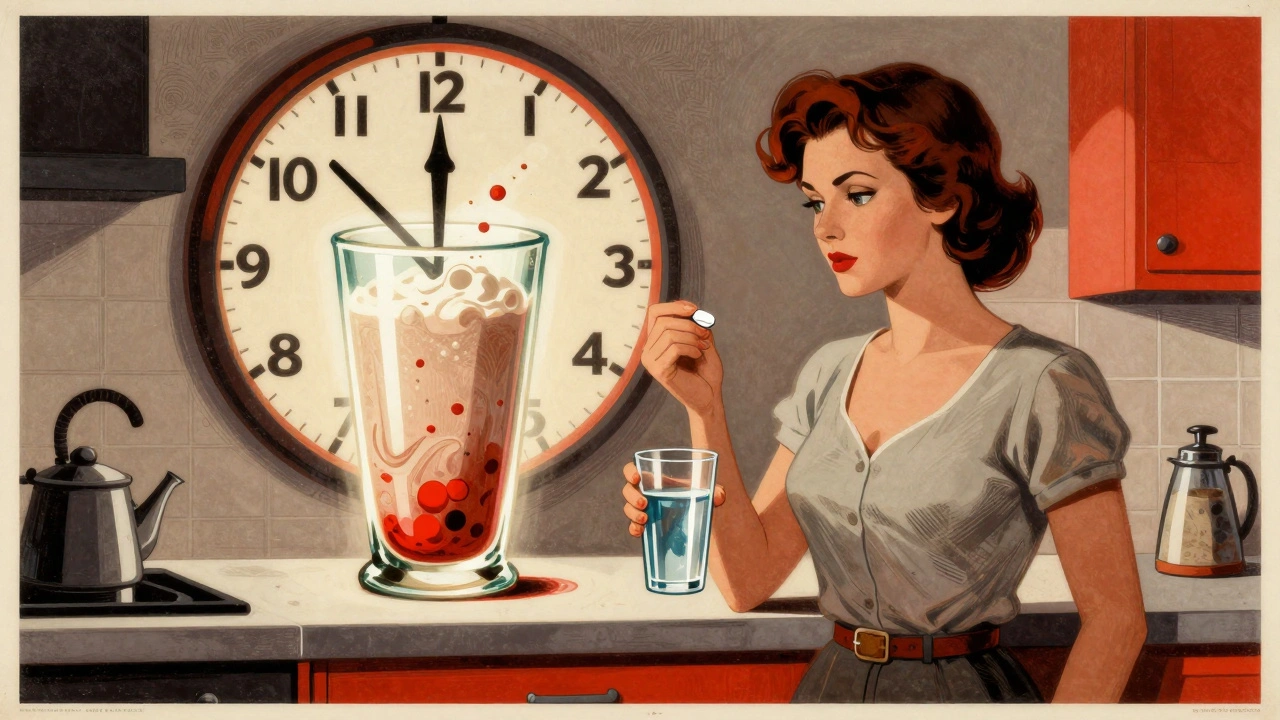
When you’re taking levothyroxine for hypothyroidism, your morning routine matters more than you think. That protein shake you grab right after waking up? It could be silently sabotaging your medication. You’re not alone - millions of people take levothyroxine daily, and many of them also rely on protein shakes to fuel their workouts or keep full through the day. But mixing the two too close together can slash how well your body absorbs the drug. The result? Fatigue, weight gain, brain fog - and a TSH level that won’t budge no matter how much you adjust your dose.
Why Protein Shakes Interfere with Levothyroxine
Levothyroxine isn’t like other pills. It needs a clear path to your small intestine to be absorbed properly. That’s why doctors tell you to take it on an empty stomach - no food, no coffee, no supplements. But protein shakes? They’re not just food. They’re thick, slow-digesting mixtures that delay how fast your stomach empties. A 2018 study in the Journal of Nutritional Science found whey protein can slow gastric emptying by up to 30%. That means your levothyroxine sits in your stomach longer, and by the time it reaches the spot where it’s supposed to be absorbed, it’s already too late.
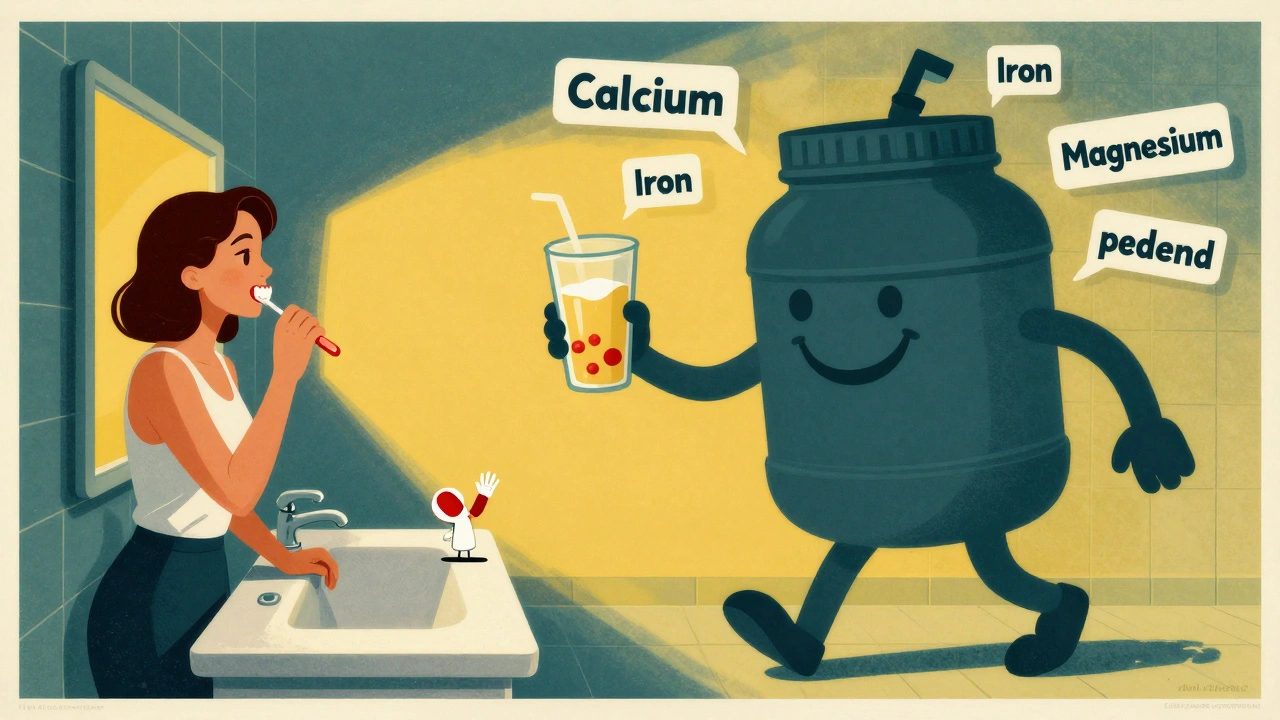
And it’s not just about timing. Many protein shakes are fortified with calcium, iron, or magnesium - all minerals that bind to levothyroxine like glue. A 2021 case report in BMJ Case Reports showed a woman’s TSH jumped from 1.8 to 15.2 mIU/L after drinking a whey protein shake just 30 minutes after her pill. Her dose didn’t change. Her shake did.
Whey protein alone can reduce absorption by as much as 30%, according to Dr. Jacqueline Jonklaas, lead author of the American Thyroid Association’s treatment guidelines. That’s not a small drop. It’s enough to push you out of the therapeutic range and into hypothyroid symptoms again.
The 4-Hour Rule: What the Science Says
The gold standard? Wait at least four hours between taking levothyroxine and consuming any protein shake. This isn’t a guess - it’s based on multiple clinical studies. The American Association of Clinical Endocrinologists (AACE) and the American Thyroid Association (ATA) both recommend this window, especially if your shake contains calcium. Why four hours? Because that’s how long it takes for your stomach and intestines to fully process the protein and clear the minerals that interfere with absorption.
A 2020 randomized trial in the Journal of General Internal Medicine followed 187 patients over six months. Those who waited four hours after taking levothyroxine before eating protein had stable TSH levels. Those who didn’t? Their TSH kept rising, and doctors had to increase their doses - even though their medication intake hadn’t changed.
Even if your shake is plain whey with no added minerals, the interference still happens. A 2023 study in the European Journal of Endocrinology compared whey to pea protein. Whey cut absorption by 28.7%. Pea protein? Only 12.3%. So if you’re stuck with a morning shake, pea protein is a better choice - but still not ideal right after your pill.
Morning Dose vs. Evening Dose: Which Works Better?
If you’re someone who can’t imagine skipping your protein shake at breakfast, here’s a game-changer: switch to taking levothyroxine at night.
A 2021 meta-analysis in the Journal of Clinical Endocrinology & Metabolism looked at over 1,200 patients. The evening group had 13.8% higher free T4 levels and 27.6% lower TSH than the morning group. Why? Because at night, your gut moves slower. That gives levothyroxine more time to absorb before food hits your system. Plus, most people aren’t eating protein after dinner - especially if they wait four hours before bed.
Here’s the catch: 78.5% of patients prefer taking it in the morning. It’s habit. It’s routine. But if your TSH is stubbornly high and you’re doing everything right - except timing your shake - switching to nighttime dosing might be the missing piece.
Studies show that when done correctly, evening dosing works just as well as morning dosing. One 2021 study found TSH levels stayed in the same healthy range (1.1-4.3 mIU/L) whether people took it at 7 a.m. or 10 p.m., as long as they waited four hours before eating.
Real People, Real Results
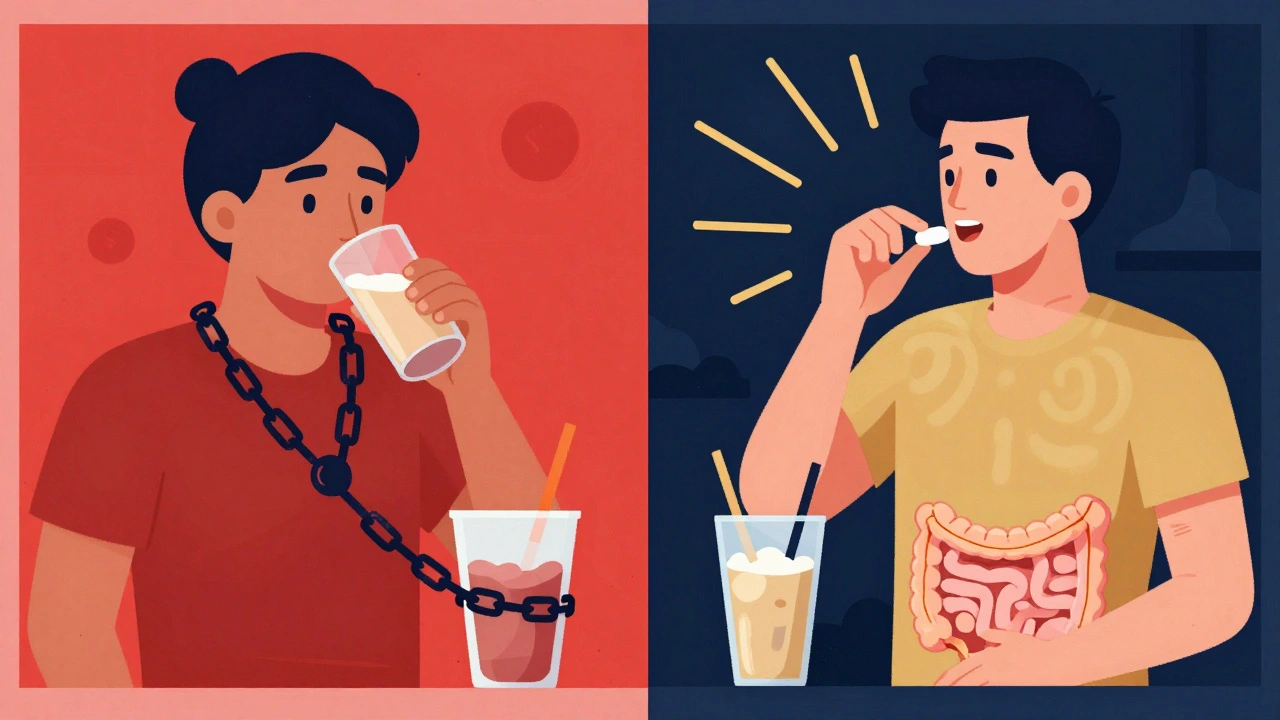
On Reddit’s r/Hypothyroidism community, over 1,200 members took a survey in 2023. Two-thirds said their TSH spiked after having protein within two hours of their pill. Nearly half ended up needing a dose adjustment.
One user, u/HypothyroidWarrior, wrote: “I’ve been on Synthroid for eight years. I thought my diet was fine. Then I found out my morning shake was the problem. I moved it to lunch and switched my pill to bedtime. In three months, my TSH dropped from 10.5 to 2.3 - no dose change.”
Another case from Thyroid UK in January 2024 showed a patient’s TSH fell from 11.4 to 2.1 in just nine weeks after waiting four hours between pill and shake. That’s not luck. That’s science.
On the flip side, 37% of people on ThyroidChange.com admitted they ignored the timing rules at first. They ended up getting their dose increased - not because they needed more medication, but because their body wasn’t absorbing it.
What to Do Instead
Here’s how to fix this without giving up your protein.
- If you take levothyroxine in the morning: Take it as soon as you wake up with a full glass of water. Wait 60 minutes before eating or drinking anything else. Then wait another three hours before having your protein shake. That’s a total of four hours. Use that time for a walk, shower, or coffee (without cream or sugar).
- If you take levothyroxine at night: Take it at least four hours after your last meal. That means if you eat dinner at 7 p.m., take your pill at 11 p.m. You can have your protein shake at breakfast, lunch, or even a post-workout snack - no conflict.
- Check your shake label: Avoid anything with calcium, iron, or magnesium listed. If it’s fortified, it’s risky. Stick to plain whey or pea protein.
- Don’t skip meals: Hunger during the fasting window is common. Drink water, herbal tea, or black coffee (no additives) to stay full. Don’t reach for yogurt, oatmeal, or fruit - they all interfere too.
What’s New in 2025
The game is changing. In 2024, the American Thyroid Association released draft guidelines suggesting different timing based on protein type: three hours for plain whey, four hours for calcium-fortified shakes. That’s a small win for fitness-focused patients.
And new tech is helping. Apps like ThyroidManager Pro (version 3.2, released January 2024) let you log your medication and supplements. It sends alerts: “Wait 3 more hours before your shake.”
Even supplement companies are catching on. Optimum Nutrition, one of the biggest brands, now adds a warning on labels: “Consult your physician if taking thyroid medication.” That didn’t exist five years ago.
Pharmaceutical companies like AbbVie (maker of Synthroid) updated their patient leaflets in 2023 to include protein shakes as a known interaction. The FDA issued a safety alert in March 2023 requiring clearer warnings on packaging.
Final Takeaway: It’s Not About Avoiding Protein - It’s About Timing
You don’t have to quit protein shakes. You don’t have to give up your fitness goals. You just need to align them with your medication schedule.
Levothyroxine works - if you let it. The difference between a TSH of 10 and a TSH of 2 isn’t a bigger pill. It’s a four-hour gap. It’s moving your shake from 7 a.m. to 11 a.m. It’s switching your pill from morning to night.
Doctors see this every day. Patients come in with high TSH, thinking their medication isn’t working. But when you ask about their morning routine, it’s always the same: “I take my pill and then have my protein shake.”
Fix that, and you fix your thyroid.
Charles Moore
December 2, 2025 AT 03:58Just switched my protein shake to lunchtime after reading this. My TSH dropped from 8.1 to 3.4 in six weeks. No dose change. I used to think my doctor was just bad at his job. Turns out I was just bad at timing.
Also, pea protein is a game-changer. Not as chalky as whey, and way less interference. Try it.
Gavin Boyne
December 3, 2025 AT 17:58So let me get this straight - the entire medical establishment spent decades telling us to take thyroid meds on an empty stomach… and now we’re surprised protein shakes interfere? I mean, it’s not like whey is a magic potion. It’s just milk with extra protein and a side of corporate marketing.
Also, ‘four-hour rule’? That’s not science - that’s just the time it takes for someone to finish a Netflix season and forget they took their pill.
Kara Bysterbusch
December 4, 2025 AT 03:07As someone who has managed hypothyroidism for over a decade, I am profoundly grateful for the clarity and rigor of this post. The integration of peer-reviewed literature - particularly the 2020 randomized trial and the 2023 European Journal of Endocrinology study - elevates this from anecdotal advice to clinically actionable guidance.
Moreover, the nuanced distinction between whey and pea protein absorption kinetics is not merely informative; it is transformative for individuals who prioritize both metabolic health and athletic performance. The evening dosing data, too, offers a compelling alternative for those whose circadian rhythms align better with nocturnal administration.
Let us not underestimate the power of temporal precision in pharmacotherapy. This is medicine at its most elegant: simple, evidence-based, and profoundly life-altering.
Cindy Lopez
December 5, 2025 AT 23:45It says 'wait four hours' but then later says 'wait 60 minutes then another three' - that's four hours. So why not just say four hours? Also, 'no additives' in coffee - but sugar is an additive. So black coffee is fine. But what about cinnamon? Is that an additive? Are you serious?
Ignacio Pacheco
December 6, 2025 AT 01:24Wait - so I’ve been taking my protein shake at 7 a.m. and my pill at 7:05 a.m. for five years… and now you’re telling me that’s why I’m still tired, bloated, and gaining weight like I’m in a horror movie?
And the worst part? My gym buddy’s been telling me to ‘just take it earlier’ for years. I thought he was just being annoying. Turns out he was a thyroid whisperer.
Jim Schultz
December 6, 2025 AT 04:44OH MY GOD. I JUST REALIZED I’VE BEEN DOING THIS WRONG FOR 7 YEARS. MY TSH WAS 14.2. I THOUGHT I WAS A FAILURE. I THOUGHT MY BODY WAS BROKEN. I THOUGHT I WAS JUST WEAK. NO. I WAS JUST DRINKING A WHEY SHAKES LIKE IT WAS A GODDAMN SACRIFICE TO THE GYM GODS. I MOVED MY SHAKES TO 1 P.M. AND MY TSH IS NOW 2.9. I’M NOT BROKEN. I WAS JUST STUPID. THANK YOU. I’M CRYING. I’M SO SORRY TO MY THYROID.
Also, why do supplement companies not put ‘DO NOT TAKE WITH THYROID MEDS’ on the label like they do for grapefruit?!!!
Kidar Saleh
December 7, 2025 AT 08:14This is the kind of post that makes you pause in the middle of your morning routine. Not because it’s shocking - but because it’s so painfully obvious once you see it.
I’ve seen patients come in with TSH levels off the charts, convinced their medication isn’t working. Nine times out of ten, it’s the protein shake. Not the dose. Not the brand. Not the stress. Just the timing.
It’s not about discipline. It’s about awareness. And awareness - that’s the real medicine.
Chloe Madison
December 9, 2025 AT 04:57Y’all, I switched to nighttime thyroid meds and my energy is UNREAL. I used to crash by 2 p.m. Now I’m hiking at 7 p.m. and still feeling strong. And yes - I still get my protein shake at breakfast. No guilt. No panic. Just freedom.
Also, if you’re scared of taking it at night - just try it for two weeks. You’ll either feel amazing… or you’ll go back to morning. Either way, you win.
And if you’re worried about sleep? I take mine with a glass of water at 11 p.m. and I sleep like a baby. No weird dreams. No insomnia. Just peace.
Vincent Soldja
December 10, 2025 AT 21:32Protein interferes. Four hours. Night dosing works. Simple.
Makenzie Keely
December 11, 2025 AT 05:42I can’t believe how many people are still taking their pill and then chugging a shake like it’s a smoothie at a yoga studio…
And the fact that Optimum Nutrition now has a warning on the label? That’s huge. It means big companies are finally listening to patients - not just doctors.
Also, the ThyroidManager Pro app? I use it. It’s the only reason I remember to wait. I used to set five alarms. Now it just pings me: ‘3 hours until shake.’ I feel like a spy.
And to anyone still thinking ‘I’ll just increase my dose’ - no. No. No. Your body isn’t broken. Your timing is. Fix that first. Please.