
Every year, millions of people in the U.S. take prescription and over-the-counter medicines without issue. But for some, a drug that’s meant to help ends up causing harm. That’s where reporting comes in. If you or someone you know has had a bad reaction to a medication, you’re not just helping yourself-you’re helping protect others. The FDA relies on reports from people like you to catch dangerous side effects that clinical trials might have missed. And the good news? It’s easier than you think.
Why Reporting Matters
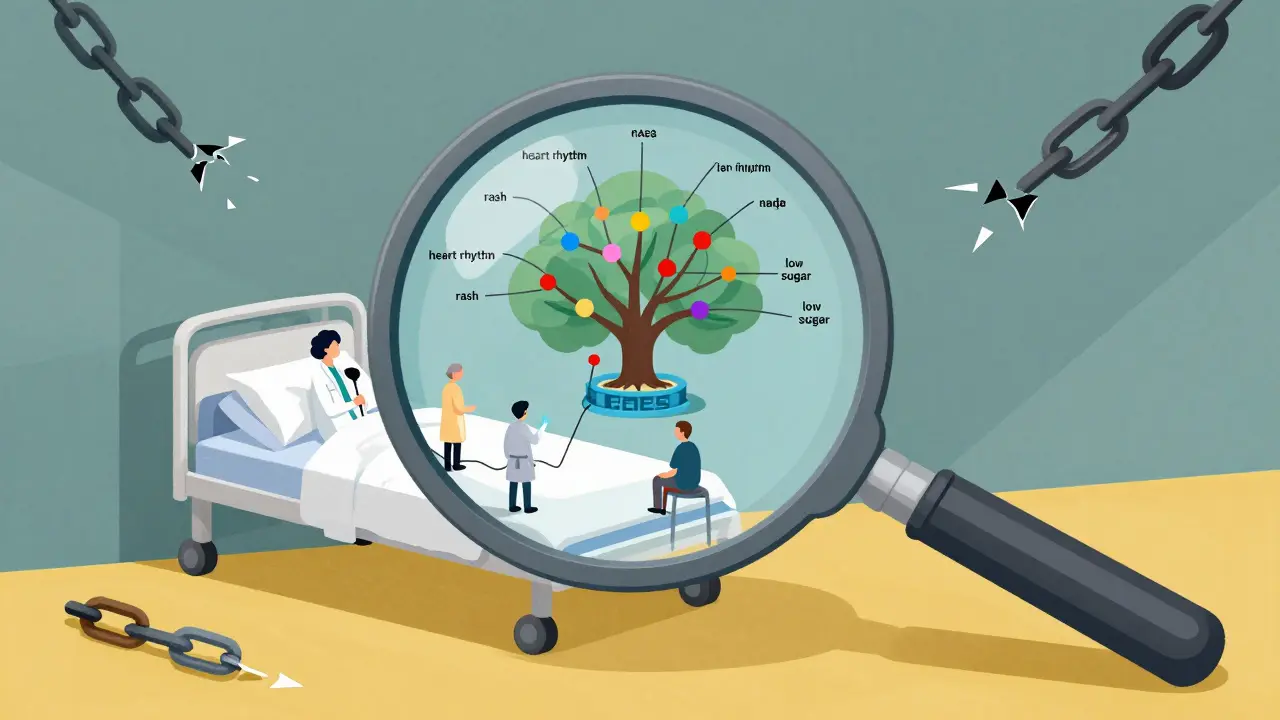
Clinical trials test drugs on a few thousand people before approval. Real life? Millions take the drug. That’s where unexpected reactions show up. Maybe it’s a rare heart rhythm problem, a sudden skin rash, or a dangerous drop in blood sugar. These aren’t always caught in testing. That’s why the FDA runs the FDA Adverse Event Reporting System (FAERS). It’s the backbone of drug safety after a product hits the market.Between 2020 and 2022, the FDA received about 2 million reports through FAERS. That sounds like a lot-but experts say only 5% to 10% of serious reactions are actually reported. That means thousands of dangerous events go unnoticed. Your report could be the one that triggers a warning, a label change, or even a drug recall. In 2022, a nurse’s report of severe low blood sugar linked to a new diabetes drug led to a label update within 47 days. That’s how powerful a single report can be.
What Counts as a Reportable Reaction?
Not every side effect needs to be reported. The FDA defines a serious adverse event as one that:- Causes death
- Is life-threatening
- Leads to hospitalization or extends a hospital stay
- Results in permanent disability or damage
- Causes a birth defect
- Requires medical intervention to prevent permanent harm
Even if you’re not sure the drug caused the reaction, report it anyway. The FDA doesn’t need proof-just a reasonable suspicion. For example, if you started a new blood pressure medication and two days later had a stroke, that’s worth reporting-even if your doctor thinks it’s unrelated. The system’s job is to find patterns, not assign blame.
Who Can Report?
Anyone can report. Patients, family members, caregivers, nurses, pharmacists, doctors-everyone plays a role. But there’s a difference in how reports are handled based on who files them.Healthcare professionals are expected to report serious reactions within 15 days if they believe the drug might be involved. Manufacturers are legally required to report serious and unexpected reactions within 15 days of learning about them. They also have to monitor scientific literature and report findings to the FDA.
For patients and caregivers? No legal obligation. But your report matters just as much. In fact, the FDA says nearly 40% of all reports come from the public. That’s why they made it simple.
How to Report: Three Easy Ways
You have three options to file a report. All are free, confidential, and available 24/7.1. Online: Use the MedWatch Portal
This is the fastest and most popular method. Go to www.accessdata.fda.gov/scripts/medwatch and click “Report a Problem.” You’ll fill out Form 3500, the official FDA adverse event form. It asks for:- Patient info: age, sex, weight (if known)
- Drug details: brand name, generic name, dose, how often taken, start and stop dates
- Adverse event: what happened, when it started, how long it lasted, severity
- Outcome: did the person go to the hospital? Did they recover? Did it cause permanent damage?
- Your info: name, phone, email (optional but helpful for follow-up)
It takes about 20 to 25 minutes to complete. The FDA’s 2021 survey found 72% of users were satisfied with the online system. But mobile users gave it only 4.2 out of 10 for ease of use on phones. If you’re on a tablet or computer, it’s smooth. On a phone? You might want to print the form and fill it out later.
2. Phone: Call 1-800-FDA-1088
If you’d rather talk to someone, call the MedWatch Safety Information hotline. A trained operator will guide you through the details over the phone. They’ll fill out Form 3500 for you. Average wait time is under 10 minutes. This is a great option if you’re not comfortable typing or if the reaction was complex.3. Mail: Download and Send Form 3500
You can download Form 3500 from the FDA website, print it, fill it out by hand, and mail it to:FDA MedWatch
5600 Fishers Lane
Rockville, MD 20852-9787
It’s slower than the online option, but it works. Just make sure you include all the key details. Missing info means the report might be thrown out.
What Happens After You Report?
Once the FDA gets your report, it goes into FAERS. The system uses software to look for patterns. If 10 different people report the same rare reaction after taking the same drug, that’s a red flag. The FDA’s analysts then investigate. They might review medical records, talk to doctors, or compare data across other countries.If enough evidence builds up, the FDA can:
- Update the drug’s label to warn about the risk
- Require a Risk Evaluation and Mitigation Strategy (REMS)
- Issue a safety alert to doctors and pharmacies
- Order a recall
Most reports don’t lead to immediate action-but they all add to the bigger picture. And that’s how safety improves.
Common Mistakes to Avoid
People often skip key details because they think they’re not important. Don’t make these mistakes:- Not listing all medications: If the patient was taking 5 drugs, list them all. The reaction might be from a drug interaction.
- Using vague terms: Instead of “felt bad,” say “sudden chest pain, shortness of breath, dizziness lasting 3 hours.”
- Leaving out dates: When did the drug start? When did the reaction begin? Exact dates help the FDA track timing.
- Assuming it’s not serious: If you’re unsure, report it. The FDA has experts who decide what’s serious-not you.
Also, don’t wait for your doctor to report it. Even if your doctor knows about the reaction, they might not file a report. The system depends on you.
What About Over-the-Counter Drugs and Supplements?
Yes, you can report reactions to OTC meds like ibuprofen, allergy pills, or sleep aids. You can also report supplements like vitamin D, herbal products, or weight-loss pills. The FDA tracks these too. In 2022, over 15% of FAERS reports involved dietary supplements. Many people don’t realize supplements are included-and that’s a problem. They’re not tested like drugs, so side effects are more likely to go unnoticed.
How the System Is Changing
The FDA is modernizing how it collects data. By December 2025, electronic health records (EHRs) will be required to send adverse event reports directly to the FDA. That means doctors won’t have to manually file-they’ll just click a button when a reaction shows up in a patient’s chart.Also, starting in 2024, the FDA will pilot a blockchain system to verify reports and reduce fake or duplicate submissions. And by 2025, companies will be required to monitor social media for mentions of drug side effects and report them.
These changes are meant to catch more reactions, faster. But until then, your report is still the most direct way to help.
Need Help? You’re Not Alone
If you’re stuck filling out the form, or unsure what to include, the FDA has support ready. Email [email protected]-they respond within 24 hours. Or call 1-800-FDA-1088 and ask for clinical help. They also offer free 90-minute webinars every month for healthcare workers. You don’t need to be a professional to join.And if you’re worried about privacy? Your name and contact info are kept confidential. The FDA doesn’t share your identity with drug companies unless you give permission.
Final Thought: Your Report Could Save a Life
You might think, “One report won’t make a difference.” But that’s not true. Behind every drug warning, label change, or recall, there’s a chain of reports. One person noticed something odd. They took the time to report it. Others did too. And together, they changed something.Don’t wait for someone else to act. If you’ve had a bad reaction-or seen one-take five minutes to report it. It’s simple. It’s free. And it might save someone you don’t even know.
Do I need to be a doctor to report a drug reaction?
No. Anyone can report-patients, family members, caregivers, or even bystanders. You don’t need medical training. The FDA just needs details about what happened, when, and what drug was involved.
Can I report a reaction that happened years ago?
Yes. The FDA accepts reports regardless of when the reaction occurred. However, the more recent the report, the more useful it is for identifying new safety issues. If it happened long ago and the drug is no longer in use, it may still be helpful for historical tracking.
Will the drug company know I reported them?
No. Your personal information is kept confidential. The FDA does not share your name or contact details with the manufacturer unless you give written permission. The report is anonymized in the database.
What if I’m not sure if the drug caused the reaction?
Report it anyway. The FDA doesn’t require proof of causation. They look for patterns across many reports. If multiple people report the same issue after taking the same drug, that’s enough to trigger an investigation.
Do I have to report to the drug manufacturer too?
No, but you can. Healthcare providers are encouraged to report to both the FDA and the manufacturer. Patients don’t need to report to both. Reporting to the FDA is enough. The FDA shares reports with manufacturers automatically.
How long does it take for the FDA to act on a report?
There’s no set timeline. Some reports lead to quick action-like the diabetes drug example that got a label update in 47 days. Others take months or years as more data accumulates. The system works over time, not instantly. But every report adds to the evidence.
Can I report a reaction to a vaccine?
Yes. The FDA handles reports for vaccines, as well as drugs and medical devices. You can use the same MedWatch portal or call 1-800-FDA-1088. For vaccine-specific reports, you can also use the CDC’s VAERS system, but the FDA accepts them too.
Is there a mobile app for reporting?
Not yet. The FDA’s MedWatch portal is mobile-friendly but not optimized for smartphones. You can fill out the form on your phone, but it’s easier on a tablet or computer. A dedicated app is under development but not expected until 2026.
Donna Peplinskie
January 1, 2026 AT 01:26I just reported my mom’s reaction to that new blood pressure med last week-she got dizzy, nearly fell, and her heart was racing. I was terrified, but I didn’t know where to start. This post literally saved me. Thank you for laying it out so clearly. I filled out the MedWatch form on my laptop, and it took me 22 minutes. I cried halfway through, not from sadness, but from relief-I felt like I finally did something right.
Also, please, if you’re reading this and you’ve ever had a weird side effect-even if your doctor said it’s ‘probably nothing’-just report it. I wish someone had told me this sooner.
And yes, I used all the commas. I can’t help it. I’m a punctuation addict.
Love you, FDA. Keep doing this work.
Olukayode Oguntulu
January 1, 2026 AT 21:26Let’s be candid: this entire system is a performative illusion of accountability. The FDA is not a regulatory body-it’s a PR arm for Big Pharma. Two million reports? That’s a drop in the ocean of iatrogenic harm. And you think a form 3500 changes anything? The algorithmic pattern recognition is a myth. It’s all curated by bureaucrats who have vested interests in not triggering recalls. The ‘label update in 47 days’? A cherry-picked anecdote to pacify the masses. The real system is rigged-pharma funds the FDA’s advisory panels, and the ‘independent’ reviewers are former industry execs. You’re not saving lives-you’re paying tribute to a broken machine.
jaspreet sandhu
January 1, 2026 AT 23:35You people think reporting is enough? That’s cute. Real change needs lawsuits and class actions. You report a reaction, nothing happens. You sue the company, they pay a fine and keep selling. I’ve seen this too many times. My cousin took that diabetes drug, ended up in ICU, and the FDA did nothing for six months. The company just changed the label and raised the price. Now they’re making more money. Reporting is a distraction. It keeps people busy while the real power stays untouched. If you really care, don’t fill out forms-find a lawyer. That’s the only language they understand.
Alex Warden
January 2, 2026 AT 11:37Why are we even letting foreigners report? I mean, look at this-Nigeria, Canada, India, all these people filing reports on American drugs. What’s next? Are we going to let China decide what’s safe for us? This isn’t a global safety network, it’s a U.S. system. If you’re not a U.S. citizen or resident, you shouldn’t be able to submit a report. We don’t need foreign opinions on our medicine. Our doctors know best. And if you think your cousin’s rash in Bangalore matters to a U.S. patient, you’re delusional. This post is good, but it’s being hijacked by globalists who don’t even live here.
LIZETH DE PACHECO
January 2, 2026 AT 13:22I’m a nurse and I’ve been telling patients for years: report everything. Even if you think it’s ‘just’ a headache or a weird rash. I had a patient who reported a tingling hand after taking a new statin-turned out it was early signs of peripheral neuropathy. We caught it before it got worse. I don’t care if it’s OTC or prescription-your body is your compass. If something feels off, say something. And if you’re nervous about the form? Call 1-800-FDA-1088. The operators are kind. They don’t judge. I’ve had patients cry on the phone because they finally felt heard. That’s what this is about-not bureaucracy. It’s about being seen.
Bill Medley
January 3, 2026 AT 21:30The structure of the FAERS system is fundamentally sound, but its implementation suffers from significant data latency and underreporting bias. The reliance on voluntary submissions from laypersons introduces selection bias, as individuals with severe reactions are more likely to report than those with mild or transient effects. Furthermore, the absence of standardized clinical coding (e.g., MedDRA) in public submissions reduces analytical fidelity. While the upcoming EHR integration and blockchain verification represent necessary modernizations, the current system remains statistically noisy. A mandatory reporting threshold for all healthcare providers, with automated EHR integration, would substantially improve signal-to-noise ratio.
Richard Thomas
January 4, 2026 AT 09:06I’ve been thinking about this a lot lately-not just the mechanics of reporting, but the moral weight of it. We live in a world where we’re told to be passive consumers, to trust the system, to take what’s given without question. But when your body betrays you because of a pill you were told was safe, that trust shatters. Reporting isn’t just about data-it’s about reclaiming agency. It’s saying: I am not a statistic. I am not a footnote in a corporate risk assessment. I am a human being who deserves to be heard, even if no one else has noticed. And maybe, just maybe, if enough of us speak up, the system will learn to listen-not because it’s required, but because it’s right.
I don’t know if my report will change anything. But I know I had to make it. For me. And for whoever comes after.
Andy Heinlein
January 5, 2026 AT 09:33Just reported my dog’s reaction to that flea med-yeah, you read that right. Dog. Vomited for 12 hours after the spot-on. I didn’t know I could report pet reactions, but the FDA site says yes. Took me 15 minutes. I’m not even sure if it’ll matter, but my pup’s okay now. And hey, if this helps someone else’s pet? Win. Also, typo in my email-wrote @gmaill.com. Oops. But the form went through. Felt good. 🐶❤️
Ann Romine
January 6, 2026 AT 19:56As someone who grew up in a country where pharmaceuticals are sold without regulation, this post made me emotional. In my hometown, people buy antibiotics off the street, supplements with no labels, and never report anything because they don’t know how-or because they don’t trust anyone. Coming to the U.S. and learning that there’s a system like this-even if it’s imperfect-felt like a gift. I told my sister back home about it. She’s going to report her husband’s reaction to the new diabetes pill. I hope she does. And if she does, I hope someone listens. Because safety shouldn’t be a privilege. It should be a right.
Austin Mac-Anabraba
January 7, 2026 AT 23:45Let’s dismantle the myth. The FDA doesn’t ‘act’ on reports. It delays, obfuscates, and buries. The 47-day label update? That drug was already pulled in Europe two years prior. The FDA only acted after the EU forced their hand. The system is reactive, not proactive. And the ‘anonymous’ reporting? Your IP address, device ID, and location are logged. The FDA shares metadata with manufacturers under ‘safety monitoring agreements.’ You think you’re anonymous? You’re not. You’re a data point in a surveillance pipeline disguised as public service. This post is propaganda. It’s designed to make you feel useful while the real problem-corporate capture of regulatory bodies-remains untouched.