
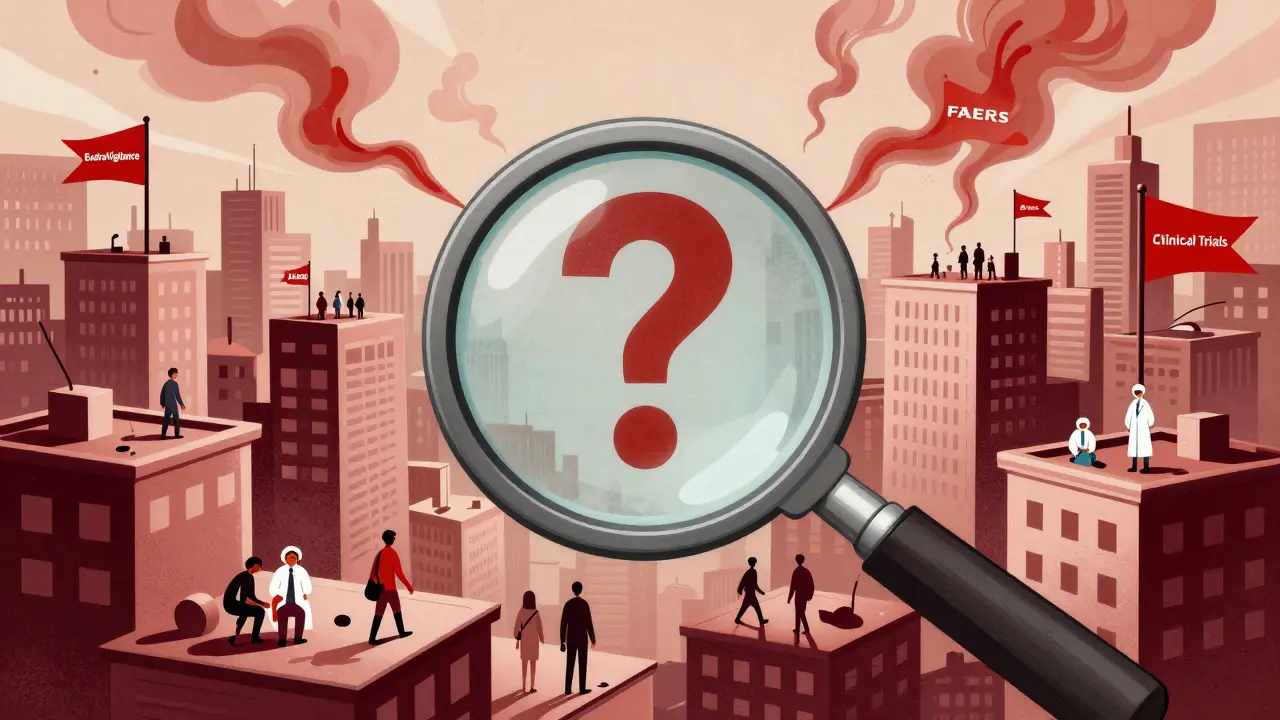
When a new drug hits the market, everyone assumes it’s been thoroughly tested. Clinical trials run for years, involve thousands of patients, and follow strict protocols. But here’s the truth: drug safety signals often don’t show up until after approval-sometimes not for years. That’s not a failure. It’s how medicine works. The real danger isn’t that risks exist; it’s that we expect to see them all upfront.
What Exactly Is a Drug Safety Signal?
A drug safety signal isn’t a confirmed danger. It’s a red flag. Something unusual. A pattern that shouldn’t be there. The Council for International Organizations of Medical Sciences (CIOMS) defines it clearly: information suggesting a possible link between a medicine and an unexpected side effect that needs further checking. It’s not proof. It’s a question. Think of it like smoke. You don’t know if there’s a fire yet. But you don’t ignore it. You look. That’s what pharmacovigilance teams do every day. They sift through millions of reports-from doctors, patients, hospitals, and clinical trials-to find patterns that might mean something serious.Why Don’t Clinical Trials Catch Everything?
Clinical trials are designed to test whether a drug works, not to find every possible side effect. Most trials enroll between 1,000 and 5,000 people. That sounds like a lot-until you realize that rare side effects might only happen in 1 out of 10,000 patients. In a trial of 3,000 people, you’d need 30 of those rare cases just to spot the trend. You won’t get that. Also, trial participants are carefully selected. They’re generally healthier than the real-world population. They don’t take 10 other medications. They don’t have three chronic conditions. They’re young, middle-aged, and mostly white. Real patients? Older. Frail. On multiple drugs. Taking supplements. Skipping doses. That’s where the real risks emerge. Take the case of rosiglitazone, a diabetes drug approved in the late 1990s. Clinical trials showed it lowered blood sugar. But after millions of prescriptions, data from spontaneous reports and studies started pointing to a higher risk of heart attacks. That signal didn’t show up in trials. It showed up in the real world.Where Do These Signals Come From?
There are two main sources: clinical trials and post-market reporting. Clinical trials give you clean, controlled data. But they’re limited. Post-market data? It’s messy-but it’s real. The FDA’s FAERS database alone holds over 30 million reports dating back to 1968. The EMA’s EudraVigilance system processes more than 2.5 million reports a year from 31 European countries. Most of these come from spontaneous reports-doctors or patients reporting side effects without being asked. About 90% of these reports are unsolicited. But here’s the catch: not all reports are equal. Serious events are reported 3.2 times more often than mild ones. A patient who has a stroke will call their doctor. Someone with a mild rash might just take an antihistamine and forget it. That creates a bias. And it’s not just about reporting-it’s about quality. A 2022 survey found that 68% of safety officers say poor data quality is their biggest challenge. Missing details. Incomplete medical history. No follow-up. That’s why signals aren’t acted on immediately.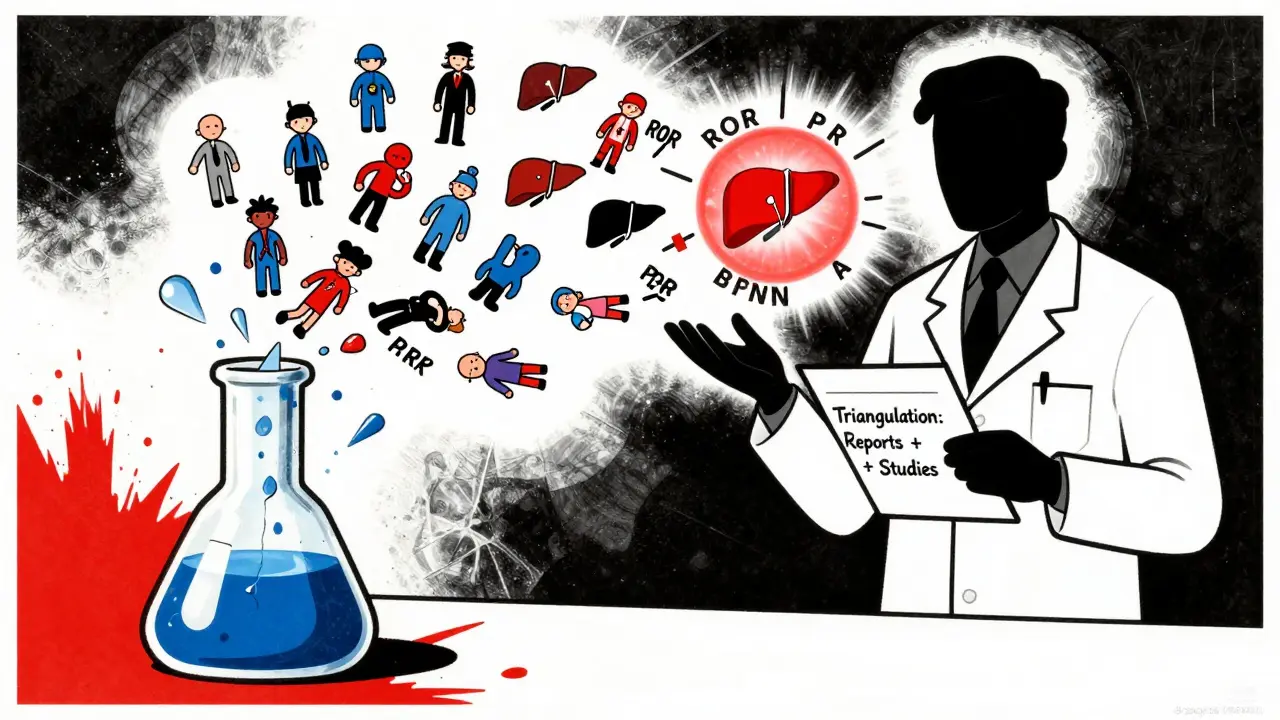
How Do Experts Find the Signal in the Noise?
It’s not just looking at reports. It’s math. Statistics. Algorithms. Pharmacovigilance teams use tools like:- Reporting Odds Ratio (ROR): Compares how often an event happens with the drug vs. other drugs. A ratio above 2.0 triggers attention.
- Proportional Reporting Ratio (PRR): Measures if a side effect is reported more often with this drug than expected.
- Bayesian Confidence Propagation Neural Network (BCPNN): A machine learning method that detects unusual patterns across millions of data points.
What Makes a Signal Actionable?
Not every signal leads to a warning label or a drug recall. Only some trigger changes to prescribing information. A 2018 study of 117 signals found four factors that predict action:- Replication across sources-if the same pattern shows up in FAERS, EudraVigilance, and a peer-reviewed study, the odds of action jump by 4.3 times.
- Plausibility-does the mechanism make sense? If a drug affects the liver and patients start showing liver damage, that’s plausible. If it’s a blood pressure drug and patients report hair loss? Maybe not.
- Severity-87% of serious events (like death, hospitalization, or permanent disability) led to label changes. Only 32% of mild ones did.
- Drug age-new drugs (under 5 years) are 2.3 times more likely to get label updates than older ones. Why? Because we’re still learning about them.
The Hidden Gaps: Delayed Risks and Complex Patients
Some dangers take years to appear. Bisphosphonates-drugs for osteoporosis-were linked to jaw bone death (osteonecrosis) only after seven years of use. Why? Because the damage builds slowly. The body’s repair systems can’t keep up. By then, millions had taken the drug. And then there’s polypharmacy. Since 2000, prescription drug use among seniors has jumped 400%. An 80-year-old might be on five or six medications. One for blood pressure. One for diabetes. One for arthritis. A supplement. A sleep aid. The interactions? We don’t have good data. Current signal detection systems weren’t built for this. They look for one drug, one side effect. Not five drugs, one unexpected reaction.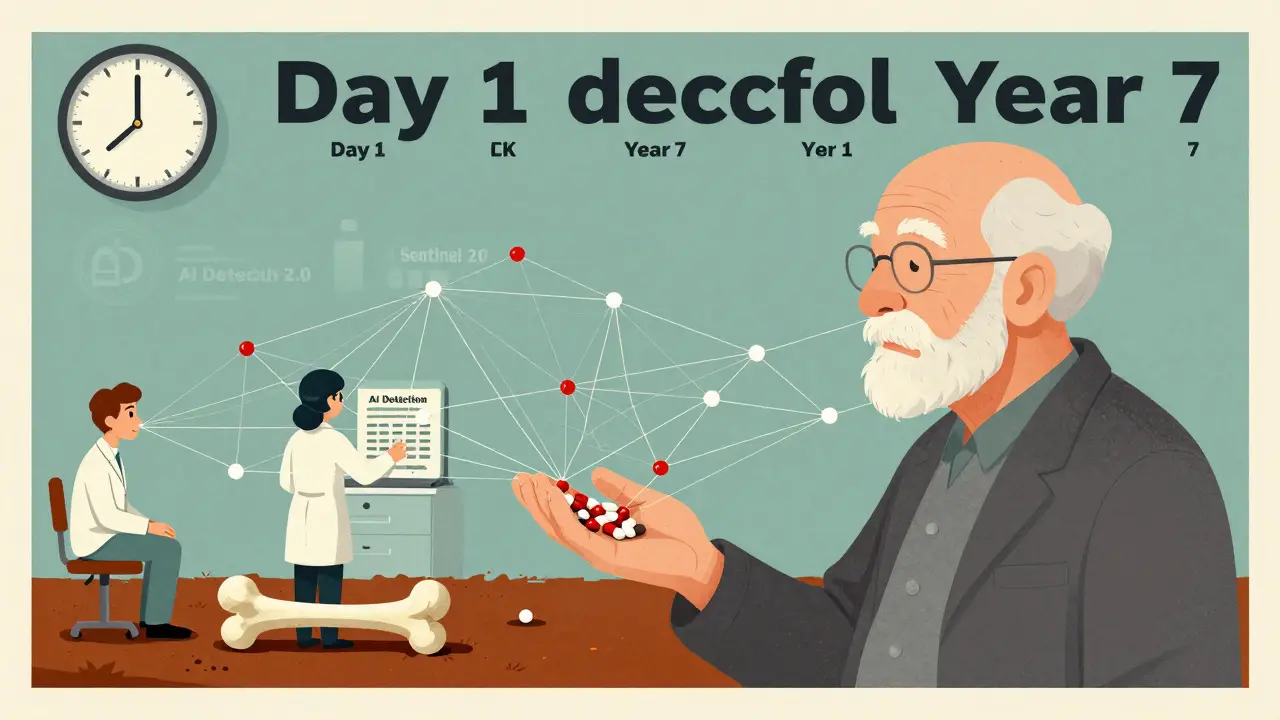
What’s Changing in 2025?
The system is evolving. The FDA’s Sentinel Initiative 2.0 now pulls data from 300 million patients across 150 healthcare systems. That’s not just reports-it’s real-time electronic health records. The EMA’s AI tools now cut signal detection time from two weeks to under two days. That’s huge. New guidelines from the International Council for Harmonisation (ICH) are pushing for standardized reporting of lab data-especially for drug-induced liver injury. And more companies are using AI to flag patterns before regulators even see them. But the biggest shift? The expectation. In 2022, the EMA required every new drug application to include a detailed signal detection plan. No more guessing. Companies now have to say: Here’s how we’ll monitor safety after approval.What This Means for Patients and Doctors
You don’t need to be a scientist to understand this. If you’re on a new medication, pay attention. Not every weird feeling is a side effect. But if something unusual happens-especially if it’s new, persistent, or serious-tell your doctor. Document it. Ask: Could this be related? Doctors, too, need to report. Even if you’re not sure. Even if it’s mild. That report might be the first clue in a pattern that saves lives later. And if you’re a patient with multiple conditions? Be extra careful. Ask your pharmacist to check for interactions. Don’t assume your doctor knows everything you’re taking. Bring a list. Every time.Final Thought: Safety Is a Process, Not a Finish Line
No drug is perfectly safe. No clinical trial can predict every risk. But we have systems now that are better than ever at catching problems after the fact. The goal isn’t perfection. It’s early detection. Fast response. Continuous learning. The next time you hear about a drug recall or a safety warning, don’t assume it was a failure. Assume it was a success. The system worked. Someone noticed something strange. They looked. They verified. And they acted. That’s how medicine gets safer-not by avoiding risk, but by understanding it.What’s the difference between a drug side effect and a safety signal?
A side effect is a known, documented reaction listed in the drug’s prescribing information-like nausea or dizziness. A safety signal is an unexplained pattern of possible harm that hasn’t been confirmed yet. It’s a clue, not a conclusion. Signals lead to investigations. Side effects lead to warnings.
Can a drug be pulled from the market because of a safety signal?
Rarely. Most signals don’t lead to removal. Regulatory agencies prefer to add warnings, restrict use, or require special monitoring. Removal only happens when the risk clearly outweighs the benefit and no safer alternative exists. Examples include rofecoxib (Vioxx) for heart risk and teriflunomide (Aubagio) for liver damage in high-risk patients.
Why do some signals take years to be confirmed?
Because rare events need time to appear, and data needs to accumulate. A side effect that happens in 1 in 50,000 patients won’t show up in a trial of 5,000 people. It takes millions of prescriptions and years of real-world use to see the pattern. Also, causality must be proven-not just correlation. That requires multiple studies, biological plausibility, and ruling out other causes.
Are newer drugs more dangerous than older ones?
Not necessarily. But they’re less understood. New drugs have fewer real-world data points. That means safety signals are more likely to emerge early. Older drugs have been studied for decades. Their risks are better mapped. But that doesn’t mean they’re safe-just that we know more about what to watch for.
How can patients help improve drug safety?
By reporting side effects-even small ones. If you notice something unusual after starting a new medication, tell your doctor. Ask if it should be reported to your country’s pharmacovigilance system. In the U.S., that’s the FDA’s MedWatch program. In Australia, it’s the TGA’s Adverse Drug Reactions Advisory Committee. Your report could be the first piece of a puzzle that protects others.
For those managing complex medication regimens, the key is vigilance-not fear. Stay informed. Ask questions. Keep track. The system works best when patients and providers work together.
Becky Baker
December 26, 2025 AT 10:22This whole system is a joke. We let Big Pharma sell drugs to millions before we even know what they do, then act surprised when people get hurt. It’s not ‘how medicine works’-it’s how corporations get rich while patients pay the price. 🤡
Rajni Jain
December 28, 2025 AT 05:06i feel u. my grandma was on 7 meds and no one ever checked how they mixed. she got dizzy for months and no one thought it was the new arthritis pill + her blood pressure med. just tell your doc, they’ll listen. 💙
Natasha Sandra
December 29, 2025 AT 08:56OMG YES!! I reported a weird rash after my new migraine med and they actually called me back!! 🙌 It felt silly at first but now I know-my tiny report might help someone else. Love that the system listens sometimes!! 🌟
Erwin Asilom
December 31, 2025 AT 00:23The distinction between side effects and safety signals is critical. Side effects are statistically anticipated and documented during pre-market phases; safety signals are emergent anomalies requiring signal detection algorithms and triangulation across disparate data sources. The current pharmacovigilance infrastructure, while imperfect, represents a significant evolution from passive reporting to active, data-driven surveillance. The challenge lies not in the system’s design, but in the quality and completeness of real-world input. Poorly structured spontaneous reports remain the bottleneck-not the methodology.
roger dalomba
December 31, 2025 AT 21:29Wow. A 2,000-word essay on how drugs are kinda dangerous. Groundbreaking. I’m sure the FDA is weeping into their coffee right now.
Sumler Luu
January 2, 2026 AT 14:28I appreciate the nuance here, but I worry about elderly patients who don’t know how to report side effects. Not everyone has a smartphone or knows what MedWatch is. We need simpler, more accessible channels-maybe through pharmacies or automated follow-ups after prescription fills.
sakshi nagpal
January 3, 2026 AT 07:53This is a profoundly important discussion. The global nature of drug distribution means safety signals must be monitored across cultures, languages, and healthcare systems. In India, for example, polypharmacy is rampant among the elderly, yet pharmacovigilance reporting remains underdeveloped. Standardized reporting frameworks like ICH guidelines are a step forward-but implementation must be localized, culturally sensitive, and supported by community health workers. Knowledge is power, but access is justice.
Sandeep Jain
January 4, 2026 AT 05:52my uncle died after a new heart med. they said it was ‘rare’ but 3 others in his support group had same thing. why wait for deaths to fix this? just ask ppl after they get the script. simple.