
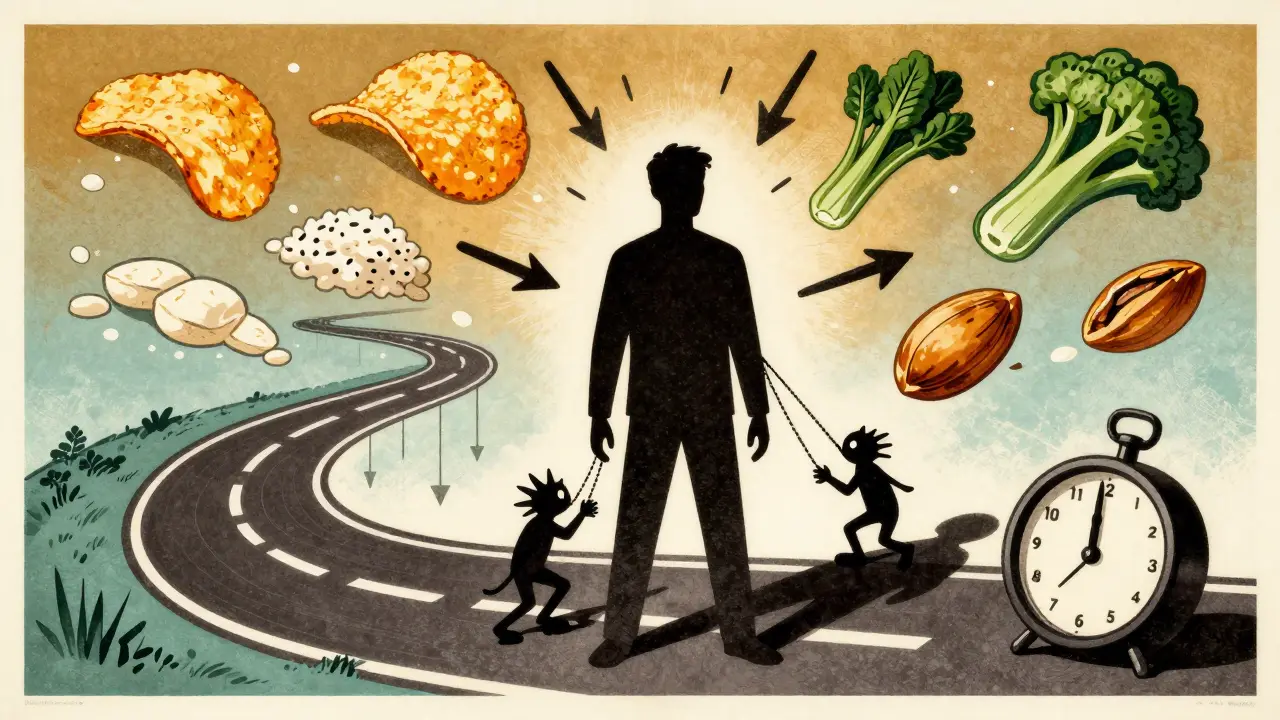
Want to lose weight? You’ve probably heard the same thing over and over: caloric deficit is the key. And it’s true - but not in the way most people think. It’s not just about eating less and moving more. If it were that simple, everyone who’s ever tried to lose weight would have succeeded. The truth is, your body fights back. Hard.
What a Caloric Deficit Really Means
A caloric deficit happens when you burn more calories than you eat. That’s it. No magic, no secret pills, no detoxes. Just basic physics: your body needs energy to function - breathing, thinking, moving, even sleeping. If you give it less than it needs, it has to dig into stored energy: mostly fat. The old rule of thumb? Cut 500 calories a day, lose one pound a week. That’s based on the idea that one pound of fat equals 3,500 calories. It sounds clean. But here’s the problem: it doesn’t hold up over time. Research from the National Institutes of Health and studies published in journals like Cell Metabolism show that as you lose weight, your body slows down. Not just because you’re lighter - but because your metabolism adapts. That 500-calorie deficit might get you 1 pound down in week one. By week eight? You’re barely moving. That’s not your fault. That’s biology.How Your Body Responds to Losing Weight
Your body doesn’t see weight loss as a win. It sees it as a threat. Evolutionarily speaking, famine was deadly. So when you eat less, your body goes into survival mode. Three things happen:- Your resting metabolism drops - sometimes by 15% more than you’d expect from just losing weight.
- Hormones like leptin and ghrelin shift. Leptin, the “I’m full” signal, plummets. Ghrelin, the “I’m hungry” hormone, spikes. You start craving carbs, fats, anything high-calorie.
- Your body becomes more efficient. Walking, climbing stairs, even fidgeting burns fewer calories than before.
Why “Eat Less, Move More” Fails Long-Term
Most people try to force a big deficit: 1,000 calories a day. They drop to 1,200 calories, hit the gym hard, and expect fast results. It works - for a while. But here’s what happens next:- You’re exhausted all the time.
- You’re obsessed with food.
- You lose muscle, not just fat.
- You hit a plateau - and then start gaining back everything you lost.
What Actually Works: The Science-Backed Approach
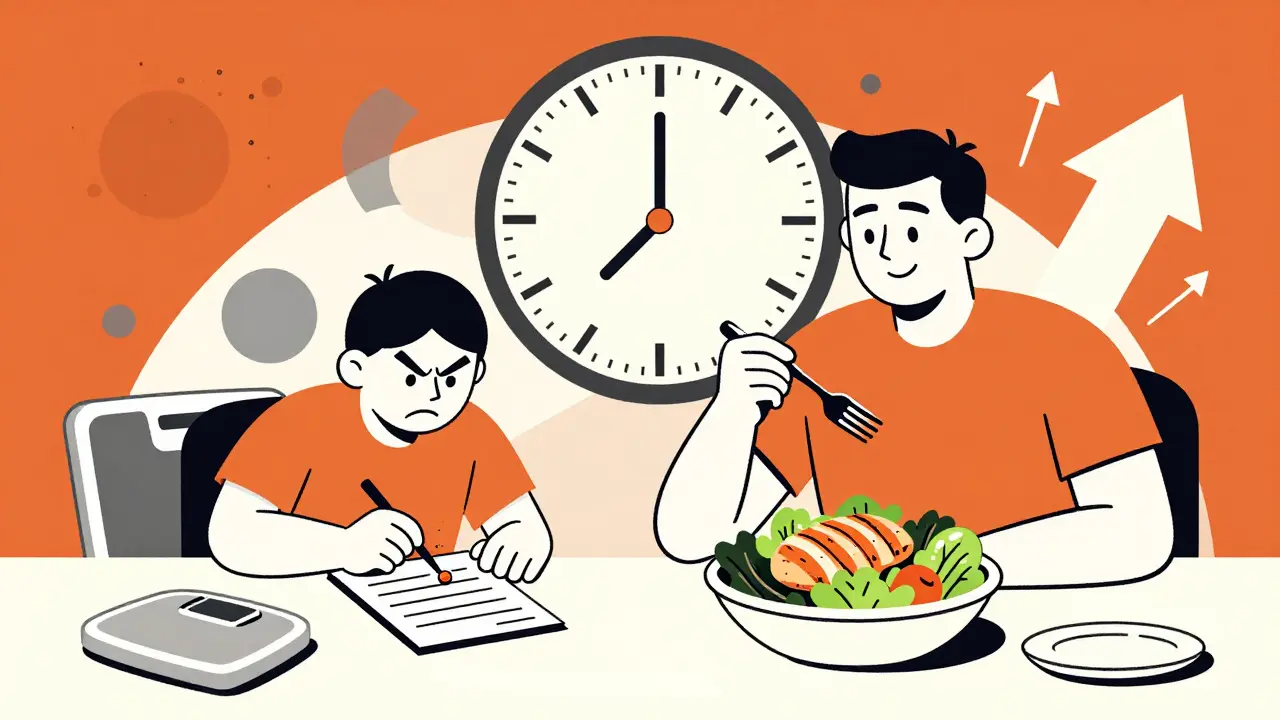
Forget extremes. The most sustainable path to fat loss is a moderate, consistent deficit - and protecting your metabolism along the way. Start with a 15-25% calorie reduction from your maintenance level. For most people, that’s a 250-500 calorie daily deficit. That means losing about 0.5 to 1 pound per week. Slow? Yes. But it’s the kind of slow that sticks. Here’s how to make it work:- Track protein, not just calories. Aim for 1.6 to 2.2 grams of protein per kilogram of body weight. That’s about 100-150 grams a day for most adults. Protein keeps you full, preserves muscle, and requires more energy to digest - meaning you burn more calories just processing your food.
- Use food scales for 2-4 weeks. Guessing portion sizes is the #1 reason people stall. A “cup” of rice isn’t a cup. A “handful” of almonds isn’t 100 calories. Weigh your food. Just for a month. You’ll be shocked.
- Choose high-volume, low-calorie foods. Vegetables, broth-based soups, lean meats, legumes, and fruits fill your stomach without blowing your calorie budget. A big salad with grilled chicken can be 300 calories and leave you satisfied. A 300-calorie bag of chips? You’ll be hungry again in an hour.
- Move more - but don’t overdo it. Walking 8,000-10,000 steps a day helps. Strength training 2-3 times a week protects muscle. But don’t think you can “out-exercise” a bad diet. One study showed people who added 150 minutes of cardio a week lost only 2.5 pounds over 6 months - even with no dietary changes.
- Take diet breaks. After 8-12 weeks of deficit, eat at maintenance for 1-2 weeks. This resets hunger hormones and gives your metabolism a chance to bounce back. People who do this lose fat more steadily over time - and keep it off longer.
It’s Not Just About Calories - But Calories Still Matter
You’ve heard the arguments: “Low-carb diets work better.” “Intermittent fasting boosts metabolism.” “Sugar is the real enemy.” Yes, diet quality matters. A diet full of processed food, sugar, and refined carbs makes hunger harder to control. But here’s the truth: even on a low-carb or keto diet, you still need a caloric deficit to lose fat. The same is true for intermittent fasting. It’s not the timing that burns fat - it’s the overall energy balance. A 2021 study in Cell Metabolism found that low-carb dieters burned about 57 extra calories per day compared to low-fat dieters after weight loss. Sounds good - until you realize that’s less than a banana. Over time, that difference fades. The real advantage of low-carb? Less hunger. Fewer cravings. That makes sticking to a deficit easier. The same goes for time-restricted eating. Eating within an 8-hour window doesn’t magically burn fat. It just makes it easier to eat fewer calories overall. Bottom line: food quality helps you stick to a deficit. But the deficit itself? That’s non-negotiable.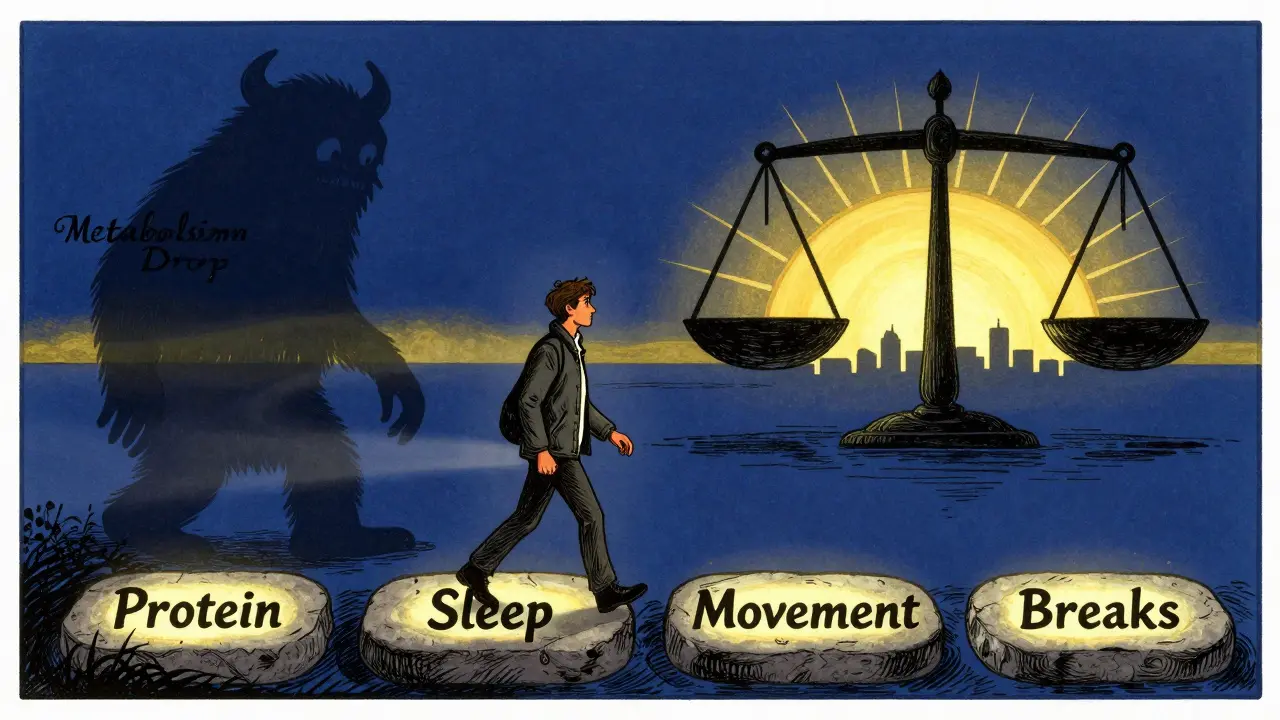
Why Most People Fail - And How to Avoid It
The biggest reason people give up? They don’t see results fast enough. Or worse - they lose weight, then hit a wall. Here’s what successful people do differently:- They focus on progress, not perfection. A 0.3-pound loss one week? Still progress.
- They track non-scale victories: clothes fitting better, more energy, better sleep, stronger lifts.
- They plan for plateaus. They know they’re coming - and they don’t panic.
- They don’t chase extremes. They build habits that last.
claire davies
December 23, 2025 AT 23:59Okay but can we talk about how the body is basically a stubborn toddler when it comes to weight loss? 🤦♀️ I lost 40 pounds last year and by week 6 I was convinced my metabolism had filed for divorce. I started doing those 2-week maintenance breaks and honestly? It was the game-changer. I stopped hating food and started enjoying it again. Also, weighing my nuts for two weeks made me cry. Who knew a ‘handful’ was 300 calories? I thought I was being good. Turns out I was just delusional. But now I’m not. And I’m still losing. Slowly. Like a snail in a sweater. But I’m moving.
Also, protein. Protein is your new BFF. I eat eggs for breakfast, chicken for lunch, lentils for dinner. I even put protein powder in my oatmeal. My cat judges me, but my jeans don’t.
And no, intermittent fasting didn’t magically melt my belly fat. It just made me eat less because I wasn’t snacking at 11pm on chips while crying over Netflix. That’s not a metabolic hack. That’s just not eating at 11pm. We’re all just trying to outsmart our evolutionary programming. Good luck, warriors.
Also, I cried when I hit my first plateau. Then I made a playlist called ‘I’m Not Giving Up’ and danced in my kitchen. It helped.
Don’t let anyone tell you it’s about willpower. It’s about biology. And biology is messy. But it’s survivable.
Harsh Khandelwal
December 24, 2025 AT 00:19lol this is just Big Pharma’s way of selling protein powder and food scales. They don’t want you to know the real secret: your body is being sabotaged by the government’s secret weight-loss suppression program. They pump fluoride into the water to slow your metabolism. Also, your phone’s blue light messes with leptin. I’ve been using a 1998 Nokia and my waist shrunk 3 inches in 3 days. No one talks about this. But I see the patterns.
Also, carbs are the real enemy. But not because of calories. Because they’re laced with glyphosate. And glyphosate is just a fancy word for ‘they want you fat so you buy more medicine.’
Just eat meat. Raw. From a cow you killed yourself. Then you’ll be fine.
Lindsey Kidd
December 24, 2025 AT 11:02YES YES YES to diet breaks!! 🙌 I did 10 weeks of deficit and felt like a zombie. Then I ate like a normal human for two weeks - pizza, ice cream, the whole thing - and I came back stronger. My energy? Skyrocketed. My cravings? Gone. My scale? Still moving down. Who knew giving yourself permission to eat was the secret? 🤯
Also, protein is life. I put it in my coffee now. Don’t judge me. I’m just trying to survive adulthood.
And yes, weighing food is terrifying. But also kind of empowering? Like, I finally understand why my ‘light snack’ was 800 calories. Oops.
Also, I’m not mad at my body. I’m mad at the diet industry. They sold us a fairy tale. We’re just trying to be human.
Rachel Cericola
December 26, 2025 AT 07:00Let me just say this: if you’re still believing in the 3,500-calorie rule, you’re operating on 1980s science. The NIH has been debunking this since 2015. Your metabolism doesn’t just ‘slow down’ - it rewires. And if you cut too hard, you lose muscle, which tanks your BMR even more. It’s a death spiral.
Here’s what actually works: protein first, then volume, then consistency. Not perfection. Not 1,200 calories. Not 2-hour gym sessions five days a week. Just 1.8g of protein per kg of body weight. Add a salad to every meal. Walk 8k steps. Sleep 7 hours. Take a break every 8-10 weeks. That’s it.
The National Weight Control Registry isn’t some fluke. Their data is gold. People who keep weight off aren’t monks. They’re just consistent. They weigh themselves. They don’t skip breakfast. They don’t binge on weekends. They accept that weight maintenance is a lifelong game - not a sprint.
And no, keto or fasting doesn’t override energy balance. It just makes it easier to hit the deficit because you’re less hungry. That’s it. Don’t let influencers sell you magic. This is physiology. It’s not complicated. It’s just hard. And it’s worth it.
Blow Job
December 26, 2025 AT 21:10Man. I lost 50 lbs last year and I still wake up at 3am thinking about pizza. Not because I’m weak. Because my brain is literally screaming at me to eat. Leptin crash. Ghrelin overload. My body thinks I’m starving. And honestly? I get it. Evolution didn’t care if I looked good. It cared if I survived.
So I stopped fighting it. I started eating more protein. I started walking. I stopped weighing myself every day. I started celebrating when my shirt buttons felt looser. And I stopped calling it a ‘diet.’ It’s just how I live now.
Also, I don’t track calories anymore. I just know what fills me up. And I don’t feel like a prisoner anymore.
It’s not about willpower. It’s about wisdom.
Christine Détraz
December 27, 2025 AT 00:04I think the most important thing here is that we stop blaming people for not losing weight. It’s not laziness. It’s not lack of discipline. It’s biology. And it’s not fair. But it’s real.
I used to think if I just tried harder, I’d get there. Then I learned that my body had a set point. And now I’m trying to live inside it, not fight it. I eat more veggies. I move every day. I don’t obsess. I don’t punish myself.
And you know what? I feel better. Not thinner. But better.
That’s enough.
EMMANUEL EMEKAOGBOR
December 28, 2025 AT 11:10Esteemed contributors, I must express my profound appreciation for the scientific rigor and compassionate tone exhibited in this discourse. The notion that metabolic adaptation constitutes a physiological defense mechanism rather than a personal failing is both empirically sound and ethically imperative. In my own experience, the transition from punitive caloric restriction to sustainable energy balance has yielded not only physical transformation but also psychological liberation.
It is my humble observation that the cultural obsession with rapid weight loss perpetuates a cycle of shame and recidivism. One does not achieve longevity through starvation; one achieves it through harmony. May we all find balance - in body, in mind, and in the quiet dignity of daily consistency.
With utmost respect,
Emmanuel
CHETAN MANDLECHA
December 29, 2025 AT 12:04Very good points. But I think people forget one thing - even if you eat right and move, if you’re stressed, your body holds fat. Cortisol is the real villain. I lost weight after I started meditating. Not because I ate less. Because I stopped panicking.
Also, sleep. If you sleep 5 hours, your hunger hormones go crazy. No amount of protein will fix that.
So yeah - protein, movement, sleep, stress management. That’s the real formula. Not scales. Not apps. Just being human.
Jillian Angus
December 31, 2025 AT 01:34my scale went up last week and i cried
then i ate a whole watermelon and felt better
my jeans still fit
so maybe the scale is lying
or maybe i’m just tired of fighting my body
either way
i’m done with diets
Paula Villete
December 31, 2025 AT 22:09Wow. So let me get this straight. The entire weight loss industry is built on a lie that’s been debunked since the 90s… and yet we’re still selling people protein shakes and 30-day challenges like they’re holy relics? 🤦♀️
Meanwhile, the people who actually keep weight off? They’re the ones who stopped caring about the scale and started caring about their lives.
Also, I once ate a whole pizza and didn’t die. And my body didn’t explode. And I didn’t gain 10 pounds. I just… ate pizza. And then I went for a walk. And then I slept. And then I ate an apple.
That’s not magic. That’s just not being a monster to yourself.
Also, I’m not ‘on a diet.’ I’m just not an idiot anymore.
Thanks for writing this. I needed to read it.
P.S. I still put cinnamon on my oatmeal. It’s not a ‘hack.’ It’s just delicious. And I’m not apologizing.