
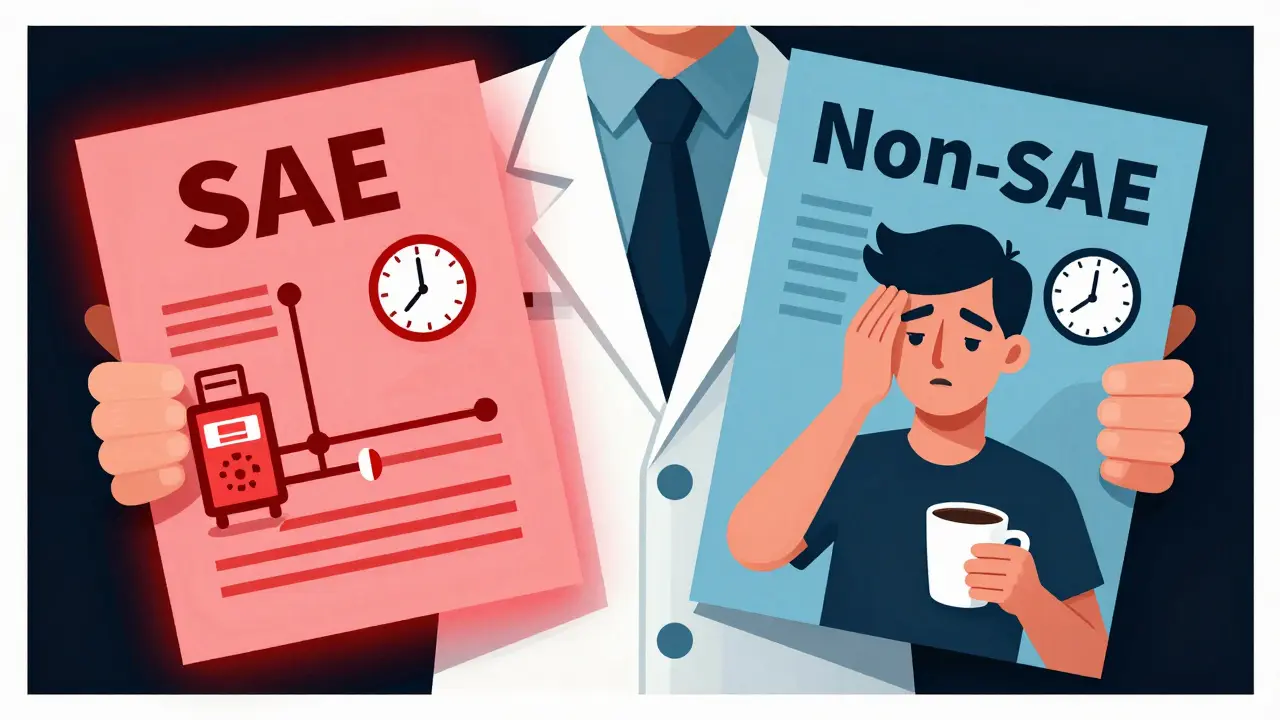
When you're running a clinical trial, every patient reaction matters. But not every reaction needs to be reported the same way. The difference between a serious adverse event and a non-serious one isn’t about how bad it feels-it’s about what it does to the patient’s life. Confusing the two isn’t just a mistake. It’s a system-wide problem that wastes time, money, and, most importantly, distracts from real safety threats.
What Makes an Adverse Event Serious?
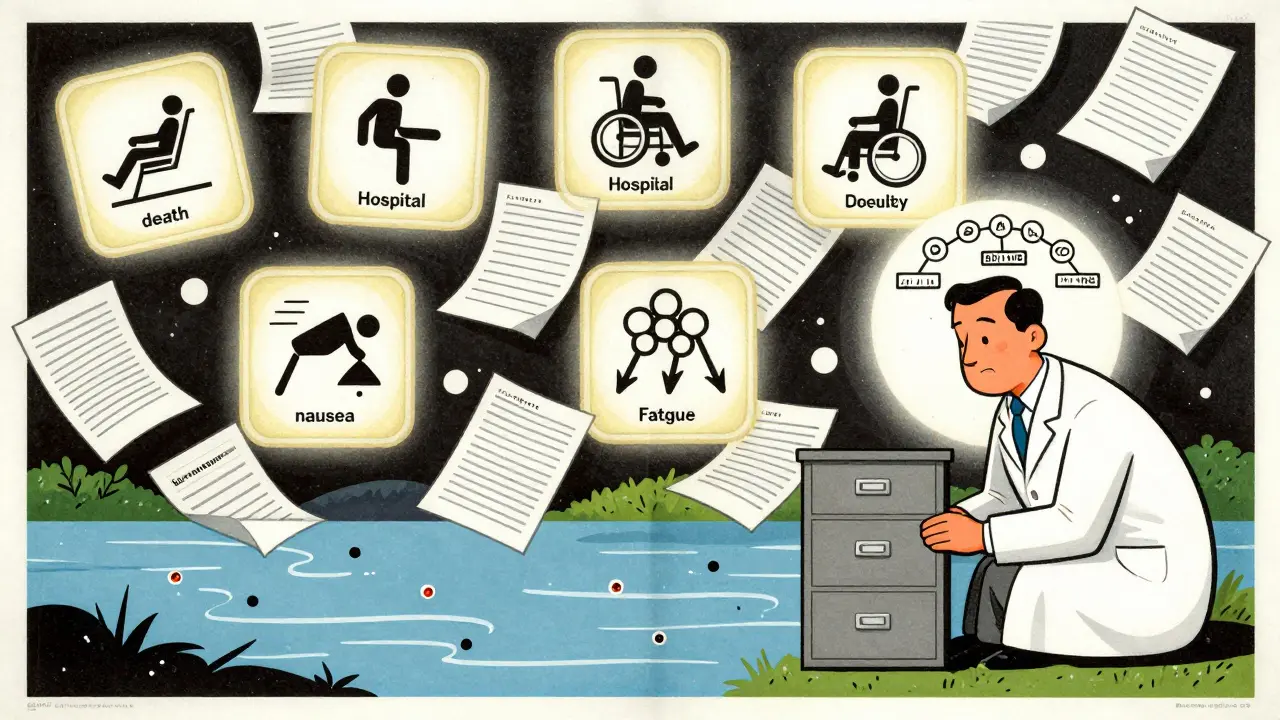
An adverse event (AE) is any unwanted medical occurrence during a clinical trial, whether or not it’s linked to the drug or device being tested. But only some of these rise to the level of serious. The FDA and ICH E2A guidelines define serious adverse events (SAEs) by six clear outcomes:
- Death
- Life-threatening condition (the patient was at immediate risk of dying)
- Requires hospitalization or extends an existing hospital stay
- Results in permanent disability or significant loss of function
- Causes a congenital anomaly or birth defect
- Requires medical or surgical intervention to prevent one of the above
That’s it. No more, no less. If none of these happened, it’s not serious-even if the symptom was intense.
Here’s the trap most people fall into: mixing up severity with seriousness. A severe headache? That’s intensity. A headache that leads to a stroke? That’s seriousness. A patient might have a Grade 3 (severe) nausea from chemotherapy, but if they don’t get hospitalized, don’t need IV fluids to prevent dehydration, and can still eat and walk, it’s not serious. Yet, in 2022, over 40% of adverse event reports submitted to one major IRB needed clarification because someone labeled a ‘severe’ symptom as ‘serious’ by accident.
When Must You Report a Serious Adverse Event?
Timing is everything. Once an investigator learns about a serious adverse event, they have 24 hours to report it to the sponsor. That’s not a suggestion. It’s a regulatory requirement under 21 CFR 312.32. The clock starts ticking the moment they know-whether it’s a phone call from the patient, a note from the ER, or a lab result that changes everything.
The sponsor then has to notify the FDA:
- Within 7 calendar days for life-threatening events
- Within 15 calendar days for all other serious events
And don’t forget the Institutional Review Board (IRB). Most IRBs require SAEs to be reported within 7 days, even if the sponsor hasn’t yet submitted to the FDA. Delays here can trigger audits, stop enrollment, or even halt the trial.
Why the rush? Because SAEs are early warning signs. If five patients in a trial develop sudden liver failure after taking a new drug, that’s not coincidence. That’s a signal. But if you’re drowning in reports of mild rashes or temporary dizziness, you’ll miss the signal in the noise.
What About Non-Serious Adverse Events?
Non-serious AEs are still important. They help track side effects, understand tolerability, and identify patterns over time. But they’re not urgent. These go into the Case Report Form (CRF) and are reported in bulk-monthly, quarterly, or during routine safety reviews.
Think of it like this: Non-serious events are the background hum of the trial. They’re logged, analyzed, and reviewed for trends. If 30% of patients report mild fatigue, that’s useful. If 30% report fatigue and then suddenly 12 develop kidney failure, that’s when the serious event reporting system kicks in.
Some protocols don’t even require non-serious AEs to be reported to the IRB at all. They’re only reviewed if they become frequent, severe, or start clustering in a way that suggests a safety issue. The NIA’s 2018 guidelines say mild events are transient, require no treatment, and don’t interfere with daily life. Moderate ones might need a doctor’s visit or a short course of medication-but still don’t meet the seriousness threshold.
The Cost of Getting It Wrong
Getting the classification wrong isn’t just a paperwork error. It’s expensive.
In 2022, the pharmaceutical industry spent $1.89 billion on adverse event reporting. Over 60% of that-more than $1.1 billion-went toward processing events that didn’t meet seriousness criteria. That’s not just wasted time. It’s staff hours, system resources, legal reviews, and delays in getting safe drugs to patients.
One study found that nearly 38% of events reported as serious to IRBs in 2019 were later determined to be non-serious. That’s like calling the fire department because someone spilled coffee. You’re not helping-you’re clogging the system.
And it’s not just small sites. Even top research centers struggle. At UCSF, 42% of AE reports in 2022 needed clarification. At SWOG Cancer Research, 32% of SAE reports had to be corrected because of misclassification. In oncology trials, where patients often have multiple baseline conditions, the confusion is worse. One coordinator on Reddit said, “I spent three hours arguing with a PI about whether ‘severe anxiety’ counted as serious. It didn’t. But we still had to file it as an SAE because the protocol said ‘any psychiatric event.’”
How to Get It Right Every Time
The solution isn’t more training. It’s better tools and clearer processes.
The NIA recommends a simple four-question decision tree:
- Did the event cause death?
- Was it life-threatening?
- Did it require hospitalization or extend an existing stay?
- Did it cause permanent disability or birth defect?
If the answer to any is yes-it’s serious. Report it now.
Use standardized tools. The Common Terminology Criteria for Adverse Events (CTCAE) version 5.0 grades severity (mild, moderate, severe). But seriousness is a separate checklist. Most sponsors now use both side-by-side. The FDA’s MedWatch Form 3500A has checkboxes for each seriousness criterion-use them.
Training matters. ICH E6(R2) requires documented training for all staff before a trial starts. Top institutions now require annual refreshers. Why? Because even experienced researchers forget. In a 2022 survey, 63% of sites had inconsistent seriousness determinations across different studies. That’s not human error-it’s a system failure.
Now, AI is helping. Automated tools now correctly classify seriousness in nearly 90% of cases-better than humans. But they’re not perfect. They miss context. A patient with metastatic cancer who gets hospitalized for pneumonia? That’s serious. But if they were already in the hospital for chemo, was the pneumonia a new event or a complication of their condition? That’s where a trained human must step in.
What’s Changing in 2025?
The rules are tightening. The FDA’s May 2023 draft guidance wants to standardize seriousness definitions across all therapeutic areas. No more “it depends.”
The EU’s Clinical Trials Regulation (2022) already unified definitions across 27 countries. Cross-border trials are now smoother. The NIH updated its guidelines in September 2023 to clarify: emergency room visits alone don’t make an event serious-unless they meet one of the six criteria.
By 2025, ICH’s E2B(R4) will replace paper and legacy systems with a single global format for electronic reporting. And the FDA is testing AI tools that can auto-triage reports using natural language processing. Early results show they could cut processing time by almost half.
But the core rule won’t change: seriousness is about outcome, not intensity. Keep that in mind. Always.
What Happens If You Don’t Report?
Ignoring a serious adverse event isn’t just a violation-it’s a risk to patients. The FDA can issue warning letters, suspend trials, or even block drug approvals. Sponsors have been fined millions for delayed SAE reporting.
But even if you’re not caught, you’re failing your patients. If a pattern of kidney injury goes unreported because someone thought “it was just a lab value,” the next patient might suffer irreversible damage.
Reporting isn’t bureaucracy. It’s protection.
Final Checklist: Report or Not?
Before you hit submit, ask:
- Did the event cause death, hospitalization, or life-threatening risk?
- Did it cause permanent disability or birth defect?
- Did it require intervention to prevent one of the above?
- Is this event new, unexpected, and possibly linked to the investigational product?
If yes to any of the first three-report as serious, immediately.
If no, log it in the CRF, track trends, and report during routine reviews.
When in doubt, ask your safety team. Or better yet-use the decision tree. It’s simple. It’s proven. And it saves lives.
Is a severe headache a serious adverse event?
Not unless it leads to hospitalization, stroke, or permanent neurological damage. A severe headache is about intensity. Seriousness is about outcome. Most headaches-even very painful ones-don’t meet the FDA’s six criteria for seriousness. Don’t report them as SAEs.
What if a patient goes to the ER but isn’t admitted?
Going to the ER alone doesn’t make an event serious. The NIH clarified this in 2023. Only if the ER visit was needed to prevent death, hospitalization, or permanent damage does it qualify. For example, if someone comes in for dehydration from vomiting and gets IV fluids to avoid kidney failure, that’s serious. If they just get a prescription and leave, it’s not.
Do I need to report every side effect from a drug?
No. Only serious adverse events require immediate reporting. Mild or moderate side effects like nausea, fatigue, or mild rash are logged in case report forms and reported in aggregate during routine safety reviews. Reporting everything as serious overwhelms the system and hides real dangers.
Who is responsible for reporting serious adverse events?
The investigator (doctor or research staff at the site) must report SAEs to the sponsor within 24 hours. The sponsor then reports to the FDA and IRB. Everyone has a role-but the investigator is the first line of detection. Don’t wait for someone else to catch it.
Can a non-serious event become serious later?
Yes. A patient might have a mild rash at first, but if it progresses to toxic epidermal necrolysis (a life-threatening skin condition), it becomes serious. Always follow up. If a patient’s condition worsens after an initial non-serious report, treat it as a new SAE and report immediately.
Are psychiatric events always serious?
No. Severe depression or anxiety is not automatically serious. Only if it leads to suicide attempt, hospitalization for psychiatric emergency, or permanent disability does it qualify. Many sites misclassify psychiatric symptoms because they sound intense. Use the six criteria-don’t rely on labels.
Colin Pierce
January 29, 2026 AT 02:40Had a trial last year where we misclassified a severe migraine as an SAE. Turned out the patient just had a bad day and a skipped coffee. We wasted 17 hours of investigator time and a whole week of audit prep. The decision tree saved us when we finally used it. Seriously, just ask the six questions. No more guessing.
Sue Latham
January 29, 2026 AT 22:29Ugh, I swear half the sites I’ve worked with think ‘severe’ means ‘serious.’ Like, honey, if your patient gets a headache and takes an Advil, that’s not a life-threatening event. It’s just a headache. Stop over-reporting and let the real red flags breathe.
Kathy Scaman
January 30, 2026 AT 18:41My PI once reported a patient’s mild rash as an SAE because ‘it looked scary.’ We had to file a correction. The FDA email back was just: ‘Did it cause death? No. Hospitalization? No. Then why?’ I still laugh about it.
Linda O'neil
February 1, 2026 AT 07:30This is exactly why we started using the CTCAE + seriousness checklist combo. It’s not magic, but it’s the closest thing we’ve got. Now our team has a 92% accuracy rate on first-pass classifications. No more midnight panic calls about ‘severe nausea.’
Timothy Davis
February 1, 2026 AT 09:2390% AI accuracy? That’s a lie. I’ve seen AI misclassify a patient with metastatic cancer getting hospitalized for pneumonia as ‘non-serious’ because ‘baseline condition.’ Humans still matter. Stop outsourcing judgment to a bot that doesn’t know what ‘terminal’ means.
Lexi Karuzis
February 2, 2026 AT 17:33And who’s really behind this ‘standardization’ push? Big Pharma. They don’t want to be held accountable for side effects-they want to bury the noise. The FDA’s ‘six criteria’? It’s a loophole. They’ve been quietly lowering the bar since 2018. Don’t be fooled.
Anna Lou Chen
February 2, 2026 AT 19:20Let’s deconstruct the epistemology of ‘seriousness’-it’s a social construct mediated by regulatory hegemony. The six criteria are a colonial imposition on embodied patient experience. A ‘severe anxiety’ episode might not meet bureaucratic thresholds, but for the patient, it’s a collapse of ontological security. We’re not just reporting events-we’re enforcing a neoliberal biopolitical regime.
Brittany Fiddes
February 3, 2026 AT 19:49Of course the US is behind. We still use paper forms in 2024? In the UK, we’ve had fully automated SAE triage since 2021. Our NHS sites flag everything in real-time. You guys are still arguing about whether a headache counts. Pathetic.
fiona vaz
February 4, 2026 AT 18:55I used to panic every time a patient said ‘I feel awful.’ Now I just run through the six questions. If none apply, I log it, send a follow-up text, and move on. It’s not cold-it’s efficient. And honestly? It lets us focus on the people who actually need help.
James Dwyer
February 5, 2026 AT 05:33My favorite part? When a PI says ‘But this patient was crying!’ and you have to explain that sadness isn’t a criterion. We’re not here to comfort-we’re here to protect.
Lance Long
February 6, 2026 AT 11:15You know what’s worse than misreporting? Not reporting because you’re afraid of the paperwork. I’ve seen good researchers avoid filing SAEs because ‘it’ll cause a headache for the sponsor.’ That’s not professionalism. That’s negligence. If you’re unsure, report it. Then get help. Better safe than sorry-always.
jonathan soba
February 7, 2026 AT 07:527251’s comment is dangerously naive. Efficiency isn’t the goal-patient safety is. If you’re logging every mild symptom just to ‘save time,’ you’re normalizing risk. One day, a real SAE will slip through because you trained your team to treat everything like noise. Don’t be the reason someone dies because you wanted to clear your inbox.