
When a generic drug hits the shelf, you might assume it’s just a cheaper version of the brand-name pill. But behind that simple label is a rigorous science designed to prove it works the same way in your body. That’s where bioequivalence testing comes in. It’s not just paperwork-it’s the gatekeeper that ensures generics are safe, effective, and interchangeable. And there are two main ways to prove it: in vivo and in vitro. One happens inside living people. The other happens in a lab dish. Knowing when each is used makes sense of why some generics get approved faster than others-and why some still require human trials.
What Bioequivalence Actually Means
Bioequivalence isn’t about matching the pill’s color or shape. It’s about proving the active ingredient gets into your bloodstream at the same rate and amount as the original drug. The FDA requires that the 90% confidence interval for the ratio of the test drug to the reference drug falls between 80% and 125% for two key measurements: Cmax (how high the drug peaks in your blood) and AUC (how much drug is absorbed over time). If it’s outside that range, the generic isn’t approved. This isn’t theoretical-it’s the law under 21 CFR 320.24.
But here’s the catch: measuring what happens in your body is messy. People vary in weight, metabolism, stomach pH, and even what they ate that morning. That’s why regulators look for alternatives that are more predictable.
In Vivo Bioequivalence: Testing in Real People
In vivo testing means running clinical studies with real humans-usually 24 healthy volunteers. They take the generic and the brand-name drug in separate periods, with a washout phase in between. Blood samples are drawn over 24 to 72 hours. Then scientists plot the drug’s concentration over time and crunch the numbers.
This method is the gold standard. It’s the only way to directly measure how the body absorbs the drug. That’s why it’s still required for about 95% of generic oral solid drugs approved by the FDA. But it’s expensive. A single study costs between $500,000 and $1 million. It takes 3 to 6 months to run, including screening, dosing, and data analysis. You need certified clinical units, trained staff, and compliance with 21 CFR Part 11 for electronic records.
It’s also not always enough. For drugs with a narrow therapeutic index-like warfarin, levothyroxine, or cyclosporine-the acceptable range tightens to 90%-111.11%. Why? Because even a small difference in absorption could lead to toxicity or treatment failure. In these cases, in vivo testing isn’t just preferred-it’s mandatory.
And if the drug’s absorption changes with food? You need two studies: one fasting, one after a meal. That doubles the cost and time. For drugs with nonlinear pharmacokinetics-where doubling the dose doesn’t double the blood level-human data is the only reliable way to confirm safety.
In Vitro Bioequivalence: Testing in the Lab
In vitro testing skips the human body entirely. Instead, scientists use lab tools to mimic how the drug behaves. The most common method is dissolution testing: placing the pill in a fluid that simulates stomach or intestinal conditions, then measuring how fast the drug dissolves. Other methods include particle size analysis, droplet size measurement for inhalers, and content uniformity checks.
These tests are precise. Dissolution results often have a coefficient of variation under 5%, compared to 10-20% in human studies. They’re faster-2 to 4 weeks instead of months. And they cost a fraction: $50,000 to $150,000 versus half a million or more.
But here’s the key: in vitro testing doesn’t prove the drug works in the body. It proves the drug behaves the same way in a controlled environment. That’s why regulators only accept it when there’s strong evidence linking lab results to real-world performance.
When In Vitro Testing Works: The BCS Class I Rule
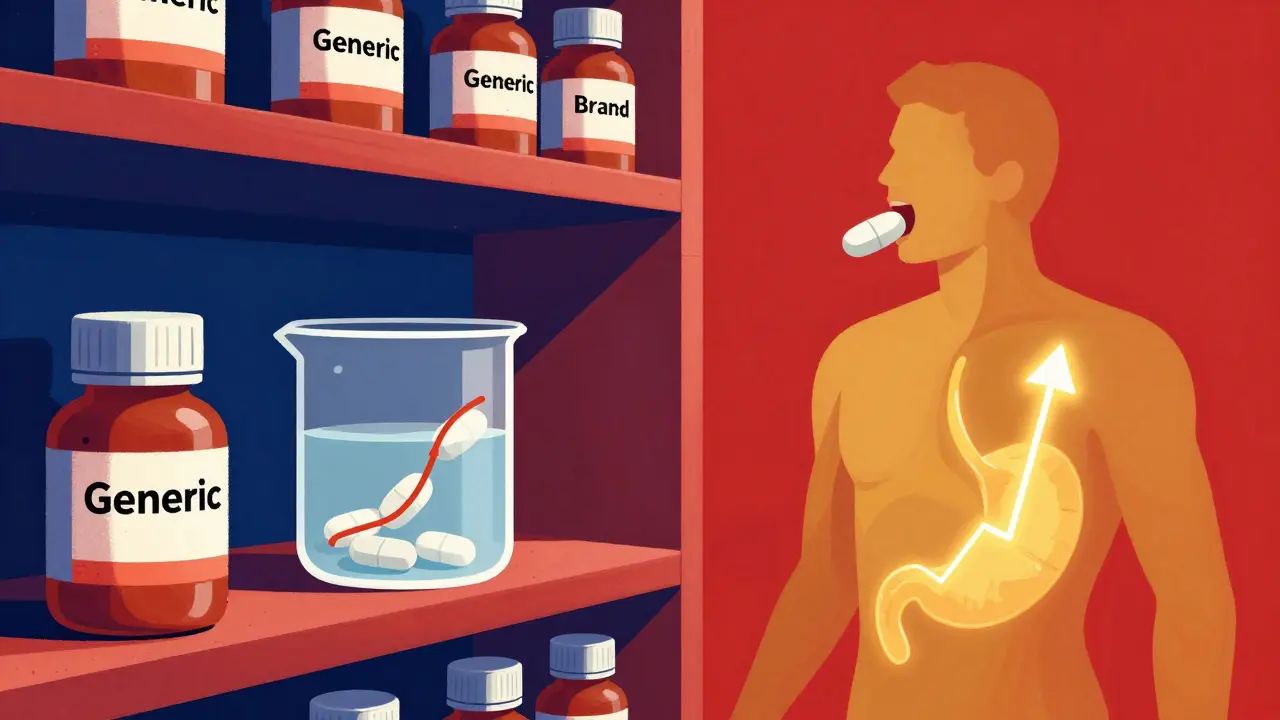
The Biopharmaceutics Classification System (BCS) is the shortcut to approval for many generics. It groups drugs by solubility and permeability. BCS Class I drugs are highly soluble and highly permeable-meaning they absorb quickly and reliably in the gut, no matter the formulation.
For these, the FDA grants biowaivers. In 2021, 78% of biowaiver requests for BCS Class I drugs were approved based on in vitro data alone. Drugs like metformin, atenolol, and ciprofloxacin fall into this category. If the generic dissolves at the same rate as the brand in multiple pH conditions (like 1.2, 4.5, and 6.8), and meets other criteria, no human study is needed.
This isn’t a loophole-it’s science. A 2018 study in the AAPS Journal showed in vitro dissolution correctly predicted in vivo bioequivalence for 92% of BCS Class I drugs. That’s why companies like Teva saved $1.2 million and 8 months on one product by using in vitro methods.
Where In Vitro Testing Falls Short
But not all drugs are that simple. BCS Class III drugs are highly soluble but poorly permeable. For them, in vitro testing only predicts bioequivalence about 65% of the time. Why? Because absorption depends on how well the drug crosses the gut wall-a process that’s hard to replicate in a beaker.
Topical products like creams or ointments are another gray area. If the drug acts locally on the skin, systemic absorption doesn’t matter. In vitro testing-measuring how much drug is released from the cream-is often enough. But if a topical drug is meant to enter the bloodstream (like some hormone patches), in vivo testing is still required.
Complex delivery systems are where in vitro really shines. Inhalers, nasal sprays, and injectables can’t be tested ethically or practically in large human studies. For metered-dose inhalers, regulators use cascade impactors to measure particle size distribution. For nasal sprays, they test droplet size and dose uniformity. The FDA approved Teva’s generic budesonide nasal spray in October 2022 based solely on in vitro data-marking a major shift in policy.
The Role of IVIVC and Modeling
The holy grail is In Vitro-In Vivo Correlation (IVIVC). This is when a lab test reliably predicts how the drug will behave in the body. A Level A IVIVC-where the dissolution curve matches the absorption curve with an r² above 0.95-is considered the strongest possible link.
It’s rare. Only a handful of drugs, like modified-release theophylline, have established Level A correlations. But when it exists, regulators trust it. The FDA’s 2023 draft guidance on nasal sprays and inhalers explicitly says in vitro testing alone can be sufficient if IVIVC is proven.
Even more promising is the rise of physiologically based pharmacokinetic (PBPK) modeling. These computer simulations use data on drug properties, anatomy, and physiology to predict absorption. The FDA accepted PBPK modeling for some modified-release products in 2023. It’s not a replacement yet-but it’s becoming a powerful tool to support in vitro data.
Why Some Companies Still Fail
Not every company that tries in vitro testing succeeds. A regulatory affairs manager from Viatris reported that their topical antifungal, approved via in vitro BE, later required an in vivo study after post-marketing reports of reduced effectiveness. The cost? $850,000 and 11 months of delay.
Why? Because in vitro methods can’t capture everything. The body has enzymes, pH shifts, motility changes, and food interactions. A drug might dissolve perfectly in a lab but get trapped in stomach mucus or broken down by gut bacteria. That’s why Dr. Lawrence Lesko warns: in vitro methods can’t replicate the full complexity of human digestion.
Method development is also a hurdle. Setting up a dissolution test that meets FDA standards can take 4 to 12 weeks. You need specialized equipment-like USP Apparatus 4 flow-through cells-that cost $85,000 to $120,000. And you need scientists with advanced degrees in pharmaceutical sciences who understand both chemistry and biology.
The Future Is Hybrid
The trend is clear: regulators want to reduce unnecessary human testing. The FDA’s 2020-2025 Strategic Plan pushes for novel approaches. The EMA approved 214 biowaivers in 2022, up 27% from 2020. The ICH has aligned U.S., EU, and Japanese standards for BCS Class I drugs.
But the future isn’t in vitro or in vivo-it’s both. For most simple oral drugs, in vitro will dominate. For narrow therapeutic index drugs, complex formulations, or those with food effects, in vivo remains essential. The goal is to use the right tool for the job.
The FDA’s 2023 White Paper envisions a future where in vitro testing, backed by modeling, becomes the primary method. In vivo studies will be reserved for the high-risk cases where the stakes are too high to guess.
For generic manufacturers, this means investing in lab capabilities and scientific expertise-not just cutting costs. For patients, it means faster access to safe, affordable medicines without compromising safety.
Bottom Line: Choose the Right Test for the Right Drug
There’s no one-size-fits-all answer. If your drug is a BCS Class I oral tablet? In vitro testing is your best bet. Fast, cheap, reliable. If it’s a blood thinner, a hormone patch, or a complex inhaler? Don’t skip the human study. The risks are too high.
The science has evolved. The rules have changed. But the goal hasn’t: make sure every generic pill you take works just like the brand. Whether it’s tested in a lab or in a person’s bloodstream, that’s the standard-and it’s non-negotiable.
Can in vitro testing replace in vivo testing for all generic drugs?
No. In vitro testing is only accepted for specific drug types, like BCS Class I oral solids, topical products with local action, or complex delivery systems like inhalers when supported by strong data like IVIVC. For drugs with narrow therapeutic indices, nonlinear absorption, or food effects, in vivo human studies are still required by the FDA and EMA.
Why is in vivo testing still used if it’s so expensive and variable?
Because it’s the only method that directly measures how the drug behaves in the human body. While in vitro tests are more precise, they can’t replicate real-world factors like stomach pH changes, gut motility, enzyme activity, or food interactions. For high-risk drugs, regulators need that direct human data to ensure safety.
What is the Biopharmaceutics Classification System (BCS)?
The BCS classifies drugs based on solubility and intestinal permeability into four classes. BCS Class I drugs are highly soluble and highly permeable, making them ideal candidates for biowaivers. About 78% of BCS Class I generic applications are approved using in vitro data alone, according to FDA 2021 data.
How do regulators verify that in vitro methods are reliable?
Regulators require method validation, including precision, accuracy, specificity, and robustness testing. For dissolution, this means testing across multiple pH levels and comparing results to in vivo data. A validated In Vitro-In Vivo Correlation (IVIVC), especially Level A with r² > 0.95, is the strongest proof a method can predict real-world performance.
Are in vitro methods accepted worldwide?
Yes. The FDA, EMA, and PMDA (Japan) all accept in vitro bioequivalence testing for BCS Class I drugs under ICH harmonization guidelines. The EMA approved 214 biowaivers based on in vitro data in 2022, and the FDA has approved multiple generics for inhalers and nasal sprays using only in vitro data since 2022.
What’s the biggest challenge in using in vitro testing?
The biggest challenge is developing a method that truly reflects how the drug behaves in the human body. It requires deep expertise in biopharmaceutics, advanced equipment, and significant time-often 4 to 12 weeks just to develop and validate the test. Many companies fail because they underestimate the complexity of method development.
Spencer Garcia
December 25, 2025 AT 06:27BCS Class I drugs are the low-hanging fruit for biowaivers. If it dissolves like the brand in pH 1.2, 4.5, and 6.8, and it’s highly soluble/permeable, skip the human trial. Saves millions and gets meds to patients faster.
Simple science, smart policy.
Abby Polhill
December 25, 2025 AT 21:17Let’s be real - in vitro is the future, but regulators still treat it like a suspicious teenager trying to borrow the car. IVIVC? Level A? That’s the golden ticket. Most labs can’t even get past Level B without crying into their HPLC columns.
Also, why is everyone still using USP Apparatus 2? Time to upgrade to flow-through cells already.
Bret Freeman
December 27, 2025 AT 02:33They let a pill dissolve in a beaker and call it ‘equivalent’? And you’re telling me this is how we’re saving healthcare costs? That’s not science - that’s corporate wishful thinking.
What happens when your ‘identical’ generic gets stuck in mucus or gets digested by gut flora? You think a dissolution profile predicts THAT? Wake up.
People are dying because we cut corners. This isn’t innovation - it’s negligence dressed up in regulatory jargon.
Lindsey Kidd
December 28, 2025 AT 16:14Yessssss!! 🙌 Love how we’re moving toward smarter, less invasive testing - especially for inhalers and nasal sprays. No one needs to be poked with needles for a bioequivalence study if the science backs it.
Big props to the FDA for evolving. More of this, less of the ‘we’ve always done it this way’ mentality. 💪🧪
Austin LeBlanc
December 28, 2025 AT 16:44Wait, so you’re saying if your drug is a BCS Class I, you don’t need to test it on humans? That’s wild. I bet 80% of these ‘approved’ generics are just cheap copies with the same active ingredient and zero quality control.
Who’s really checking if the dissolution test was done right? Or if they just faked the data to save money?
Don’t be fooled - this is pharma’s way of outsourcing safety to algorithms.
Christine Détraz
December 30, 2025 AT 09:18I get the push for in vitro - cheaper, faster, ethical. But I also remember when the EMA approved a generic warfarin based on dissolution data, and then post-marketing reports came in of INR spikes.
It’s not that in vitro is wrong - it’s that we need to be humble about its limits.
Maybe we need a tiered system: in vitro for low-risk, in vivo for high-risk, and mandatory post-market surveillance for all.
Science should be bold, but not reckless.
Gray Dedoiko
December 31, 2025 AT 07:11My cousin’s on levothyroxine and switched to a generic. Her TSH went nuts for a month. Docs said ‘it’s bioequivalent’ - but her body didn’t agree.
That’s the gap. Lab numbers ≠ real life.
Still, I’m glad they’re trying to cut costs. Just don’t pretend it’s perfect.
Aurora Daisy
December 31, 2025 AT 11:43Oh, so now the Americans are proud of cutting corners? Brilliant. In the UK, we still require at least one human study for anything that touches the bloodstream - even if it’s ‘just’ a BCS Class I. You call that innovation? We call it recklessness.
At least here, people don’t die because someone thought a dissolution curve was ‘good enough’.
Paula Villete
January 1, 2026 AT 09:31So… you’re telling me we’ve spent 20 years developing IVIVC models and PBPK simulations… and now we’re using them to avoid human trials? That’s not progress - that’s poetic justice.
Also, ‘typo-prone’ is my middle name, but I still know a Level A IVIVC when I see one. r² > 0.95? That’s the holy grail. Most papers lie about that.
Also, why is no one talking about how the FDA approves inhalers based on particle size but still requires human data for nasal sprays? Double standards.
Georgia Brach
January 3, 2026 AT 00:20The entire premise is flawed. Bioequivalence is not a technical problem - it’s a regulatory illusion. You cannot reduce human physiology to dissolution curves and particle size distributions. The FDA’s 2023 White Paper is not visionary - it’s a surrender to cost-cutting disguised as scientific advancement.
There is no substitute for direct measurement in the living system. Period.
Anyone who claims otherwise is either ignorant or complicit.
Katie Taylor
January 4, 2026 AT 08:38Enough with the fearmongering. In vitro testing is SAFE, it’s SCIENTIFIC, and it’s FASTER. Stop acting like we’re letting dangerous drugs slip through. The data backs it - 92% accuracy for BCS I drugs. That’s better than some clinical trials.
Stop being afraid of progress. The world doesn’t need more blood draws - it needs more affordable medicine.
siddharth tiwari
January 5, 2026 AT 01:05u think this is science? nah. big pharma and FDA are in cahoots. they dont want you to know that generics are made in india with bad quality control. the dissolution test? they just change the pH till it matches. then they say ‘look, same!’
but when you take it, your stomach dont like it. you get bloated, dizzy, sick. but no one cares. because its cheaper.
its a conspiracy. i know it.
Adarsh Dubey
January 6, 2026 AT 10:15Good breakdown. I’d add that IVIVC isn’t just about correlation - it’s about mechanistic understanding. If you know how the drug dissolves, diffuses, and permeates, you can model it. But that takes real R&D, not just running a dissolution machine for a week.
Companies that treat this like a checklist fail. The ones that invest in biopharmaceutics win - and patients win too.