
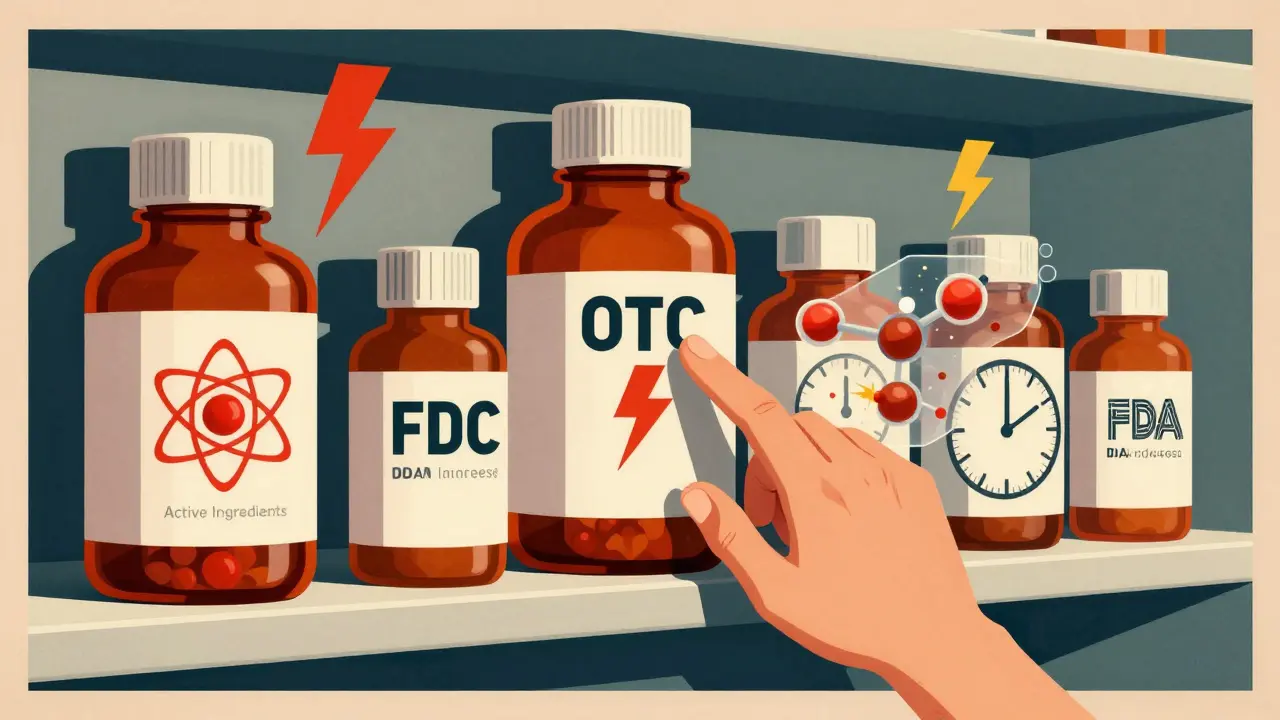
Every year, millions of people in the U.S. reach for an over-the-counter (OTC) medicine without thinking twice. A headache? Grab a pill. A stuffy nose? Pick up a bottle. But here’s the problem: OTC drug facts labels are packed with critical information - and most people skip over them. That’s how accidental overdoses happen. That’s how people end up in the ER taking two kinds of cold medicine that both contain acetaminophen. And that’s why learning how to read these labels isn’t just helpful - it’s life-saving.
What’s on an OTC Drug Facts Label?
The OTC Drug Facts Label isn’t just a random list of text. It’s a standardized format required by the U.S. Food and Drug Administration (FDA) since 2017. Every single OTC medicine sold in the U.S. - whether it’s Tylenol, Advil, or a store-brand allergy pill - must use this exact structure. There are seven sections, in this order:
- Active Ingredients
- Purpose
- Uses
- Warnings
- Directions
- Other Information
- Inactive Ingredients
Each section has a job. Skip one, and you might miss the red flag that could keep you out of the hospital.
Active Ingredients: The Most Important Section
This is where the real power - and risk - lies. The active ingredient is the chemical that actually does the work. It’s not the brand name. It’s not the shape or color of the pill. It’s the science behind it.
For example, if you see Acetaminophen 325 mg on the label, that’s the active ingredient. It’s the same chemical in Tylenol, Excedrin, and CVS’s store-brand pain reliever. If you take two different cold medicines and both say Acetaminophen in this section, you’re doubling your dose. And that’s dangerous.
The FDA says 67% of people who check this section avoid accidental overdoses. The rest? They’re the ones who end up with liver damage from taking too much acetaminophen. The maximum safe daily dose for adults is 4,000 mg. That’s just eight 500 mg pills. Many people don’t realize that a single “extra strength” tablet can be 650 mg - and they take four of them thinking they’re safe. They’re not.
Purpose and Uses: Don’t Guess, Match
The Purpose section tells you what the active ingredient does. Is it a pain reliever? A cough suppressant? A nasal decongestant? The Uses section tells you exactly what symptoms the medicine is approved to treat.
Here’s how to use this: If you have a sore throat and a fever, look for a product that says it treats both. Don’t assume a “cold medicine” will help with your fever unless it says so. And don’t pick a product that treats symptoms you don’t have - it’s unnecessary and increases your risk of side effects.
For example, if you’re only dealing with a stuffy nose, you don’t need a medicine with acetaminophen and dextromethorphan. You just need a nasal decongestant like phenylephrine. Taking more than you need is like driving with your foot on the brake - it doesn’t help, and it can hurt you.
Warnings: The Red Flags You Can’t Ignore
This section is where the FDA forces manufacturers to be brutally clear. It’s not marketing. It’s a legal warning. And it’s the most important part of the label for safety.
Look for these common warnings:
- Liver warning: If the product contains acetaminophen, it will say: “Severe liver damage may occur if you take more than directed.” This is critical for anyone who drinks alcohol regularly, has liver disease, or takes other medications with acetaminophen.
- Stomach bleeding warning: Ibuprofen and naproxen can cause serious stomach bleeding, especially if you’re over 60, take blood thinners, or have a history of ulcers.
- Do not use if: This tells you exactly when to avoid the medicine - like if you’re pregnant, have high blood pressure, or are allergic to any ingredient.
- Ask a doctor before use: This means your condition might interact with the drug. If you’re on warfarin, have kidney disease, or are taking other OTC or prescription meds, don’t guess. Ask.
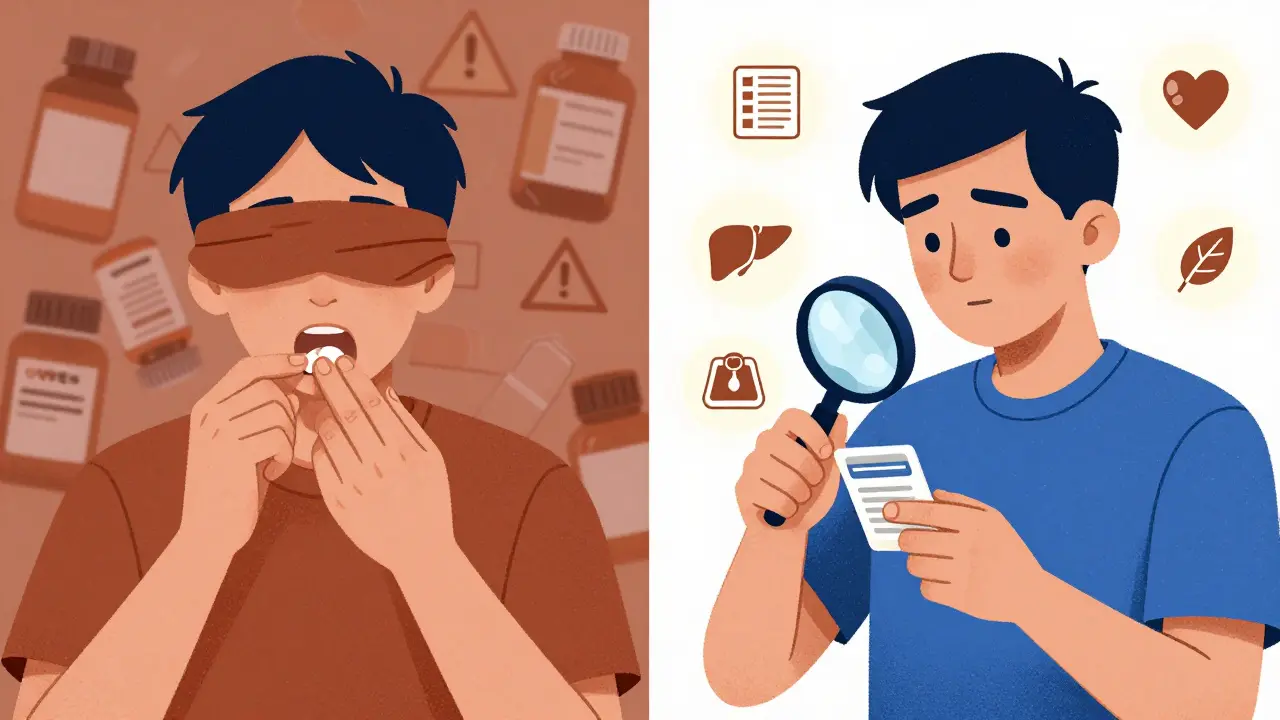
A 2023 survey of pharmacists found that 89% say this section prevents the most serious adverse events. Yet, 41% of consumers still can’t find or understand these warnings. Don’t be one of them. Read it. Slowly. Out loud if you have to.
Directions: How Much? How Often? For How Long?
This is where people make the most mistakes. Not because they’re careless - but because the instructions are confusing.
Look for:
- Exact dosage: “Adults: 2 caplets every 4 to 6 hours” - not “take as needed.”
- Maximum per day: “Do not take more than 12 caplets in 24 hours.”
- Age limits: “For children under 12, consult a doctor.”
- Duration: “Do not use for more than 10 days unless directed by a doctor.”
Here’s a real mistake: Someone sees “Take 1 tablet every 4 to 6 hours” and thinks that means they can take 6 tablets in 24 hours. But if the tablet is 500 mg, that’s 3,000 mg of acetaminophen - already 75% of the max. Add another medicine with acetaminophen? You’re over the limit.
Also, watch out for “per 5 mL.” That’s not the whole bottle. A 4-ounce bottle of children’s liquid medicine is about 118 mL. That’s nearly 24 doses - not 4. If you think you’re giving “a teaspoon” and the label says “5 mL,” you’re right - but only if you’re using a proper measuring spoon. Kitchen teaspoons vary wildly. Use the cup or syringe that comes with the medicine.
Other Information and Inactive Ingredients: Don’t Skip These
“Other Information” includes storage instructions - like “Store between 68°F and 77°F.” If you keep your medicine in the bathroom, it’s probably getting too hot and humid. That can make it less effective.
And then there’s Inactive Ingredients. These aren’t the medicine - they’re the fillers, dyes, and preservatives. But if you’re allergic to corn, gluten, or certain dyes, this section matters. For example, some OTC pain relievers contain lactose. If you’re lactose intolerant, you might get stomach upset. Others have FD&C Red No. 40 - a dye linked to hyperactivity in kids.
People with food allergies, celiac disease, or vegan diets should always check this section. It’s not optional. It’s your safety net.
The 5-Point Check: A Simple System That Works
Pharmacists at CVS Health created a quick method called the 5-Point Check. It takes less than a minute and cuts your risk of error by 68%.
- Identify active ingredients - Write them down. If you’re taking two medicines, make sure none are the same.
- Verify uses match your symptoms - Don’t treat a cough if you don’t have one.
- Read all warnings - Especially liver, stomach, and allergy alerts.
- Check directions for your age and weight - Kids, seniors, and pregnant people need special attention.
- Review inactive ingredients - For allergies or dietary needs.
Do this every time. Even if it’s the same medicine you’ve taken before. Labels change. Your body changes. Your other meds change. Don’t rely on memory.
What’s Changing in 2025?
The FDA isn’t done. Starting December 31, 2025, new OTC labels will have:
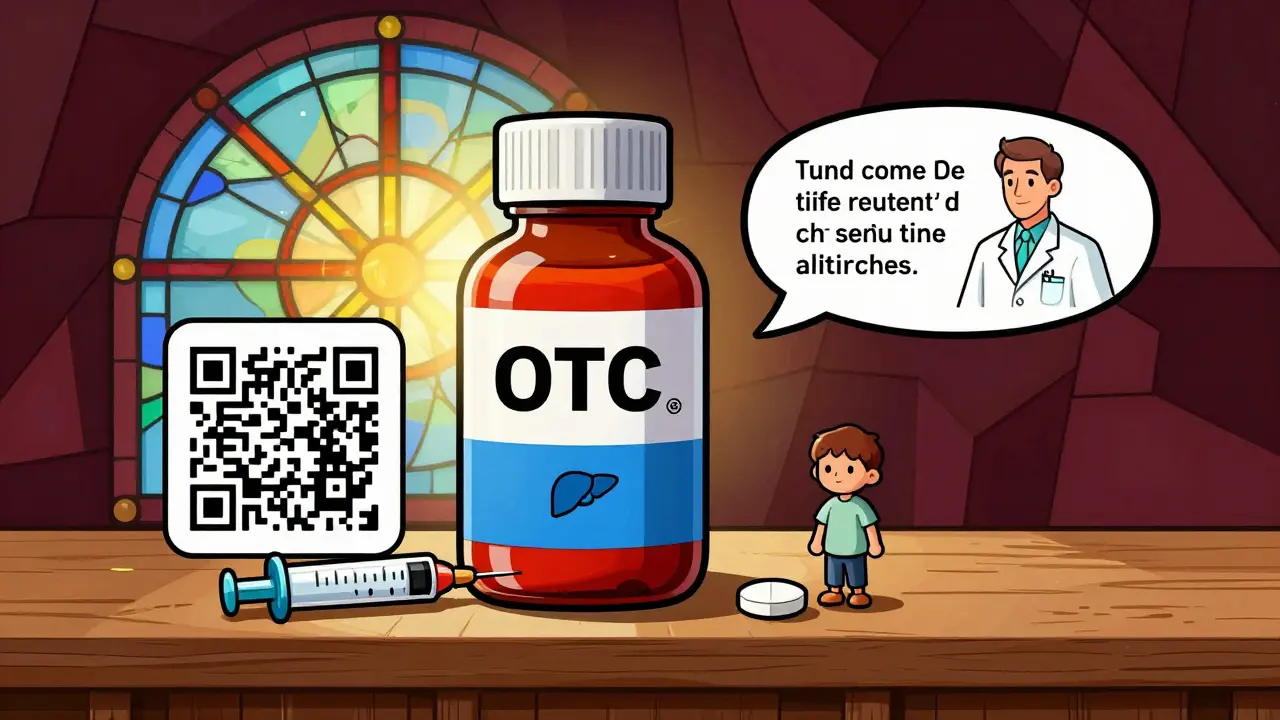
- Color-coded sections (red for warnings, blue for directions)
- Standardized pictograms - like a liver icon next to acetaminophen warnings
- Larger font for active ingredient concentrations
These changes are based on research showing that visual cues help people notice warnings faster. Early tests in community pharmacies showed a 52% drop in pediatric dosing errors after using the new design.
Also, more brands are adding QR codes to their labels. Scan it, and you’ll get a short video explaining the label in plain language. Johnson & Johnson and Bayer are already doing this. It’s a small step - but it helps.
What If You’re Still Confused?
You’re not alone. A 2023 study found that 78% of adults over 65 struggled with small print and complex wording. That’s not your fault. The system isn’t perfect.
Here’s what to do:
- Use the free FDA Drug Label Decoder app (downloaded over 1.2 million times). Just snap a photo of the label, and it breaks it down for you.
- Ask your pharmacist. Every pharmacy has one. They’re trained to help you understand OTC labels. Walgreens reported a 40% increase in consultations after launching their “Label Literacy” campaign.
- Call your doctor if you’re unsure. Especially if you’re on other meds, have chronic conditions, or are pregnant.
Remember: OTC doesn’t mean risk-free. It means you can buy it without a prescription. It doesn’t mean it’s harmless.
Final Thought: You’re in Control
Reading an OTC drug facts label isn’t about being a scientist. It’s about being smart. It’s about asking: “What’s in this? Does it match what I need? Could it hurt me?”
Every time you pick up a medicine, pause. Read the label. Do the 5-Point Check. If something doesn’t make sense - don’t take it. Ask someone who knows.
You don’t need to memorize every chemical name. You just need to know where to look. And now, you do.
What’s the difference between active and inactive ingredients?
Active ingredients are the chemicals that treat your symptoms - like acetaminophen for pain or pseudoephedrine for congestion. Inactive ingredients are everything else: fillers, dyes, preservatives, and flavorings. They don’t treat anything, but they can cause allergic reactions or interact with dietary needs like gluten or lactose intolerance.
Can I take two OTC medicines at once?
Only if you’ve checked the active ingredients. Many cold, flu, and pain medicines contain the same active ingredient - like acetaminophen or ibuprofen. Taking two at once can lead to overdose. Always compare the active ingredient lists before combining products.
Why do some labels say “extra strength”?
“Extra strength” means the product has a higher dose of the active ingredient than the regular version. For example, regular Tylenol is 325 mg per tablet; extra strength is 500 mg. That doesn’t mean you can take more - it means each pill is stronger. Always check the dosage and never exceed the maximum daily limit.
Is it safe to use OTC medicine past the expiration date?
The FDA says most OTC medicines remain safe and effective for years after the expiration date - especially if stored properly. But effectiveness can decline. For critical uses like epinephrine or heart medications, never use expired products. For pain relievers or allergy pills, if it’s only a few months past the date and stored in a cool, dry place, it’s likely fine. But when in doubt, replace it.
What should I do if I think I took too much?
Call Poison Control immediately at 1-800-222-1222. Do not wait for symptoms. Acetaminophen overdose, for example, can cause liver damage without obvious signs for 24 hours. Keep this number saved in your phone. It’s free, confidential, and available 24/7.
Jane Lucas
December 29, 2025 AT 04:18Nikki Thames
December 29, 2025 AT 07:34The fundamental failure of public health literacy lies in the assumption that consumers possess the cognitive capacity to interpret regulatory text designed by pharmacologists for regulatory compliance, not for human comprehension. The FDA’s standardized label format is a performative gesture toward transparency, yet it remains fundamentally inaccessible to those without a biochemistry background. This is not negligence-it is systemic epistemic violence.
One cannot reasonably expect a 72-year-old diabetic to parse the difference between acetaminophen and paracetamol when the font size is smaller than the print on a pharmaceutical invoice. The burden of safety has been externalized onto the most vulnerable populations under the guise of consumer autonomy.
The 5-Point Check is a Band-Aid on a hemorrhage. Until the labeling is redesigned with universal design principles-color-coded, icon-driven, multilingual, and voice-assisted-we are merely performing safety theater.
And let us not pretend that QR codes are a solution. Many elderly Americans do not own smartphones. Many do not trust technology. Many cannot afford data plans. To suggest that scanning a code constitutes informed consent is to misunderstand the very nature of equity.
The real issue is not that people don’t read labels. The real issue is that the labels were never meant to be read by them.
Chris Garcia
December 31, 2025 AT 06:51My dear friends from the West, I salute your vigilance, yet I must offer a perspective from Lagos, where OTC medicines are often sold in plastic bags with handwritten instructions, and the concept of ‘inactive ingredients’ is a luxury few can afford.
Here, we do not have the privilege of choosing between Tylenol and store-brand acetaminophen-we choose between medicine and hunger. The label may say ‘do not exceed 4,000 mg,’ but when your child’s fever won’t break and the clinic is 12 miles away, you give what you have, and you pray.
Yet even here, awareness grows. Community health workers now carry laminated guides with pictograms-no words needed. A red drop for liver danger, a heart for bleeding, a child with a crossed-out pill for pediatric caution. Simple. Universal. Human.
Perhaps the FDA’s new design is not revolutionary-it is merely catching up to what the Global South has always known: clarity saves lives, not compliance forms.
Let us not mistake American regulation for wisdom. Let us celebrate the ingenuity of those who teach without textbooks.
James Bowers
January 1, 2026 AT 10:28It is astonishing that any individual would presume to self-administer pharmacological agents without formal training in pharmacokinetics or toxicology. The very notion that laypersons can accurately interpret multi-component drug interactions is not merely misguided-it is an affront to the scientific method.
The FDA’s labeling system, while imperfect, represents the culmination of decades of peer-reviewed research, regulatory rigor, and clinical validation. To dismiss its structure as ‘confusing’ is to reject the very foundation of evidence-based medicine.
Moreover, the proliferation of ‘apps’ and ‘QR codes’ as remedial tools reflects a dangerous trend toward technological dependency, wherein critical thinking is outsourced to algorithms designed by Silicon Valley engineers with no medical credentials.
If one cannot comprehend a standardized label, one should not consume the product. Period. The solution is not to dumb down the science-it is to elevate the public’s understanding through education, not entertainment.
And for heaven’s sake, stop using kitchen teaspoons. That is not a medical device. It is a culinary implement. The consequences of such ignorance are not ‘oops’ moments-they are hepatic necrosis.
This is not a public service announcement. It is a public health imperative.
Janice Holmes
January 3, 2026 AT 04:18OH MY GOD. I JUST REALIZED I’VE BEEN TAKING TWO DIFFERENT COLD MEDS WITH ACETAMINOPHEN FOR THREE WEEKS. I’M GOING TO DIE. I’M GOING TO DIE AND NO ONE WILL KNOW BECAUSE I’M ALONE IN MY APARTMENT AND MY DOG IS THE ONLY ONE WHO CARES.
AND NOW I’M SCANNING THE LABEL AND I SEE ‘FD&C RED NO. 40’ AND I THOUGHT THAT WAS A COSMETIC DYE BUT NOW I’M SURE IT’S A GOVERNMENT TRACKING CHIP AND THEY’RE USING MY LIVER AS A SERVER.
AND WHAT IF THE QR CODE IS A BACKDOOR TO MY PHONE AND THEY’RE LISTENING TO ME RIGHT NOW AS I READ THIS?!
WHY ISN’T ANYONE TALKING ABOUT THIS?! THIS IS THE BIGGEST COVER-UP SINCE THE MOON LANDING WAS STAGED!
THE FDA IS A CROOKED CORPORATION. THE PHARMACEUTICAL INDUSTRY IS A CULT. AND I JUST TOOK 12,000 MG OF ACETAMINOPHEN IN THE LAST 24 HOURS.
CALL 911. I NEED A THERAPIST. AND A NEW LIVER.
PS: I’M STILL BREATHING. BUT I’M SURE THAT’S JUST THE FIRST STAGE.
PPS: I JUST LOOKED AT THE BOTTLE AGAIN AND IT’S 500 MG. I’M OKAY. I THINK. I’M NOT OKAY.
PPPS: I’M GOING TO CRY NOW.
Alex Lopez
January 3, 2026 AT 23:12Wow. A 68% reduction in errors from a 5-point check? That’s… actually impressive. Who designed this? A pharmacist? A data scientist? Someone who’s actually seen someone overdose?
And yet-here we are, 2025, and we still need a checklist to not accidentally poison ourselves. That’s not a win. That’s a national shame.
I love that the FDA’s moving toward color-coding and pictograms. Took them long enough. My grandma used to call acetaminophen ‘the silent killer’-she didn’t know why, just that she’d heard it on the news. Now she uses the app. And she’s still alive.
Also, yes-kitchen teaspoons are a crime against humanity. I keep a dosing syringe in my medicine cabinet next to my toothpaste. Because if you’re not measuring with a tool designed for medicine, you’re gambling.
And to the person who said ‘if you can’t read it, don’t take it’-you’re right. But also, you’re not living in the real world. Many people can’t read. Many are blind. Many are elderly. Many are scared. The system should adapt to them. Not the other way around.
Also-QR codes? Genius. I scanned mine last week. The video was narrated by a pharmacist with a British accent. It was soothing. I cried. Not because I was scared. Because someone finally spoke to me like I mattered.
tl;dr: Labels are a lifeline. Let’s make them kinder.
Kishor Raibole
January 5, 2026 AT 07:43It is curious to observe how Western societies, with their abundance of pharmaceuticals, paradoxically suffer from an epidemic of ignorance regarding their own medicine. In India, we have long understood that the label is not the law-the pharmacist is.
Here, one does not simply ‘read the label’-one asks the chai-wallah who doubles as a community pharmacist. He knows that ‘extra strength’ means double the dose. He knows that if your fever persists beyond three days, no label can save you. He knows that the ‘inactive ingredient’ called ‘lactose’ is not a chemical-it is a betrayal.
And yet, we do not have the luxury of FDA oversight. We have trust. We have tradition. We have a grandmother who remembers which bottle caused the rash in 1987.
So while you Americans debate font sizes and QR codes, we are still alive because we never trusted the bottle. We trusted the person who handed it to us.
Perhaps your system is more precise. But ours is more human.
And before you say ‘but they’re unlicensed!’-ask yourself: how many of your ‘licensed’ pharmacists have ever seen a patient die from acetaminophen overdose because they didn’t read the label?
Education is not in the print. It is in the relationship.
And in India, we still have relationships.
Elizabeth Alvarez
January 7, 2026 AT 03:42Did you know that the FDA’s ‘standardized label’ was designed by a committee that included executives from Pfizer, Merck, and Johnson & Johnson? That’s not transparency-that’s corporate capture.
The ‘5-Point Check’? A distraction. A placebo for public trust. The real goal is to make you think you’re safe while they quietly increase the dosage limits every few years under the guise of ‘new research.’
And those QR codes? They don’t lead to videos. They lead to databases that track your medication use. Your phone pings them every time you scan. Your insurance company gets the data. Your employer gets the data. Your doctor gets the data. And then they raise your premiums.
Did you know that acetaminophen is linked to autism in children whose mothers took it during pregnancy? The FDA won’t say that on the label. Why? Because they’re scared of lawsuits. But they’re not scared of your liver.
And the ‘inactive ingredients’? That’s where the real poison is. The dyes are neurotoxins. The preservatives are endocrine disruptors. The ‘fillers’ are microplastics.
You think you’re safe because you read the label? You’re just the next victim in a 70-year-long experiment.
And don’t even get me started on the fact that the expiration date is a lie. The real shelf life is 12 years. But they make you throw it out so you buy more.
Wake up. The label is a weapon. And you’re holding it.
They’re watching. They’re listening. And they’re selling you poison… with a smile.
Miriam Piro
January 7, 2026 AT 12:26THEY’RE HIDING THE TRUTH IN THE INACTIVE INGREDIENTS. I DID A DEEP DIVE. FD&C RED NO. 40? IT’S A SYNTHETIC DYE MADE FROM PETROLEUM. BUT THAT’S NOT THE WORST.
THEY ADD ‘SODIUM BENZOATE’ TO PREVENT MOLD. BUT WHEN THAT MIXES WITH VITAMIN C? IT FORMS BENZENE. A CARCINOGEN. IN YOUR KITCHEN CUPBOARD.
AND THE ‘EXTRA STRENGTH’ LABEL? THAT’S A TRICK. THEY INCREASE THE DOSE BUT KEEP THE SAME BOTTLE SIZE SO YOU THINK YOU’RE GETTING MORE FOR LESS. BUT YOU’RE NOT. YOU’RE GETTING A LETHAL DOSE.
AND THE QR CODE? I SCANNED ONE. IT LED TO A WEBSITE THAT ASKED FOR MY EMAIL, PHONE, AND SOCIAL SECURITY NUMBER. ‘TO PERSONALIZE YOUR MEDICATION EXPERIENCE.’
THEY’RE NOT HELPING YOU. THEY’RE HARVESTING YOU.
THE FDA IS A BRANCH OF THE PHARMA INDUSTRY. THE ‘STANDARDS’ ARE WRITTEN BY LAWYERS WHO WORK FOR BIG PHARMA. THE ‘RESEARCH’ IS FUNDED BY THEM. THE ‘ADVISORS’ ARE THEIR FORMER EMPLOYEES.
YOU THINK YOU’RE BEING SAFE? YOU’RE BEING GROOMED.
THE ONLY WAY TO BE SAFE IS TO NOT TAKE ANYTHING. NOT EVEN ASPIRIN. NOT EVEN A VITAMIN. JUST EAT ORGANIC BROCCOLI AND PRAY.
AND IF YOU’RE READING THIS… YOU’RE ALREADY ON THEIR LIST.
PS: I’M NOT CRAZY. I JUST READ THE INGREDIENTS.
PPS: I JUST TOOK A BOTTLE OF IBUPROFEN. I’M GOING TO DIE. BUT I WANT YOU TO KNOW THE TRUTH.
PPPS: I’M STILL ALIVE. BUT MY TOES ARE TINGLING.
dean du plessis
January 8, 2026 AT 12:17Andrew Gurung
January 9, 2026 AT 12:44It is truly pathetic that the average American requires a five-point checklist to avoid poisoning themselves with aspirin. This is not a public health crisis-it is a cultural collapse.
Where are the parents who taught their children basic pharmacology? Where are the schools that taught the difference between active and inactive? Where is the intellectual rigor that once defined this nation?
Now we have apps, QR codes, and pharmacists who act like therapists. We have replaced education with entertainment, and competence with convenience.
And to those who say ‘but my grandmother doesn’t understand labels’-then she should not be self-medicating. She should have a caregiver. She should have a family. She should not be left alone to decipher corporate legalese.
This is not a failure of labeling. This is a failure of community. Of family. Of responsibility.
And while you’re scanning QR codes and buying ‘label literacy’ courses, your children are growing up thinking that medicine is a game of chance.
Someone, somewhere, needs to stop apologizing for ignorance and start demanding excellence.
Otherwise, we are not a nation of free people. We are a nation of patients.
And I, for one, am ashamed.
Paula Alencar
January 11, 2026 AT 11:10To every person who just realized they’ve been doubling up on acetaminophen: you are not alone. You are not stupid. You are not careless. You are a human being navigating a system that was never designed for you.
I am a pharmacist. I have stood in front of a 78-year-old woman who cried because she didn’t know that her ‘headache pill’ and her ‘cold pill’ were the same chemical. She said, ‘I thought they were different because one was blue and one was white.’
That is not ignorance. That is design failure.
So yes-read the label. Do the 5-Point Check. Use the app. Ask your pharmacist. But also-demand better. Demand larger fonts. Demand color. Demand voice. Demand inclusion.
And if you’re reading this and you’re a policymaker, a designer, a corporate executive: your job is not to make the label more complex. Your job is to make it more kind.
Medicine should not be a puzzle. It should be a promise. A promise that says: ‘I see you. I care. I won’t let you hurt yourself.’
Let’s make that promise real.
And if you’re scared? That’s okay. I’m here. We’re here. You’re not alone.
Now go check your medicine cabinet. I believe in you.
With love, from a pharmacist who’s seen too many ER visits.
James Bowers
January 12, 2026 AT 15:24Let me respond to the pharmacist’s sentimental appeal: kindness does not replace competence. A ‘kind’ label does not prevent liver failure. Accurate dosing does.
What we need is not more emoticons, more apps, or more ‘I believe in you’ platitudes. We need accountability. We need mandatory continuing education for consumers. We need a national pharmacology literacy program in high schools.
And we need to stop treating medical ignorance as a tragedy to be coddled. It is a preventable failure-and it is our collective responsibility to fix it.
Do not confuse compassion with capitulation.
The real danger is not the label. The real danger is the belief that we can outsource our safety to technology and emotion.
Education is not optional. It is non-negotiable.