
If you're taking warfarin, a blood thinner used to prevent clots, you might think a glass of cranberry juice is just a healthy habit. But it could be quietly raising your risk of dangerous bleeding. This isn't speculation - it's documented in hospitals, FDA warnings, and real patient stories. The interaction between cranberry products and warfarin is real, unpredictable, and potentially life-threatening.
What Happens When Cranberry Meets Warfarin
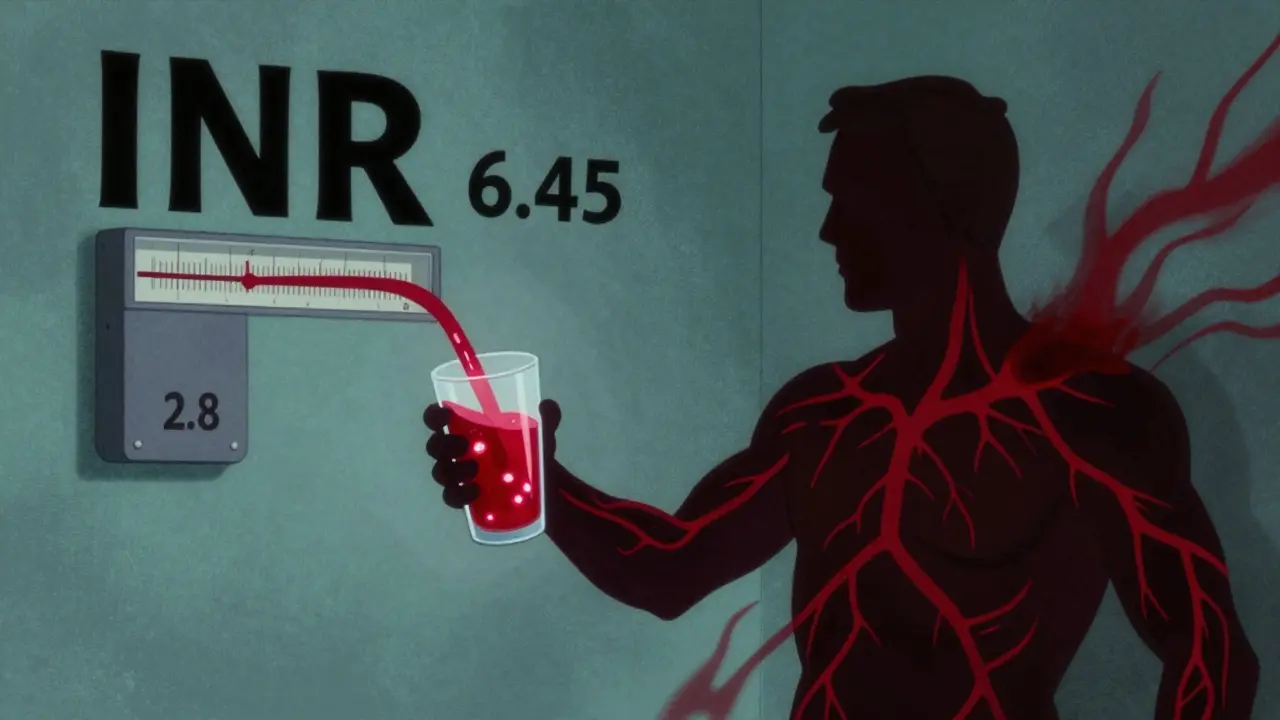
Warfarin works by slowing down your blood’s ability to clot. Too little, and you risk clots; too much, and you bleed. The goal is to keep your INR - a lab test that measures how long your blood takes to clot - between 2.0 and 3.0. But cranberry products can push that number up, sometimes dramatically. One patient in a 2007 case report saw his INR jump from a stable 2.8 to 6.45 after drinking half a gallon of cranberry-apple juice every week. That’s more than double the upper safe limit. At that level, even a minor bump or fall could cause internal bleeding. The culprit isn’t sugar or acidity. It’s chemicals in cranberries - mainly flavonoids like quercetin - that interfere with how your liver breaks down warfarin. Specifically, they block the CYP2C9 enzyme, which handles about 75% of the active form of warfarin. When that enzyme slows down, warfarin builds up in your bloodstream. You’re not taking more pills - your body just can’t clear the drug like it used to.It’s Not Just Juice
Many people assume only cranberry juice is risky. That’s a dangerous myth. Capsules, tablets, extracts, powders, and even cranberry-flavored sodas or snacks can trigger the same reaction. The active compounds are concentrated in extracts, meaning a single capsule might pack more punch than a glass of juice. One patient developed gastrointestinal bleeding after drinking cranberry juice cocktail daily for two weeks. Her INR soared from 2.5 to 8.3. Another, who took cranberry pills for UTI prevention, saw his INR climb from 2.4 to 4.1 in just one week. His hematologist told him to stop - immediately. The Merck Manual, a trusted medical reference updated in 2023, is blunt: “People taking warfarin should avoid cranberry products.” The FDA added warnings to warfarin labels back in 2005. Health Canada and the European Medicines Agency followed. New Zealand’s Medsafe reported 33 food and supplement interactions with warfarin in just one year - and cranberry was a frequent offender.Why the Confusion?
You might have heard conflicting advice. Some studies say there’s no real risk. That’s true - but only in controlled trials with small, inconsistent doses. Real life isn’t a lab. People drink different brands, at different times, in different amounts. One person might sip 150 mL a day and never have an issue. Another might drink the same amount and spike their INR. Why? Genetics. Some people have a genetic variation in the CYP2C9 enzyme that makes them extra sensitive. If you carry the *CYP2C9*2 or *CYP2C9*3 variant, cranberry can raise your INR two to three times more than in others. Also, intermittent use makes things worse. If you only drink cranberry juice when you feel a UTI coming on, your body gets hit with sudden spikes of inhibition. That’s why the American Heart Association says even occasional use is risky. Consistency doesn’t make it safe - it just makes the danger more predictable.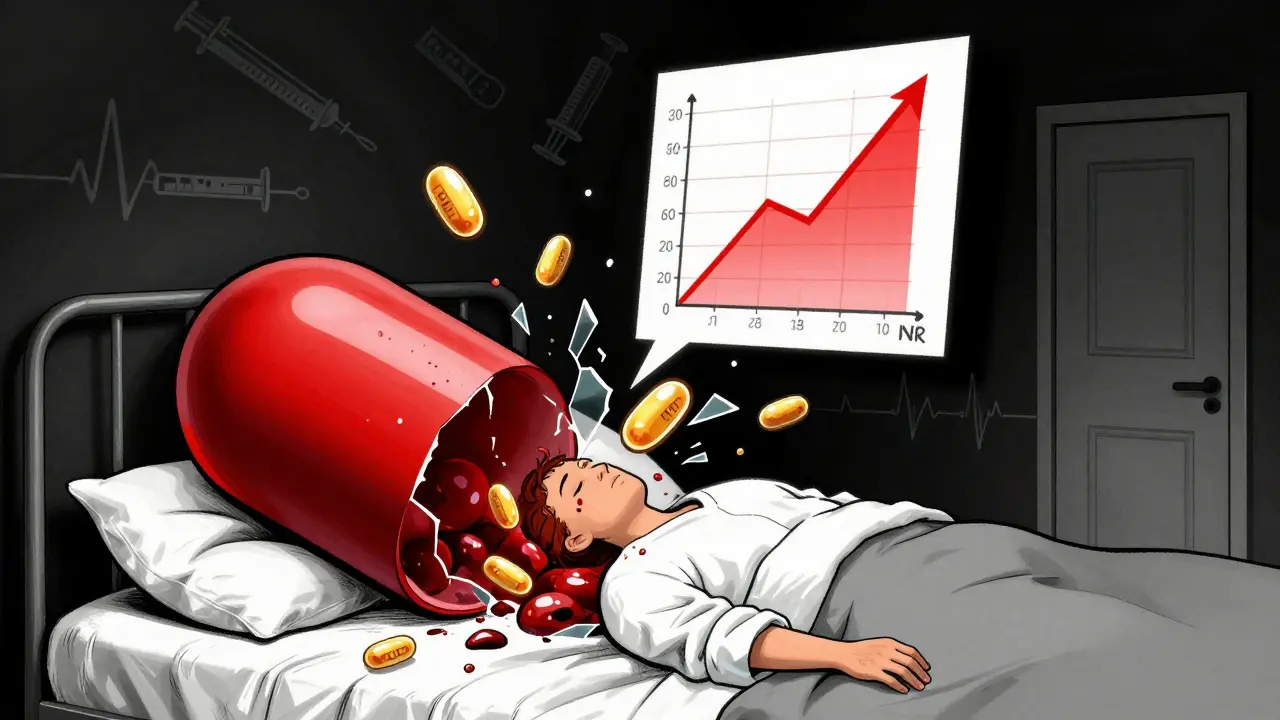
What Do Experts Really Say?
Dr. Paul Offit, a well-known vaccine expert and pharmacologist, calls this one of the most dangerous food-drug interactions he’s seen. Dr. David Flockhart, a former clinical pharmacology chief, explains the inconsistency: “It’s not that cranberry doesn’t interact - it’s that we haven’t figured out who it will hit hardest.” The American College of Chest Physicians (ACCP) updated its guidelines in 2021: avoid cranberry products entirely unless you’re under close monitoring. If you insist on using them, get your INR checked within 3-5 days of starting, then weekly. If your INR climbs above 3.5, stop immediately. For those who rely on cranberry to prevent urinary tract infections - a common reason people take it - there are safer alternatives. Methenamine hippurate or low-dose antibiotics are proven options that don’t interfere with warfarin. Your doctor can help you switch.Real Stories, Real Risks
Reddit’s r/anticoagulants community has dozens of threads where people share their experiences. One user wrote: “I thought cranberry juice was harmless. My INR jumped so high I ended up in the ER with a hematoma on my thigh. My doctor said if I’d kept drinking, I could’ve bled out from a simple fall.” Another user, who’s been on warfarin for 12 years, says: “I’ve had cranberry pills for five years with no issues. But my INR is checked every two weeks. That’s how I stay safe.” That’s the key: regular monitoring can catch problems early. But relying on monitoring alone isn’t a substitute for prevention. Why take the risk when you can avoid it?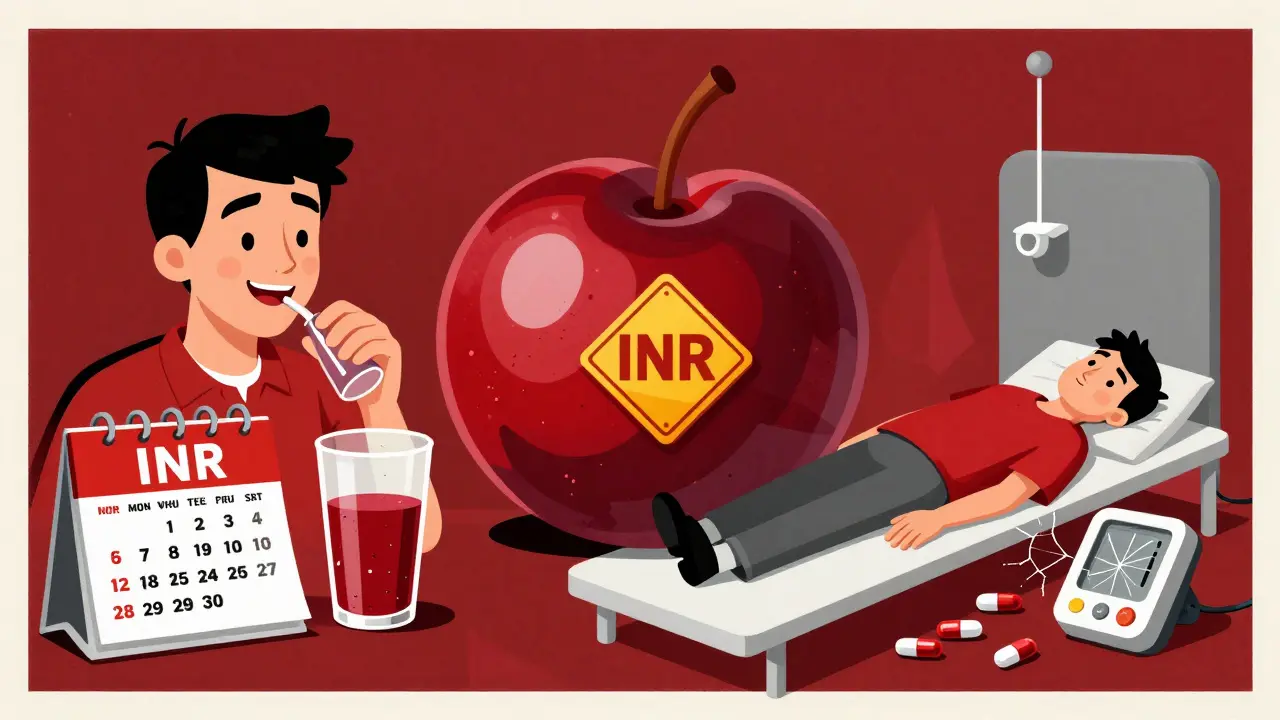
What Should You Do?
If you’re on warfarin:- Avoid all cranberry products - juice, pills, sauces, dried fruit, flavored drinks.
- Read labels carefully. “Cranberry-flavored” doesn’t mean “no cranberry.”
- Don’t assume natural = safe. Natural doesn’t mean harmless when you’re on blood thinners.
- If you’ve been drinking cranberry juice regularly, tell your doctor. Don’t wait for symptoms.
- If you’re unsure about a supplement, check with your pharmacist. Many don’t even list cranberry as an ingredient on the bottle.
Jhoantan Moreira
February 3, 2026 AT 16:40Man, I never realized cranberry juice could be this dangerous with blood thinners 😅 I always thought it was just a ‘healthy’ drink. Thanks for laying this out so clearly - I’m telling my uncle who’s on warfarin right now. Better safe than sorry, right?
pradnya paramita
February 4, 2026 AT 18:12Pharmacokinetically, the CYP2C9 inhibition by cranberry flavonoids (particularly quercetin and anthocyanidins) is well-documented in vitro and in vivo. The inhibition constant (Ki) for quercetin against CYP2C9 is ~1.8 µM - well within plasma concentrations achieved after consuming 250 mL of concentrated juice. This directly reduces warfarin clearance by 20–40% in susceptible individuals. Genetic polymorphisms (CYP2C9*2/*3) further reduce metabolic capacity, elevating INR unpredictably. Bottom line: it’s not anecdotal - it’s enzymology.
Keith Harris
February 6, 2026 AT 08:13Oh please. This is just another fear-mongering medical myth. I’ve been drinking cranberry juice with my warfarin for seven years and my INR’s been stable as hell. Your ‘case reports’ are just cherry-picked outliers. Meanwhile, the Cochrane Review from 2019 found no significant interaction in randomized trials. You’re scaring people for clicks. Chill out. Maybe your doctor’s just bad at managing dosing?
Prajwal Manjunath Shanthappa
February 7, 2026 AT 09:43How quaint. You think a Cochrane review is the final word? Please. The clinical reality is far messier than your sterile meta-analyses. I’ve seen INRs spike from 2.6 to 9.1 in patients who swore they ‘only had a glass once a week.’ The variability isn’t noise - it’s a biological roulette wheel. And you, sir, are the kind of person who thinks ‘natural’ means ‘harmless’ - and then ends up in the ICU wondering why the docs won’t give you a blood transfusion fast enough. Your ignorance is not a valid data point.
Mandy Vodak-Marotta
February 8, 2026 AT 14:12Okay but like, I get why people are confused - I used to drink cranberry juice every morning because my mom said it ‘cleansed my system’ and now I’m just like… why does everyone keep saying ‘avoid it’ when it’s literally in every grocery store next to the orange juice? Like, if it’s that dangerous, why isn’t there a giant warning label on the bottle? Why do companies even make cranberry-flavored yogurt if it’s going to kill people? I just feel like the system is failing us by not being clearer. Also, I just checked my fridge - I have a bottle. I’m gonna throw it out. Just in case.
Caleb Sutton
February 10, 2026 AT 12:44They don’t want you to know the truth. Cranberry is a tool. The pharmaceutical industry hates it because it’s cheap, natural, and people might stop taking warfarin if they thought they could ‘manage’ it with juice. The FDA warning? A cover-up. They’re protecting profits. Look at the lawsuits. Look at the patents. This isn’t about bleeding - it’s about control.
Alec Stewart Stewart
February 11, 2026 AT 02:28Thanks for the detailed breakdown. I’ve been on warfarin for 8 years and my doc told me to avoid cranberry, but I never knew why. Now I do. I’ll pass this along to my mom - she’s been taking those little cranberry pills for her ‘bladder health.’ She’s gonna be shocked. Really appreciate the real-life examples too. Stay safe out there, folks.
Samuel Bradway
February 11, 2026 AT 02:30I had no idea even dried cranberries could do this. I put them in my oatmeal every day. Just deleted my grocery list. I’ll switch to blueberries - they taste almost as good and don’t try to kill me. Thanks for the heads-up. Really.
caroline hernandez
February 12, 2026 AT 22:58As a clinical pharmacist, I’ve managed over 200 patients on warfarin. The cranberry interaction is one of the top 3 food-drug risks I flag during med recs. Even ‘low-dose’ supplements (like 500mg capsules) can elevate INR by 0.5–1.5 units within 72 hours. I always ask: ‘Do you consume any cranberry products, even occasionally?’ - and if they say ‘no,’ I follow up with ‘What about sauces, snacks, or flavored waters?’ Most don’t realize it’s in those. Education > fear. But avoidance > monitoring.
Joy Johnston
February 13, 2026 AT 11:31It is imperative to underscore that the pharmacodynamic interaction between cranberry-derived phytochemicals and the cytochrome P450 2C9 isoform constitutes a clinically significant, dose-dependent, and genetically modulated phenomenon. The potential for hemorrhagic complications necessitates strict dietary avoidance, irrespective of perceived tolerance or historical stability of INR values. Adherence to evidence-based guidelines is not optional - it is a non-negotiable component of safe anticoagulation therapy.
Alex LaVey
February 14, 2026 AT 17:18As someone from a culture where cranberry is rarely used, I’m amazed how much fear this one fruit generates in the US. But honestly? I get it. Your healthcare system is so complex that even a juice can feel like a landmine. I’m glad this post exists - it’s a reminder that sometimes the safest thing isn’t the most ‘natural’ thing. Thanks for the clarity.
Jamillah Rodriguez
February 15, 2026 AT 06:05I’ve been drinking cranberry juice with my warfarin for 10 years. My INR is perfect. You’re all overreacting. This post is just fear porn. I’m not stopping. 😘